Facts
The plaintiff filed a suit for specific performance and permanent injunction on 5 October 2016, relying on a registered agreement to sell dated 8 May 2015 for a plot allotted to the original defendants by the U.P. Avas Evam Vikas Parishad.
Source reference: paras. 6, 16–18The agreement contemplated execution of a sale deed within six months after the Parishad executed its deed in favour of the original defendants.
Source reference: paras. 6, 16–18The plaintiff alleged part-payment, readiness and willingness to perform, and that on 3 October 2016 he learned that the original defendants intended to transfer the plot to others.
Source reference: paras. 6, 16–18The revisionists, who later purchased the plot under a sale deed dated 23 November 2016 and were impleaded as defendants, applied under Order VII Rule 11 CPC. The trial court rejected their application; they challenged that order in revision.
Source reference: paras. 7–8Issues
Whether the plaint disclosed a cause of action for specific performance and injunction, or was liable to rejection under Order VII Rule 11(a) CPC
Source reference: paras. 11, 20, 24Whether the suit was premature or appeared, on the plaint’s statements, to be barred by limitation under Order VII Rule 11(d) CPC
Source reference: paras. 11, 18, 21–23Law Applied
Order VII Rule 11(a) CPC requires rejection where the plaint does not disclose a cause of action; Rule 11(d) applies where the plaint’s own statements show that the suit is barred by law.
Source reference: paras. 12–15The inquiry is ordinarily confined to the plaint read as a whole, and disputed questions or the defendant’s case are not to be determined at this stage (Madanuri Sri Rama Chandra Murthy v. Syed Jalal; Srihari Hanumandas Totala v. Hemant Vithal Kamat).
Source reference: paras. 12–15Article 54 of the Limitation Act, 1963 prescribes three years for a specific-performance suit, running from the date fixed for performance or, if no such date is fixed, from when the plaintiff has notice that performance is refused. A “date fixed” must be definite and crystallised (Ahmadsahab Abdul Mulla v. Bibijan).
Source reference: paras. 21–22A suit that is premature is not necessarily liable to dismissal at the threshold; prematurity does not, by itself, go to the court’s jurisdiction (Vithalbhai (P) Ltd. v. Union Bank of India; Virgo Industries (Eng.) Pvt. Ltd. v. Venturetech Solutions Pvt. Ltd.).
Source reference: para. 10Reasoning
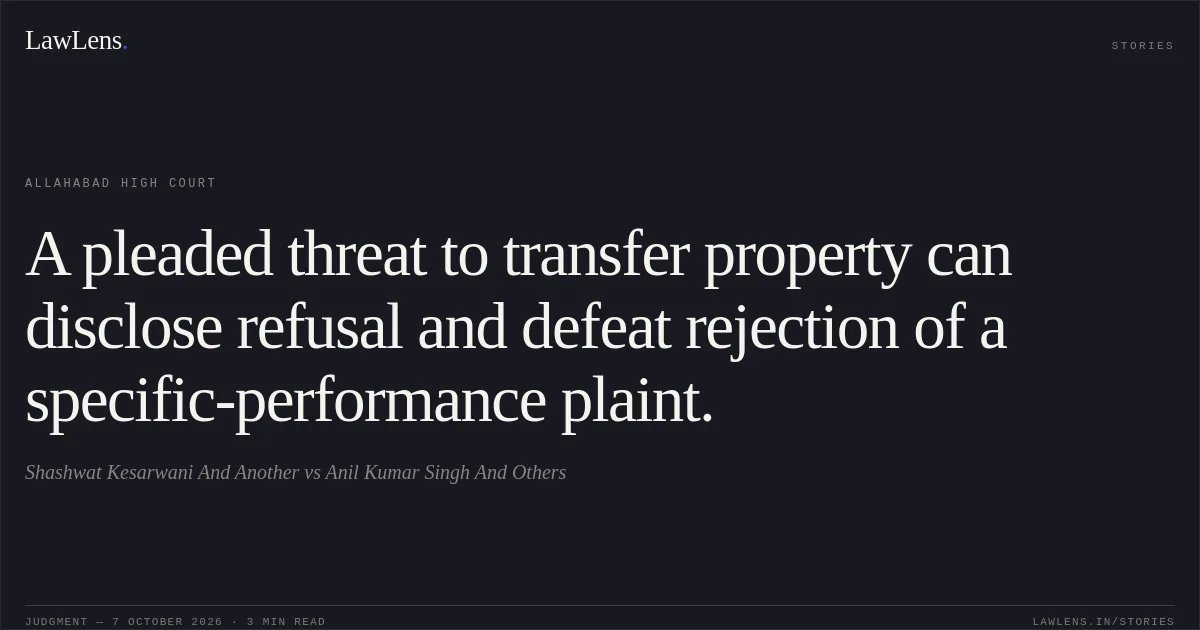
The Court read the plaint and agreement as a whole. Although the agreement linked performance to the Parishad’s execution of a sale deed and provided a six-month period thereafter, the Court found no fixed calendar date for performance.
Source reference: paras. 16–18, 22–23It therefore applied the second limb of Article 54.
Source reference: paras. 22–23The plaint alleged that the plaintiff received information on 3 October 2016 that the original defendants intended to transfer the property to third parties, and that he had previously issued notices seeking performance.
Source reference: paras. 16–18, 22–23Those pleaded facts disclosed a threatened refusal and a cause of action for the reliefs claimed; whether the agreement was enforceable, or whether the Specific Relief Act otherwise affected the plaintiff’s entitlement, was left for trial.
Source reference: paras. 20, 24–25The plaint did not, on its face, establish a limitation bar. The Court accordingly held that the asserted prematurity did not warrant rejection under Order VII Rule 11.
Source reference: paras. 23–26Holding
The High Court held that the plaint disclosed a cause of action and did not show on its face that the suit was barred by limitation.
It found no ground to interfere with the trial court’s rejection of the Order VII Rule 11 application and dismissed the revision petition.
Source reference: paras. 26–27Acts & Sections Cited
32 provisions across 4 statutes referred to in this judgment. Each provision opens on LawLens.
Specific Relief Act, 19632
Limitation Act, 1963
Indian Penal Code, 18601
Code of Civil Procedure, 19083
Original Court PDF
Shashwat Kesarwani And AnothervsAnil Kumar Singh And Others
Click to open original judgment
Original judgment, available to read, download and summarize on LawLens.in