Facts
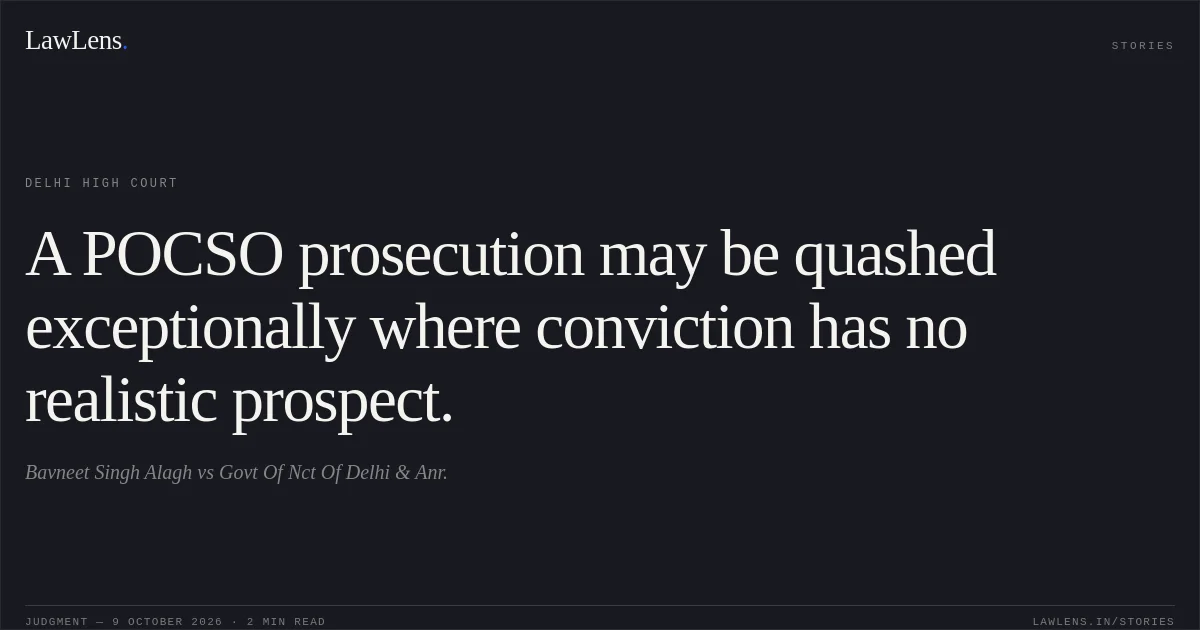
The petitioner sought quashing of FIR No. 538/2021, registered under Sections 354 and 506 of the IPC and Section 10 of the POCSO Act. The complainant, his first cousin, alleged that he touched her inappropriately on 21 March 2021, when she was about 17 years and 10 months old, and later threatened and harassed her.
Source reference: para. 1–4The FIR was registered about six months after the incident, during a period when the families were involved in cross-complaints and a money dispute. The chargesheet also invoked Sections 354D IPC and 12 POCSO Act; the case was pending trial.
Source reference: para. 1–4The parties later executed a settlement. The complainant, then an adult and studying in Canada, appeared before the Court and confirmed that the settlement was voluntary and that she did not wish to pursue the case; she was the only material witness to the alleged incident.
Source reference: para. 5–9, 18Issues
Whether the High Court could quash proceedings involving alleged offences under the POCSO Act on the basis of settlement and the circumstances of the case.
Source reference: para. 10–15, 18Whether continuation of the prosecution would serve the ends of justice where the complainant did not wish to proceed and the prospect of conviction was remote.
Source reference: para. 14, 18–19Law Applied
Section 528 of the BNSS (corresponding to Section 482 of the CrPC) preserves the High Court’s inherent power to quash proceedings to secure the ends of justice or prevent abuse of process.
Source reference: para. 1; para. 12Under Gian Singh v. State of Punjab, (2012) 10 SCC 303, quashing is distinct from statutory compounding, depends on the facts of each case, and requires due regard to the nature and gravity of the offence; heinous and serious offences, including offences under special statutes, ordinarily cannot be quashed merely because the parties have settled.
Source reference: para. 12CBI v. A. Ravishankar Prasad, (2009) 6 SCC 351, reiterates that inherent powers are to be exercised sparingly to prevent injustice or abuse of process.
Source reference: para. 13Under Narinder Singh v. State of Punjab, (2014) 6 SCC 466, the Court may consider whether the possibility of conviction is remote and bleak and whether continuation would cause oppression or injustice.
Source reference: para. 14Reasoning
The Court recognised that POCSO offences are serious and that a private settlement alone would not justify quashing.
Source reference: para. 10–12, 15It nevertheless treated the case as exceptional: the allegation concerned a single incident of attempted touching, not penetrative sexual assault; the complainant was close to majority at the time; the FIR followed a six-month delay amid family disputes; and the complainant, now an adult, personally confirmed her voluntary settlement and unwillingness to pursue the case.
Source reference: para. 18As the complainant was the only material witness and was living abroad, the Court considered the prospect of conviction unrealistic and continuation of the trial futile.
Source reference: para. 18–19Holding
The Court answered the issues in the affirmative and allowed the petition.
It quashed FIR No. 538/2021 under Sections 354, 506 and 354D IPC and Sections 10 and 12 of the POCSO Act, together with all proceedings arising from it.
Source reference: para. 20The petitioner was directed to pay Rs. 1,00,000 to the Delhi High Court Legal Services Committee within four weeks and file proof of deposit.
Source reference: para. 21Acts & Sections Cited
8 provisions across 4 statutes referred to in this judgment. Each provision opens on LawLens.
Bharatiya Nagarik Suraksha Sanhita, 20231
Code of Criminal Procedure, 19733
Indian Penal Code, 18602
Protection of Children from Sexual Offences Act, 20122
Original Court PDF
Bavneet Singh AlaghvsGovt Of Nct Of Delhi & Anr.
Click to open original judgment
Original judgment, available to read, download and summarize on LawLens.in