Facts
The petitioners, accused Nos. 1–7, were alleged to have conspired to eliminate respondent No. 2 in the context of a land dispute, and to have approached persons to act as “supari killers”.
Source reference: para. 3–4After an NCR was registered, the investigating officer sought the Magistrate’s permission to investigate the alleged non-cognizable offences under Sections 120-B and 506 read with Section 34 of the IPC. The Magistrate granted permission, the police investigated and filed a charge-sheet, and proceedings were taken up in C.C. No. 18663/2020.
Source reference: para. 5, 16–17, 25The petitioners sought to quash the proceedings, contending that the police had not referred the informant to the Magistrate as required by Section 155(1) of the Code of Criminal Procedure, 1973 (CrPC).
Source reference: para. 6, 14Issues
Whether failure to refer the informant to the Magistrate under Section 155(1) CrPC invalidated the investigation where the investigating officer had obtained the Magistrate’s permission under Section 155(2) CrPC.
Source reference: para. 14–15, 18Law Applied
Section 155(1) CrPC requires the police to record information concerning a non-cognizable offence and refer the informant to the Magistrate; Section 155(2) bars police investigation of such an offence without the Magistrate’s order.
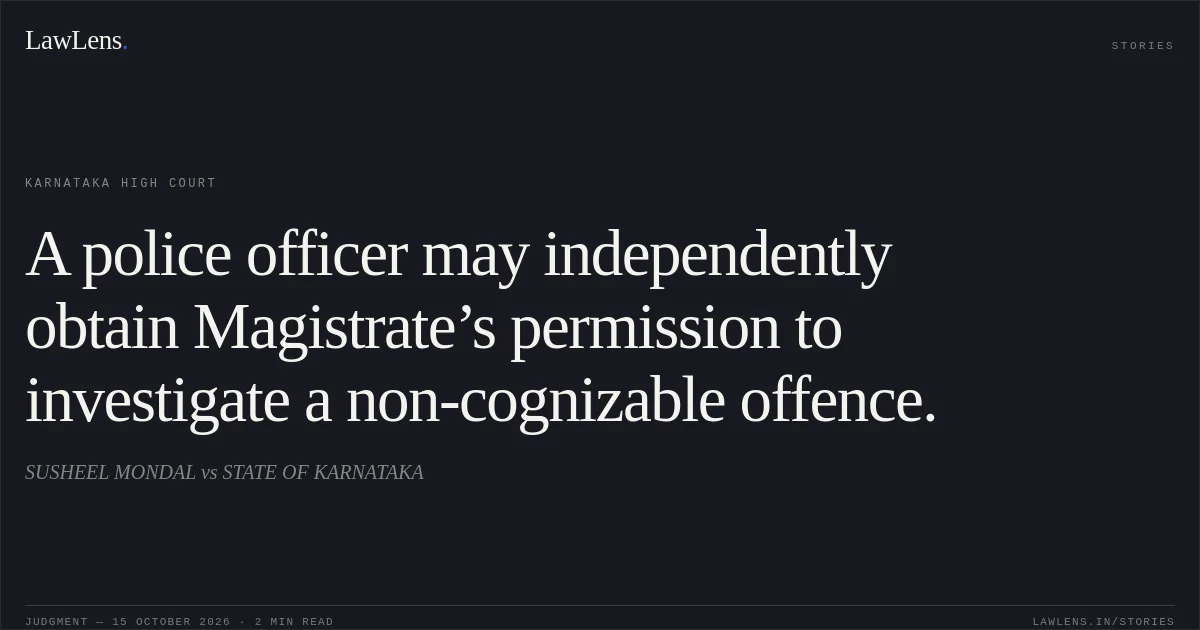
Source reference: no citationThe court held that Section 155(2) does not require the informant alone to seek permission: the investigating officer may also apply for it, and may investigate once permission is granted.
Source reference: para. 21–24In reaching that conclusion, the court relied on State of Gujarat v. Girish Radhakrishnan Varde, Crl. A. No. 1996/2013 (25 November 2013), and the subsequent Karnataka High Court decisions discussed in the judgment.
Source reference: para. 20–24It distinguished the petitioners’ reliance on Praveen Basavanneppa Shivalli v. State of Karnataka.
Source reference: para. 19The court also noted that the proviso to Section 174 of the Bharatiya Nagarik Suraksha Sanhita, 2023 (BNSS), is in pari materia with the relevant CrPC provision.
Source reference: para. 28Reasoning
The court found that the alleged offences were non-cognizable and that the investigating officer had obtained the Magistrate’s permission before proceeding with the investigation.
Source reference: para. 15–17, 25It rejected the argument that the officer’s failure to refer the informant under Section 155(1) necessarily invalidated the investigation: Section 155(2) is silent as to who must seek permission, and the officer’s application was therefore permissible.
Source reference: para. 21–27The court considered the authorities supporting the petitioners’ position but concluded that the Supreme Court’s decision and the later Karnataka High Court ruling supported the view that the officer could seek permission directly.
Source reference: para. 19–24Holding
The court answered the issue against the petitioners and dismissed the criminal petition, declining to quash the proceedings.
It also directed the Registry to forward the order to the Law Commission of Karnataka for consideration of appropriate rules in light of the BNSS.
Source reference: para. 30(ii)Acts & Sections Cited
5 provisions across 3 statutes referred to in this judgment. Each provision opens on LawLens.
Code of Criminal Procedure, 19732
Indian Penal Code, 18602
Bharatiya Nagarik Suraksha Sanhita, 20231
Original Court PDF
SUSHEEL MONDALvsSTATE OF KARNATAKA
Click to open original judgment
Original judgment, available to read, download and summarize on LawLens.in