Facts
The respondents-plaintiffs instituted a suit for permanent prohibitory injunction concerning 102 Kanals 13 Marlas of apple-orchard land in Ramnagri, Shopian.
Source reference: pp. 3–10, paras 1–20They claimed ownership and possession based on sale transactions, mutations, revenue entries, cultivation, harvesting, employment of labour, and transport of apple boxes.
Source reference: pp. 3–10, paras 1–20The appellants-defendants denied the plaintiffs’ possession and claimed either ownership through original owners or the status of caretakers.
Source reference: pp. 3–10, paras 1–20The trial Court held that the plaintiffs had established possession, while leaving title undecided, and restrained the defendants from interfering with that possession.
Source reference: pp. 3–10, paras 1–20The defendants challenged the decree under Section 96 CPC, contending, inter alia, that the suit was not maintainable without a declaration of title, the revenue documents were inadmissible, the earlier suit barred the present action, and the plaintiffs had failed to prove possession.
Source reference: pp. 3–10, paras 1–20During the appeal, the plaintiffs sought to produce additional title documents under Order XLI Rule 27 CPC.
Source reference: p. 10, para 21Issues
1. Whether a suit for prohibitory injunction simpliciter was maintainable without a declaration of title
Source reference: pp. 10–13, paras 22(a), 23–272. Whether the plaintiffs proved possession of the orchard on the standard of preponderance of probabilities
Source reference: pp. 10, 13–15, paras 22(b), 24–323. Whether the photocopies of the revenue record, supported by the Patwari’s testimony and other oral evidence, were sufficient to establish possessory entitlement
Source reference: pp. 10, 14–15, paras 22(c), 29–304. Whether the defendants’ plea that they were caretakers defeated the plaintiffs’ claim for injunction
Source reference: pp. 10, 15–16, paras 22(d), 33–345. Whether the earlier suit filed before the Munsiff, Shopian, barred the present suit under Order II Rule 2, Order XXIII Rule 1, or the principles of res judicata
Source reference: pp. 10, 16–17, paras 22(e), 35–376. Whether the objections concerning court fee, late production of documents, and procedural irregularities vitiated the decree
Source reference: pp. 10, 17–18, paras 22(f), 38, 407. Whether the additional documents sought to be produced under Order XLI Rule 27 CPC were necessary for deciding the appeal
Source reference: pp. 10, 18, paras 22(g), 39Law Applied
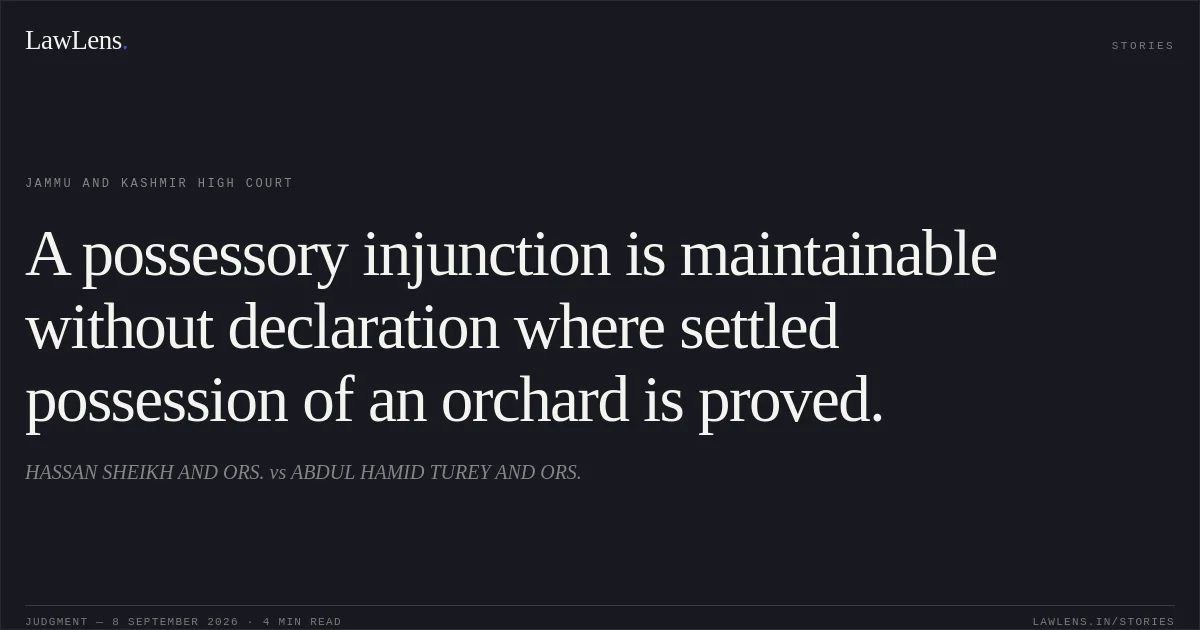
A possessory suit for prohibitory injunction is maintainable without a declaration of title where the dispute principally concerns interference with peaceful possession; however, where title is under a genuine cloud and possession cannot be determined independently of title, a suit for declaration, possession, and injunction may be necessary, as explained in M. Kallappa Setty v. M.V. Lakshminarayana Rao, Rame Gowda v. M. Varadappa Naidu, and Anathula Sudhakar v. P. Buchi Reddy.
Source reference: p. 11, para 23Settled possession may be protected against a person who has not established a better legal right.
Source reference: pp. 11–12, paras 24–25Possession of an orchard may be proved through physical acts of control, including cultivation, spraying, harvesting, employment of labour, and movement of produce, assessed on a preponderance of probabilities.
Source reference: pp. 11–12, paras 24–25Revenue entries carry a rebuttable presumption regarding possession and fiscal liability under Section 31 of the Jammu and Kashmir Land Revenue Act, although they do not constitute conclusive proof of title.
Source reference: p. 12, para 25A caretaker’s possession is permissive and cannot ordinarily be asserted against the person in whom legal possession resides; the Court relied on Maria Margarida Sequeria Fernandes v. Erasmo Jack de Sequeira.
Source reference: pp. 15–16, para 33Parties cannot depart from their pleadings, following Ram Sarup Gupta v. Bishun Narain Inter College.
Source reference: p. 16, para 34The Court also applied the principles governing fresh causes of action in injunction suits and the reception of public records through competent official testimony under the Evidence Act.
Source reference: pp. 14, 16–18, paras 30, 35–40Reasoning
The High Court held that the suit was one for protection of possession and did not require prior adjudication of title because the subject property was an actively cultivated apple orchard rather than vacant land.
Source reference: pp. 11–13, paras 23–27The plaintiffs’ evidence regarding cultivation, pruning, spraying, harvesting, labour, and transportation of apple boxes formed a consistent account of long-standing control.
Source reference: pp. 13–15, paras 28–32This oral evidence was corroborated by the Patwari, who testified from the official revenue record that, following mutations, the plaintiffs were recorded in the self-cultivation column and that the defendants were not recorded against the suit survey numbers.
Source reference: pp. 13–15, paras 28–32Although the photocopies of revenue documents contained procedural defects, those defects affected their weight rather than eliminating the Patwari’s testimony based on the original official record.
Source reference: p. 14, para 30The defendants produced no revenue extracts, mutation documents, or written authority from the alleged owners and gave inconsistent evidence, alternatively claiming caretaking status, ancestral cultivation, and inheritance.
Source reference: pp. 15–16, paras 33–34Their caretaker defence therefore neither displaced the plaintiffs’ proved possession nor established a better right.
Source reference: pp. 15–16, paras 33–34The earlier suit did not bar the present action because the later suit was based on a subsequent act of interference, and a fresh interference gives rise to a recurring cause of action in possession suits.
Source reference: pp. 16–17, paras 35–37The technical objections were insufficient to unsettle the decree after a full trial, and the additional title documents were unnecessary because title was deliberately left open.
Source reference: pp. 17–18, paras 38–40Holding
The appeal was dismissed and the judgment and decree dated 18 June 2019 were affirmed.
The permanent prohibitory injunction restraining the defendants from interfering with the plaintiffs’ possession of the 102 Kanals 13 Marlas orchard was upheld.
Source reference: pp. 19–20, paras 41–43The Court clarified that the decree protected possession only and did not determine ownership; either party remained free to institute a comprehensive suit for declaration of title and, if appropriate, possession.
Source reference: p. 19, para 42The application for additional evidence under Order XLI Rule 27 CPC was dismissed as unnecessary, without prejudice to reliance on the documents in appropriate title proceedings.
Source reference: p. 20, paras 39, 44–45There was no order as to costs, and pending miscellaneous applications were disposed of.
Source reference: p. 20, paras 39, 44–45Acts & Sections Cited
1 provisions across 1 statute referred to in this judgment. Each provision opens on LawLens.
Code of Civil Procedure, 19081
Original Court PDF
HASSAN SHEIKH AND ORS.vsABDUL HAMID TUREY AND ORS.
Click to open original judgment
Original judgment, available to read, download and summarize on LawLens.in