Facts
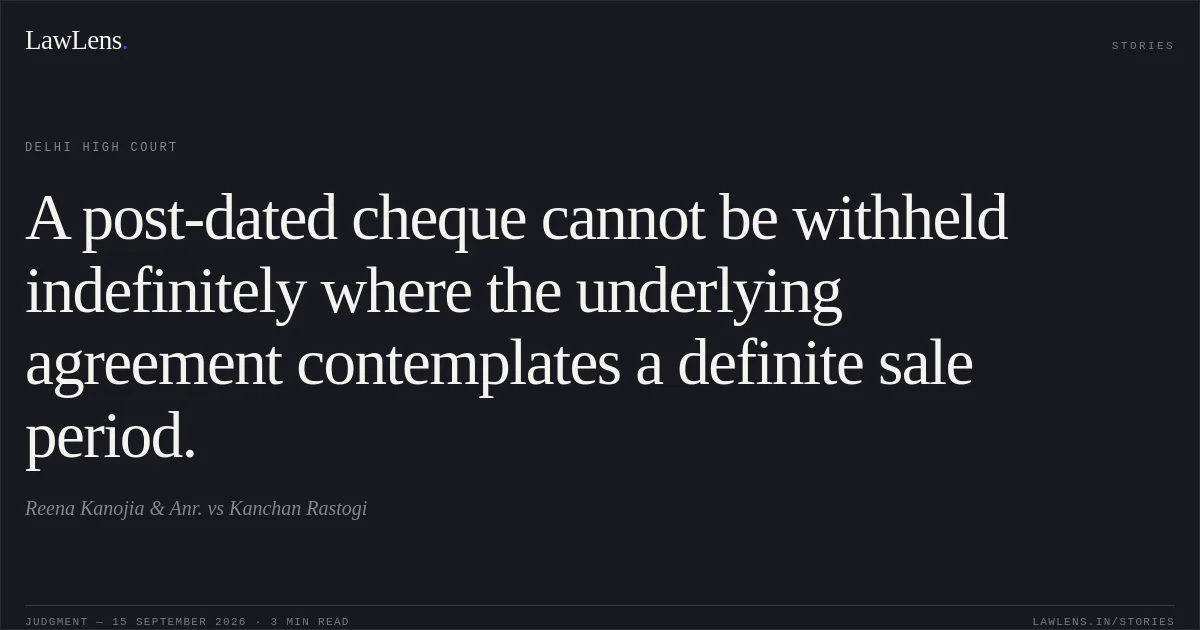
The respondent/plaintiff, who was the real sister of Appellant No. 2 and sister-in-law of Appellant No. 1, entered into a General Agreement dated 08.04.2024 concerning relinquishment of her share in a property.
Source reference: paras. 2–3; p. 2Under the agreement, she was to receive ₹10,00,000: ₹5,00,000 through demand draft upon execution of the Relinquishment Deed and the balance ₹5,00,000 through a post-dated cheque upon sale of the property.
Source reference: paras. 2–3; p. 2The appellants issued cheque no. 618811 dated 09.10.2024 for ₹5,00,000. The cheque was dishonoured first for “Funds Insufficient” and, upon re-presentation, for “Stop Payment”.
Source reference: paras. 3–5; pp. 2–3The respondent instituted a summary suit under Order XXXVII of the Code of Civil Procedure, 1908, for recovery of ₹5,00,000 with interest. The Trial Court decreed the suit with pendente lite and future interest at 7% per annum on 23.04.2026.
Source reference: paras. 1, 15; pp. 1, 4The appellants challenged that decree under Section 96 read with Order XLI CPC.
Source reference: para. 1; p. 1Issues
Whether the respondent was entitled to recover ₹5,00,000 under the General Agreement and the post-dated cheque, despite the property not having been sold?
Source reference: paras. 8, 13–15, 22–27; pp. 3–6Whether presentation of the cheque was premature because payment of the balance amount was conditional upon sale of the property?
Source reference: paras. 17–21, 23–27; pp. 5–6Whether the respondent was entitled to interest on the decretal amount?
Source reference: para. 8; p. 3Law Applied
The Court applied Section 96 read with Order XLI CPC governing a regular first appeal against a decree, and considered the terms of the admitted General Agreement dated 08.04.2024 as the governing contractual document.
Source reference: para. 1; p. 1It applied the principle that contractual terms must be construed as a whole and that a construction rendering a party’s accrued contractual entitlement nugatory or indefinitely postponing payment should not ordinarily be adopted.
Source reference: paras. 23–27; pp. 6–7The Court further relied on the legal significance of the issued post-dated cheque and its dishonour upon presentation, particularly where the cheque was subsequently subject to a “Stop Payment” instruction.
Source reference: paras. 25, 28–29; pp. 6–7The decree of interest at 7% per annum was maintained as part of the Trial Court’s relief.
Source reference: paras. 1, 15, 31–32; pp. 1, 4, 8Reasoning
The execution of the General Agreement and the Relinquishment Deed was undisputed, and the appellants had admittedly paid only the first ₹5,00,000.
Source reference: paras. 22–23; p. 6Although the agreement referred to payment of the balance upon sale of the property, the Court found from the respondent’s evidence that the parties had contemplated completion of the sale within a reasonable period, and that the post-dated cheque dated 09.10.2024 reflected an agreed outer timeframe of approximately six months.
Source reference: paras. 24, 26–27; pp. 6–7The respondent could not be expected to wait indefinitely because the cheque would become incapable of presentation after its validity period.
Source reference: para. 25; p. 6Interpreting the agreement as making payment entirely dependent upon an indefinite future sale would effectively defeat the respondent’s entitlement to the balance amount.
Source reference: para. 27; p. 7The subsequent dishonour for “Stop Payment,” after an earlier dishonour for insufficient funds, further supported the finding that the appellants were avoiding payment after obtaining the benefit of the Relinquishment Deed.
Source reference: paras. 28–30; p. 7Holding
The High Court held that the respondent was entitled to present the cheque and recover the unpaid balance of ₹5,00,000, notwithstanding that the property had not been sold.
The appellants’ plea that the suit was premature and that the cheque was merely a security instrument was rejected.
Source reference: paras. 25–31; pp. 6–8The Trial Court’s decree for ₹5,00,000 with pendente lite and future interest at 7% per annum was affirmed. The appeal was dismissed, and the pending applications were disposed of accordingly.
Source reference: para. 32; p. 8Acts & Sections Cited
2 provisions across 2 statutes referred to in this judgment. Each provision opens on LawLens.
Code of Civil Procedure, 19081
Bharatiya Sakshya Adhiniyam, 20231
Original Court PDF
Reena Kanojia & Anr.vsKanchan Rastogi
Click to open original judgment
Original judgment, available to read, download and summarize on LawLens.in