Facts
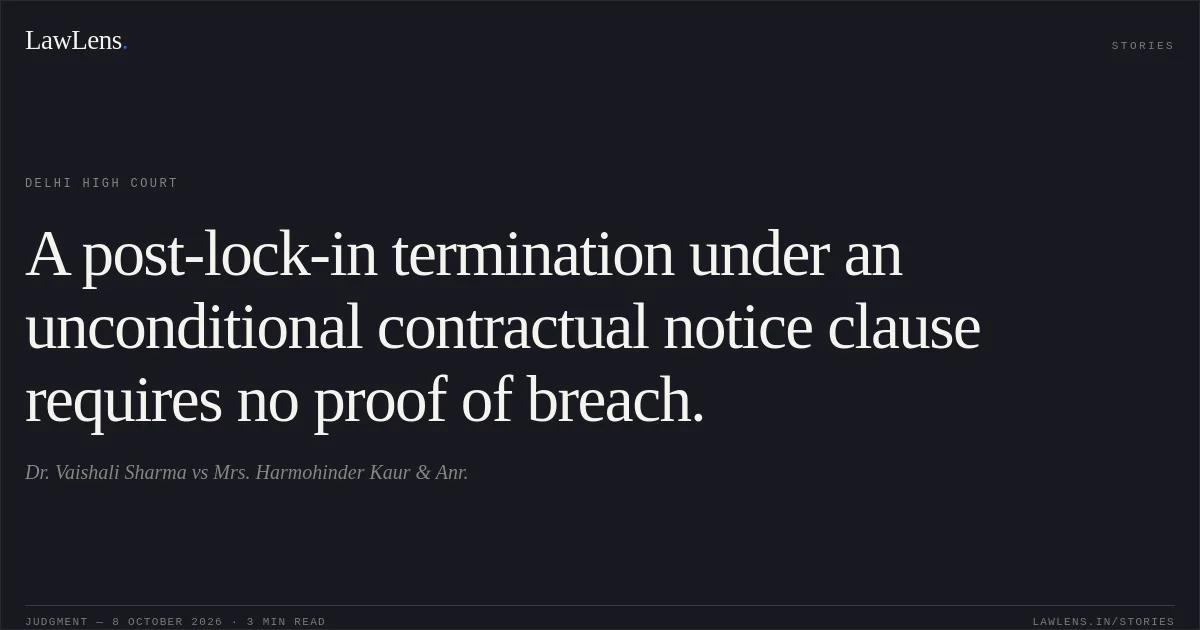
The parties entered into a nine-year lease deed on 18 January 2021, with a three-year lock-in period. Clause 8 permitted either party to terminate the lease after the lock-in period by giving 60 days’ notice; the lessors also had a separate right to terminate on 30 days’ notice for breach. Clause 11 provided for a daily payment if the lessee failed to vacate after termination.
Source reference: p. 2–3On 14 August 2024, the lessors issued a notice terminating the lease on 60 days’ notice. The lessee disputed its validity.
Source reference: p. 3, 8In an interim award dated 4 August 2026, the sole arbitrator upheld the termination and directed the lessee to hand over possession by 30 September 2026, while leaving other claims for later adjudication.
Source reference: p. 1, 15–16The lessee challenged the award under Section 34 of the Arbitration and Conciliation Act, 1996, alleging, among other things, that the tribunal granted possession without evidence, wrongly rejected the lessee’s defences, and made inconsistent directions concerning rent.
Source reference: p. 3–5Issues
1. Whether the arbitrator could grant an interim award for possession under Section 31(6) after finding that the lease had been validly terminated.
Source reference: p. 5–6, 14–162. Whether the termination notice or the manner in which the arbitrator determined the possession issue disclosed a ground for setting aside the award under Section 34.
Source reference: p. 3–5, 15–173. Whether the alleged post-notice payment or receipt of rent waived the termination under Section 113 of the Transfer of Property Act, 1882, and whether the possession direction was inconsistent with continued payment of rent.
Source reference: p. 4, 16–18Law Applied
Section 31(6) of the Arbitration and Conciliation Act permits an interim award at any stage on a matter that, once decided, cannot be reopened in the final award; such an award is challengeable under Section 34.
Source reference: p. 5Section 34 does not permit an appellate reappraisal of evidence or substitution of the arbitrator’s plausible view; interference is limited to the statutory grounds, including patent illegality going to the root of the matter.
Source reference: p. 5–6, 15–16Under Sections 105 and 108(q) of the Transfer of Property Act, a lease grants a right to enjoy property for a term, and on determination the lessee must restore possession to the lessor.
Source reference: p. 6Payal Vision Ltd. v. Radhika Choudhary holds that, for recovery of possession from a tenant not protected by rent-control legislation, the landlord must establish the landlord–tenant relationship and termination of the tenancy.
Source reference: p. 15Section 113 of the Transfer of Property Act requires an intention to treat the lease as subsisting for waiver; payment or receipt of rent alone is insufficient.
Source reference: p. 17The Court also relied on IFFCO Ltd. v. Bhadra Products and MCM Worldwide (P) Ltd. v. Construction Industry Development Council on interim awards, and Getwell Healthcare (P) Ltd. v. Santosh Sahi (Dr) on the consequences of valid termination.
Source reference: p. 5, 15–16Reasoning
The Court found that the lease, the parties’ lessor–lessee relationship, Clause 8, and receipt of the notice were undisputed. The notice referred to alleged breaches but expressly terminated the lease under Clause 8’s 60-day option, which did not depend on proving a breach; the lock-in period had expired, and no subsequent agreement, waiver, novation, or modification was shown to have displaced that right.
Source reference: p. 8–14Applying the possession principles in Payal Vision, the Court held that the relationship and valid termination were established, so the lessee’s remaining claims concerning investment, damages, and other consequences did not prevent a separate determination of possession.
Source reference: p. 14–16It rejected the objections based on the absence of evidence and Section 113, noting that the arbitrator had considered the parties’ material and that the lessors’ pursuit of possession was inconsistent with an intention to continue the lease.
Source reference: p. 16–17The Court considered the 57-day period insufficient to justify Section 34 interference. It also stated that the award’s reference to continued rent payment appeared to be a typographical error and left the parties to seek clarification from the arbitrator.
Source reference: p. 16–18Holding
The Court held that the lease was validly terminated and that the arbitrator’s direction to deliver possession disclosed no ground for setting aside the interim award under Section 34.
The petition was dismissed, with pending applications disposed of and no order as to costs. The Court clarified that its observations concerned only the Section 31(6) interim award, not the separate decision under Section 17, and granted liberty to seek clarification or challenge the rent-related reference before the appropriate forum.
Source reference: p. 17–18Acts & Sections Cited
8 provisions across 2 statutes referred to in this judgment. Each provision opens on LawLens.
Arbitration and Conciliation Act, 19964
Transfer of Property Act, 18824
Original Court PDF
Dr. Vaishali SharmavsMrs. Harmohinder Kaur & Anr.
Click to open original judgment
Original judgment, available to read, download and summarize on LawLens.in