Facts
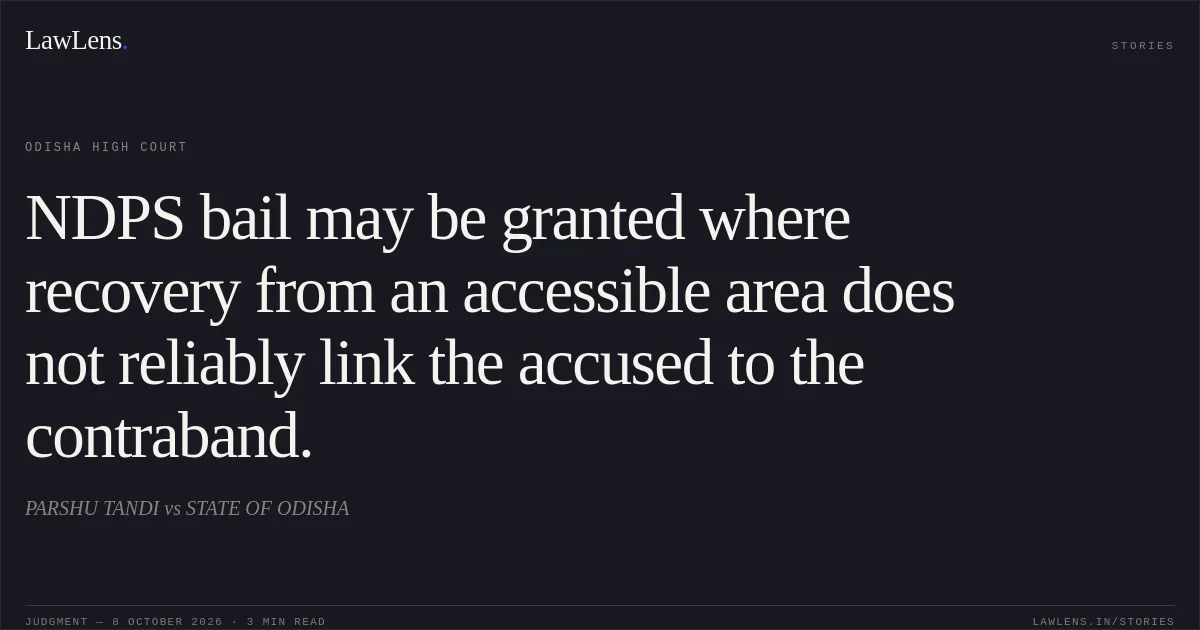
The petitioner sought bail under Section 483 of the Bharatiya Nagarik Suraksha Sanhita, 2023, in a case registered under Section 20(b)(ii)(C) of the NDPS Act.
Source reference: p. 1–5, 14Police alleged that 42 kg 476 g of ganja was recovered from behind his house.
Source reference: p. 1–5, 14The petitioner, who had a 100% disability and both legs amputated below the knees, argued that the recovery site was an open area accessible to others and that nothing was recovered from his conscious possession.
Source reference: p. 1–5, 14The State opposed bail, relying on the quantity seized and the petitioner’s alleged confession.
Source reference: p. 1–5, 14The charge sheet was filed on 4 October 2026; the application was heard on 7 October and decided on 8 October 2026.
Source reference: p. 1–5, 14Issues
1. Whether the petitioner could be granted bail despite the restrictions in Section 37(1)(b) of the NDPS Act, given the alleged commercial quantity of ganja.
Source reference: p. 5–6, 10–112. Whether the case materials provided reasonable grounds to believe that the petitioner was not guilty of the alleged offence and was not likely to commit an offence while on bail.
Source reference: p. 6–10, 11–13Law Applied
Section 483 of the BNSS provides the basis for the bail application.
Source reference: p. 5–6Under Section 37(1)(b) of the NDPS Act, bail for an offence involving commercial quantity may be granted only after the Public Prosecutor has an opportunity to oppose it and the court is satisfied that there are reasonable grounds to believe the accused is not guilty and is not likely to commit an offence while on bail; these conditions are cumulative and additional to ordinary bail requirements.
Source reference: p. 5–6, 7–10“Reasonable grounds” require more than a prima facie basis, but the bail court need not make a final finding of acquittal: Union of India v. Shiv Shanker Kesari, (2007) 7 SCC 798; Union of India v. Rattan Mallik, (2009) 2 SCC 624; State of Kerala v. Rajesh, (2020) 12 SCC 122.
Source reference: p. 6–10The commercial quantity for ganja is 20 kg; the alleged seizure therefore attracted Section 37.
Source reference: p. 11Reasoning
The Public Prosecutor opposed bail, and the alleged seizure exceeded the commercial-quantity threshold, so the Section 37 conditions applied.
Source reference: p. 4–5, 11In assessing whether those conditions were met, the Court noted that the recovery site was about 30 metres from the petitioner’s house and closer to several other houses and cultivated land; the case diary contained no local-witness statements attributing the growing, procuring, or storing of ganja to him; and the petitioner had a certified 100% disability.
Source reference: p. 11–13The charge sheet had been filed, and there was no allegation of similar NDPS or excise antecedents.
Source reference: p. 12–13On those materials, the Court found reasonable grounds for the limited purpose of bail to believe that the petitioner was not shown to have committed the offence and was not likely to commit a similar offence while on bail.
Source reference: p. 13Holding
The Court allowed the bail application and directed that the petitioner be released on bail on terms fixed by the Special Court, subject to verification that he had no NDPS antecedents.
Conditions included that he not commit a similar offence or threaten or influence prosecution witnesses; breach could lead to cancellation of bail.
Source reference: p. 13–14The Court clarified that its observations were confined to the bail application and were not an expression on the merits of the prosecution case.
Source reference: p. 14Acts & Sections Cited
10 provisions across 4 statutes referred to in this judgment. Each provision opens on LawLens.
Bharatiya Nagarik Suraksha Sanhita, 20231
Narcotic Drugs and Psychotropic Substances Act, 19854
Indian Penal Code, 18604
Code of Criminal Procedure, 19731
Original Court PDF
PARSHU TANDIvsSTATE OF ODISHA
Click to open original judgment
Original judgment, available to read, download and summarize on LawLens.in