Facts
The Applicant claimed that a Development Agreement dated 18 December 2024 was executed by him as developer with Late Narendra Dattaram Patkar and Respondent No.1, granting him exclusive and irrevocable redevelopment rights in “Patkar House” and containing an arbitration clause. After Late Narendra Patkar’s death, Respondent No.1 allegedly executed a Gift Deed dated 4 February 2026 in favour of Respondent No.2, who allegedly attempted to interfere with the Applicant’s possession and redevelopment rights.
Source reference: pp. 1–3; paras. 1–3The Applicant invoked arbitration by notice dated 15 June 2026 and nominated a former Judge of the Bombay High Court as sole arbitrator. The Respondents disputed the Development Agreement, alleging that it was forged, fabricated, unregistered and insufficiently stamped. Respondent No.2 additionally claimed independent rights in Shop Nos. 1 and 2 under an earlier Gift Deed dated 23 January 2024 and contended that, as a non-signatory, she was not bound by the arbitration agreement.
Source reference: pp. 4–8; paras. 5–11The Applicant relied upon the registered Will dated 11 April 2025 and the subsequent Gift Deed dated 4 February 2026 as documents which allegedly referred to, or recognised, the Development Agreement. He consequently sought appointment of a sole arbitrator under Section 11 of the Arbitration and Conciliation Act, 1996.
Source reference: pp. 3–4, 11–13; paras. 4, 17–20Issues
Whether there was sufficient prima facie material to establish the existence of an arbitration agreement between the Applicant and Respondent No.1 despite Respondent No.1’s denial of execution and allegations of forgery and fabrication?
Source reference: p. 9; para. 13Whether the allegations concerning the execution, genuineness, validity, stamping and enforceability of the Development Agreement had to be finally decided by the Court at the Section 11 stage or left to the Arbitral Tribunal under Section 16?
Source reference: pp. 9–10, 13–15; paras. 13–16, 21–28Whether Respondent No.2, a non-signatory claiming independent rights under the earlier Gift Deed dated 23 January 2024, was bound by the arbitration agreement and whether disputes concerning her rights could be referred to arbitration?
Source reference: pp. 9, 16–18; paras. 13, 29–34Law Applied
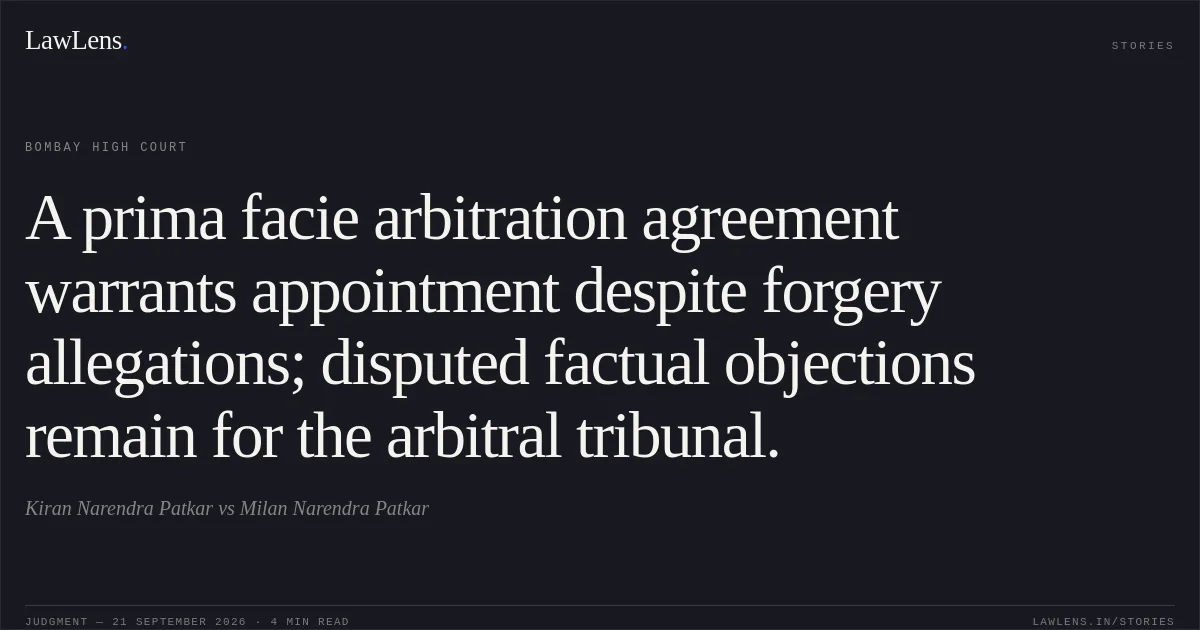
The Court applied Sections 11(6), 11(8), 12 and 16 of the Arbitration and Conciliation Act, 1996. At the Section 11 stage, the Court’s inquiry is limited to determining whether an arbitration agreement prima facie exists; disputed questions of execution, validity, genuineness and enforceability that require evidence should ordinarily be left to the Arbitral Tribunal under the principle of kompetenz-kompetenz.
Source reference: pp. 13–15; paras. 23–26Relying on Rajia Begum, 2026 SCC OnLine SC 135, the Court held that a party cannot be compelled to arbitrate where it is clear, even prima facie, that the arbitration agreement is forged or that the party never consented; however, a mere allegation of fraud or forgery does not automatically defeat a Section 11 application.
Source reference: pp. 10–15; paras. 15, 21, 26–28Relying on Ajay Madhusudan Patel, (2025) 2 SCC 147, read with Cox & Kings Ltd. v. SAP India (P) Ltd., (2024) 4 SCC 1, the Court held that complex questions concerning non-signatories and whether they are bound by an arbitration agreement may be considered by the Arbitral Tribunal under Section 16, particularly where their determination involves disputed facts and legal issues.
Source reference: pp. 14, 17–18; paras. 23–25, 32–33Reasoning
The Court found that the Applicant’s case was not based solely on the disputed Development Agreement. The registered Will dated 11 April 2025 allegedly referred to the redevelopment transaction and the consideration payable by the Applicant, while the subsequent Gift Deed dated 4 February 2026 allegedly referred to the Will and thereby provided independent prima facie support for the Applicant’s case.
Source reference: pp. 11–13; paras. 17–19, 27Although Respondent No.1’s allegations regarding age, illness, lack of understanding of English, absence of signatures and the conduct of the attesting witnesses were serious, they required evidence and could not be finally adjudicated in Section 11 proceedings without effectively conducting a trial.
Source reference: pp. 13–15; paras. 22–28The Court therefore held that the material did not make the non-existence of the arbitration agreement so clear as to justify refusing constitution of the Tribunal.
Source reference: pp. 15, 20; paras. 27–28, 38–40As regards Respondent No.2, the Court held that the effect of the earlier Gift Deed, her alleged independent ownership of the shops, and whether she claimed through or under the parties were disputed questions. Her non-signatory status did not permit the Court to conclusively determine at the Section 11 stage that she was either bound or not bound by the arbitration agreement. Those objections were left open for determination by the Arbitral Tribunal under Section 16.
Source reference: pp. 16–18; paras. 29–34Holding
The Court allowed the Section 11 application and appointed Mr. Ranjeev Carvalho, Advocate, as Sole Arbitrator to adjudicate disputes arising between the Applicant and Respondent No.1 out of or in connection with the Development Agreement dated 18 December 2024.
The Tribunal was permitted to decide objections concerning the existence, execution, genuineness, validity, stamping and enforceability of the Development Agreement and arbitration agreement.
Source reference: p. 22; para. 42(iii)The question whether Respondent No.2, as a non-signatory, was bound by the arbitration agreement and whether claims against her were arbitrable was expressly left open for determination by the Tribunal.
Source reference: p. 22; para. 42(iv)–(v)The Section 9 petition was converted into an application under Section 17 for consideration by the Tribunal, the parties were directed to bear arbitral costs equally in the first instance, and the Respondents’ request for stay of the judgment was rejected.
Source reference: pp. 23–25; paras. 42(ix)–(xi), 43Acts & Sections Cited
6 provisions across 1 statute referred to in this judgment. Each provision opens on LawLens.
Arbitration and Conciliation Act, 19966
Original Court PDF
Kiran Narendra PatkarvsMilan Narendra Patkar
Click to open original judgment
Original judgment, available to read, download and summarize on LawLens.in