Facts
The petitioners, arrayed as accused Nos. 14 and 17, sought to quash an FIR registered under Sections 420 and 120-B IPC concerning dealings with property at Door No. 74, Azhagarkovil Road, Madurai.
Source reference: para. 1The temple’s complaint alleged that the property was endowed for religious services under a 1930 instrument and that, after disputed patta transfers, a power of attorney was executed in 2021 and a mortgage created over the property.
Source reference: para. 2–5, 17The temple also alleged that the documents were registered outside the districts where the property was situated and in breach of legal restrictions and a subsisting interim stay.
Source reference: para. 2–5, 17The petitioners disputed the temple’s title and relied, among other things, on a later Will and revenue proceedings.
Source reference: para. 6–9, 13The title dispute remained pending, including in a writ petition in which an interim stay had been granted.
Source reference: para. 6–9, 13The FIR was registered on 25 July 2026, and the petition was filed under Section 528 of the BNSS.
Source reference: para. 1, 19Issues
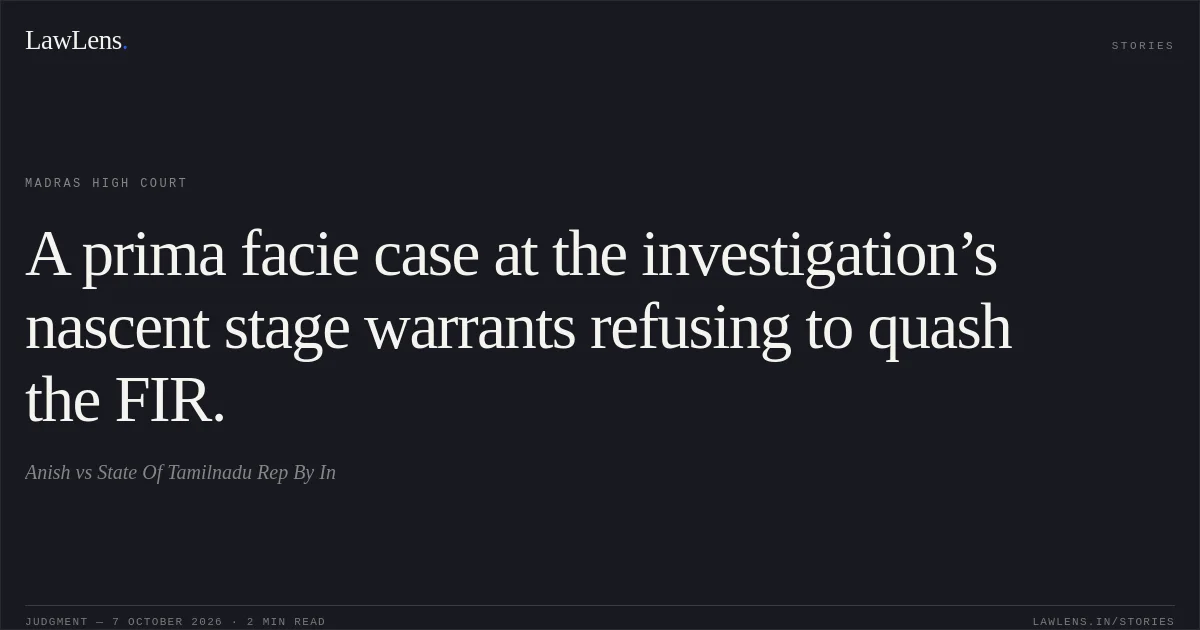
Whether the FIR, on its face, disclosed a prima facie case against the petitioners warranting continuation of the investigation, or whether it should be quashed under Section 528 of the BNSS.
Source reference: para. 1, 9, 19Whether the disputed ownership and revenue proceedings justified quashing the FIR at the investigation stage.
Source reference: para. 6–9, 13, 19Law Applied
Section 528 of the BNSS empowers the High Court to exercise its inherent jurisdiction, including to prevent abuse of process; however, the Court declined to terminate an investigation where the allegations and surrounding circumstances disclose a prima facie case and investigation remains at an early stage.
Source reference: para. 1, 19The FIR invoked Sections 420 and 120-B IPC, while the alleged dealings also raised issues under Section 22-A of the Registration Act and Section 34 of the Tamil Nadu Hindu Religious and Charitable Endowments Act.
Source reference: para. 1, 4The petitioners relied on State of Haryana v. Bhajan Lal, 1992 Supp (1) SCC 355, for the principle that an FIR may be quashed where its allegations, even taken at face value, do not disclose an offence; the Court did not separately analyse or apply that precedent in its reasoning.
Source reference: para. 9Reasoning
The Court considered the 1930 Will’s provision concerning the property, the disputed patta history, and the documents executed on the strength of the power of attorney.
Source reference: para. 16–17It noted that the mortgage was executed in favour of the petitioners’ father by the son and another person, and that the power of attorney and mortgage were registered at offices with no jurisdiction over the property’s location; these circumstances raised serious suspicion.
Source reference: para. 16–17The Court also noted a subsequent power of attorney concerning the same property and the pending challenge to revenue orders.
Source reference: para. 18–19In its view, these matters warranted investigation into the involvement of the accused and others, including government officials.
Source reference: para. 19Because a prima facie case was made out and the FIR was recent, the Court held that it would be inappropriate to stop the investigation at that stage.
Source reference: para. 19Holding
The Court answered against the petitioners, finding no merit in their request to quash the FIR.
It dismissed the Criminal Original Petition and closed the connected miscellaneous petition, leaving the investigation to proceed.
Source reference: para. 20Acts & Sections Cited
5 provisions across 4 statutes referred to in this judgment. Each provision opens on LawLens.
Bharatiya Nagarik Suraksha Sanhita, 20231
Indian Penal Code, 18601
Registration Act, 19082
TAMIL NADU HINDU RELIGIOUS AND CHARITABLE ENDOWMENTS ACT, 19591
Original Court PDF
AnishvsState Of Tamilnadu Rep By In
Click to open original judgment
Original judgment, available to read, download and summarize on LawLens.in