Facts
The petitioner was a guarantor for a loan and had deposited title and mortgage documents relating to his property with the Bank.
Source reference: pp. 2–3The principal borrower was undergoing insolvency proceedings under the Insolvency and Bankruptcy Code, 2016; an insolvency resolution professional had been appointed and the NCLT had appointed a liquidator.
Source reference: pp. 2–3The petitioner relied on Section 134 of the Indian Contract Act, 1872, to seek return of his documents, contending that his liability had been discharged.
Source reference: pp. 2–3He also sought removal of restrictions on his bank account and refund of ₹20 lakh deposited as a condition for interim stay in a SARFAESI application.
Source reference: pp. 2–3The sale notice had subsequently been withdrawn.
Source reference: pp. 6–7Issues
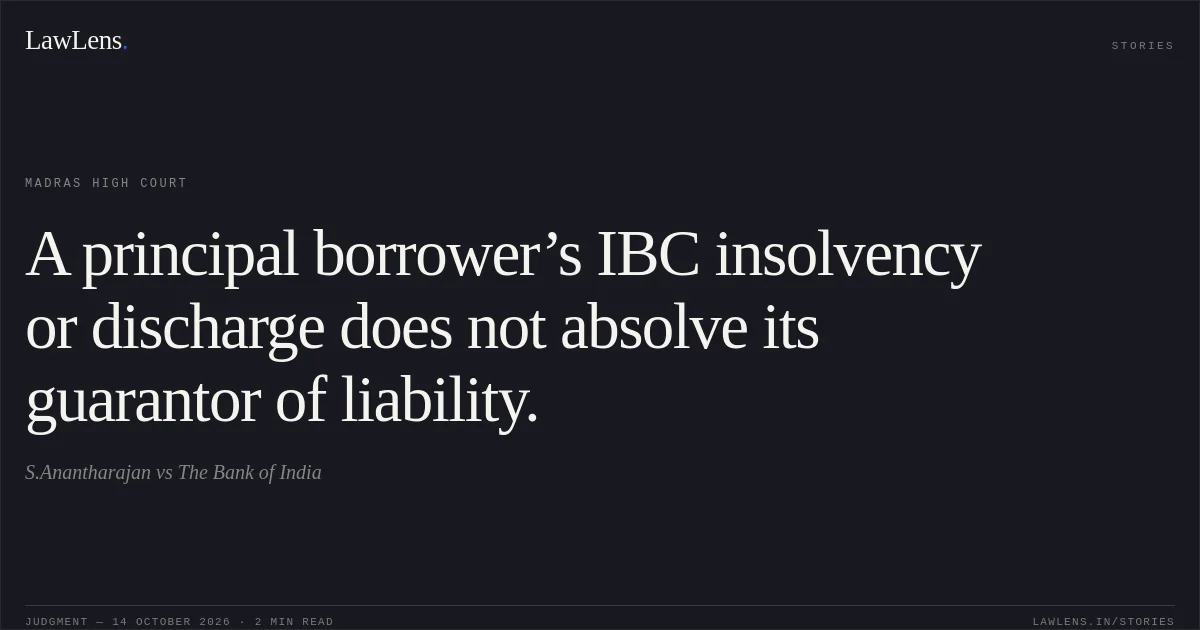
Whether the principal borrower’s insolvency or liquidation proceedings discharged the petitioner, as guarantor, from his independent liability and entitled him to return of the title documents.
Source reference: pp. 2–5Whether the petitioner was entitled in the writ petition to return of the ₹20 lakh deposited as a condition for interim stay after withdrawal of the sale notice.
Source reference: p. 6Law Applied
Section 134 of the Indian Contract Act, 1872 discharges a surety where the creditor and principal debtor contract to release the principal debtor, or where an act or omission of the creditor legally discharges the principal debtor.
Source reference: pp. 3–5However, a discharge resulting from insolvency or liquidation by operation of law does not, without more, discharge the surety.
Source reference: pp. 3–5In Lalit Kumar Jain v. Union of India, (2021) 9 SCC 321, the Supreme Court held that approval of a resolution plan does not ipso facto discharge a personal guarantor from liability under the independent contract of guarantee; the judgment also referred to subsequent decisions following that principle.
Source reference: pp. 3–5Section 31 of the SARFAESI Act was raised in relation to the petitioner’s claim that the secured property was agricultural land, but the Court did not decide its applicability because no SARFAESI action was then under challenge.
Source reference: p. 6Reasoning
The Court held that the principal borrower’s entry into the IBC regime and the resulting restructuring or discharge did not amount to a creditor-caused discharge within Section 134.
Source reference: pp. 3–5Applying Lalit Kumar Jain, it treated the petitioner’s guarantee liability as independent and unaffected by the outcome of the borrower’s insolvency proceedings; accordingly, the IBC proceedings did not entitle him to return of the documents.
Source reference: pp. 3–5Although the petitioner’s Section 31 argument concerning agricultural land was found to have considerable force, it could be raised if SARFAESI action were initiated, since no such action was under review in this writ petition.
Source reference: p. 6As to the deposit, the Court left the refund question to the Tribunal, where the petitioner could seek relief in the disposed SARFAESI application; the petitioner stated that he would not claim interest.
Source reference: p. 7Holding
The Court dismissed the writ petition, holding that the petitioner’s liability as guarantor remained unaffected by the principal borrower’s IBC proceedings.
It granted liberty to the petitioner to file a miscellaneous petition before the Tribunal seeking refund of the ₹20 lakh, with the refund question to be decided after hearing the Bank; the petitioner would not claim interest.
Source reference: p. 7No costs were ordered.
Source reference: pp. 7–8Acts & Sections Cited
2 provisions across 2 statutes referred to in this judgment. Each provision opens on LawLens.
Indian Contract Act, 18721
Securitisation and Reconstruction of Financial Assets and Enforcement of Security Interest Act, 20021
Original Court PDF
S.AnantharajanvsThe Bank of India
Click to open original judgment
Original judgment, available to read, download and summarize on LawLens.in