01Facts
The petitioners, heirs of M. Muniyappa, challenged the Land Tribunal’s order granting respondent No. 3 occupancy rights over land in Ganakallu Village.
¶ 2Their father had purchased the land by registered sale deed dated 26 April 1971.
¶ 2In an earlier civil suit, respondent No. 3 claimed ownership by adverse possession; the court declared Muniyappa the owner and directed respondent No. 3 to deliver possession.
¶ 8–9The Tribunal nevertheless granted respondent No. 3 occupancy rights by order dated 29 March 2023, prompting this writ petition.
¶ 2, 8–902Issues
i.Whether respondent No. 3 established that he cultivated the land as a tenant so as to qualify for occupancy rights under the Karnataka Land Reforms Act, 1961.
¶ 4, 9–10ii.Whether the Land Tribunal’s order granting occupancy rights could stand in light of respondent No. 3’s earlier pleadings and the civil court decree.
¶ 9–1003Law Applied
Under Section 4 of the Karnataka Land Reforms Act, 1961, the relevant inquiry was whether respondent No. 3 was a deemed tenant; cultivation or possession alone did not establish tenancy.
¶ 10The Court relied on Parameshwar Timmayya Hegde and Others v. Venkataraman Manjappa Hegde (since deceased by his LRs) and Others, ILR 2000 KAR 3170, for the principle that a claimant seeking occupancy rights must prove cultivation as a tenant under the landlord, and that mere cultivation is insufficient.
¶ 10The respondent’s reliance on Section 133 of the Karnataka Land Revenue Act, 1964, and Koraga Marakalu & Another v. Smt. Kamala & Others, AIR 1988 KAR 123, did not alter the Court’s conclusion on the facts.
¶ 6, 10Provisions in the judgment · 1 · Linked ones open on LawLens
KARNATAKA LAND REFORMS ACT, 1961 Section 4
04Reasoning
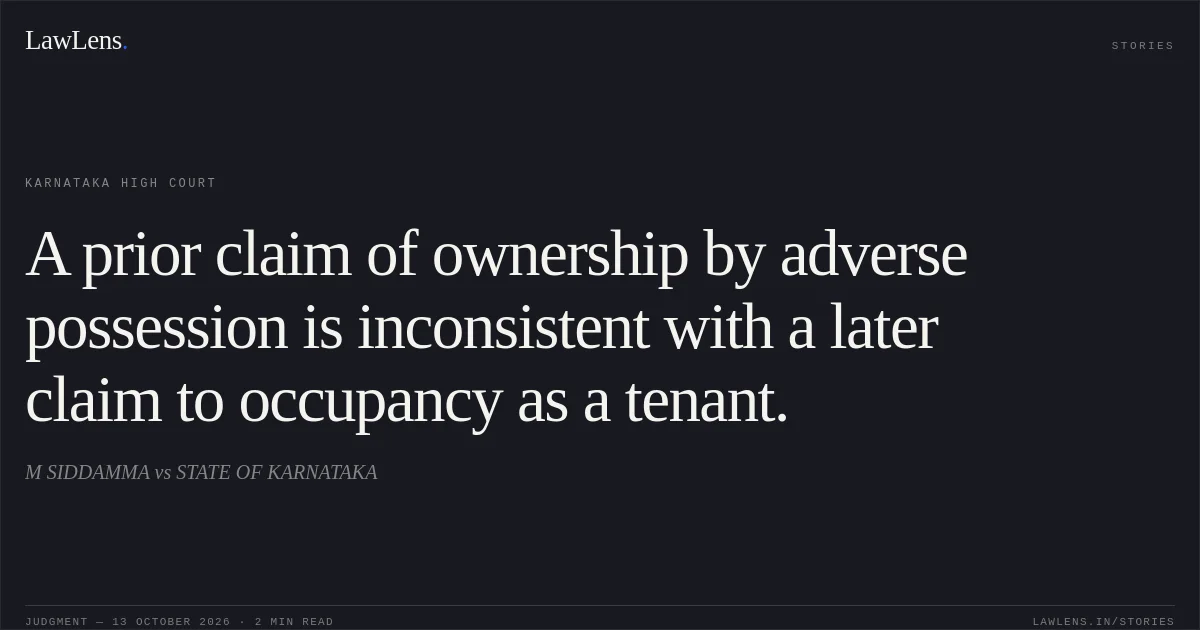
Respondent No. 3’s written statement in the earlier civil suit asserted ownership and title by adverse possession, but did not claim that he was a tenant under the landlord.
¶ 9The civil court subsequently declared Muniyappa the owner and directed respondent No. 3 to restore possession.
¶ 9The High Court held that these pleadings and the decree were inconsistent with the Tribunal’s finding of tenancy.
¶ 9–10Further, respondent No. 3’s alleged cultivation, without proof that it was as a tenant, could not satisfy the requirement for occupancy rights.
¶ 10The Tribunal’s decision was therefore contrary to the record and the governing legal principles.
¶ 1005Holding
The Court allowed the writ petition and set aside the Land Tribunal’s order dated 29 March 2023 granting occupancy rights to respondent No. 3.
¶ 11It directed the jurisdictional Tahsildar to enter the petitioners’ names in the revenue records for the subject land; the pending interlocutory application was held not to survive.
¶ 11Original Court PDF
M SIDDAMMAvsSTATE OF KARNATAKA
Click to open original judgment
Original judgment, available to read, download and summarize on LawLens.in