01Facts
Twenty-five petitioners sought quashing of the entire proceedings in C.C. No. 2737/2021, pending before the Additional Civil Judge and JMFC, Bantwal, Dakshina Kannada, for offences under Sections 78(1)(b) and 80 of the Karnataka Police Act, 1963.
p. 8 · ¶ 2The petitioners' counsel contended that the issue was squarely covered by the Court's earlier order in Crl.P. No. 1757/2026, decided on 23.02.2026.
p. 8 · ¶ 3In that matter, the petitioner was prosecuted under Section 78(3) of the Karnataka Police Act in C.C. No. 1005/2023 (Pavagada), and the contention was that no permission had been obtained under Section 155(2) of the Cr.P.C. before registering and investigating the case.
pp. 8–9 · ¶ 3The Court in that matter quashed the proceedings against the petitioner.
pp. 14–15The present order does not recite any factual particulars of the Bantwal case, such as the date of the complaint, the entry in the station diary, or whether a requisition was made to the Magistrate.
02Issues
i.1. Whether proceedings under Sections 78(1)(b) and 80 of the Karnataka Police Act, 1963, which relate to non-cognizable offences, are liable to be quashed where the police investigated and filed a charge sheet without the order of the jurisdictional Magistrate required under Section 155(1)–(2) Cr.P.C.
p. 8 · ¶ 3 · pp. 10–11ii.2. Whether a mere endorsement by the Magistrate on the police requisition constitutes the "order" contemplated under Section 155(2) Cr.P.C.
p. 14 · ¶ 1503Law Applied
Section 155 Cr.P.C. provides that an officer-in-charge receiving information of a non-cognizable offence must enter its substance in the prescribed book and refer the informant to the Magistrate (s.155(1)), and no police officer may investigate such a case without a Magistrate's order (s.155(2)).
pp. 10–11, quoting Vaggeppa Gurulinga Jangaligi v. State of Karnataka, ILR 2020 KAR 630As laid down in Vaggeppa, the SHO has no power to seek the order himself; the informant must approach the Magistrate, and absent such an order the police acquire no jurisdiction to investigate or file a final report or charge sheet.
p. 11 · ¶ 9The Court relied on Praveen Basavanneppa Shivalli v. State of Karnataka (2017).
p. 11 · ¶ 10The Court relied on Mukkatira Anitha Machaiah v. State of Karnataka (Crl.P. 5934/2009, 2013).
p. 12 · ¶ 11–12In Padubidri Members Lounge v. DG & IGP (W.P. Nos. 42073–75/2018), s.155 was applied to a charge sheet under Section 87 of the Karnataka Police Act.
p. 13 · ¶ 14In Veeranagouda v. State of Karnataka (Crl.P. No. 102021/2018, 2019), it was held that an endorsement on a requisition is not a permission in law.
p. 14 · ¶ 15The Court noted that its earlier decisions quashed such proceedings but laid down no guidelines for Magistrates on the manner of passing s.155(2) orders.
p. 14 · ¶ 16Provisions in the judgment · 6 · Linked ones open on LawLens
Code of Criminal Procedure, 1973 Section 482Section 155
Bharatiya Nagarik Suraksha Sanhita, 2023 Section 528
KARNATAKA POLICE ACT, 1963. Section 78Section 80Section 87
04Reasoning
The Court treated the petitioners' challenge as identical to the one decided in Crl.P. No. 1757/2026 and applied that ruling directly.
p. 8 · ¶ 3 · p. 15The reasoning is that the Bantwal police, like the Pavagada police, were required to refer the informant to the Magistrate and obtain a s.155(2) order before investigating, and the proceedings were initiated and continued without such an order.
pp. 10–11 · ¶ 8–9 · p. 13 · ¶ 14Because the investigation lacked statutory authority, the resulting charge sheet and cognizance were treated as vitiated, and continuing the trial was held to be an abuse of process.
p. 14 · ¶ 15The judgment does not expressly classify Sections 78(1)(b) and 80 of the Karnataka Police Act as non-cognizable; it proceeds on the premise that the offences are non-cognizable, as it did for Section 87 in Padubidri and for Section 78(3) in the earlier order.
p. 10 · ¶ 8 · p. 13 · ¶ 14The order does not record a separate finding on whether a Magistrate's order was in fact absent in the Bantwal case. The quashing therefore rests on the precedential holding rather than on an independent examination of the Bantwal record.
05Holding
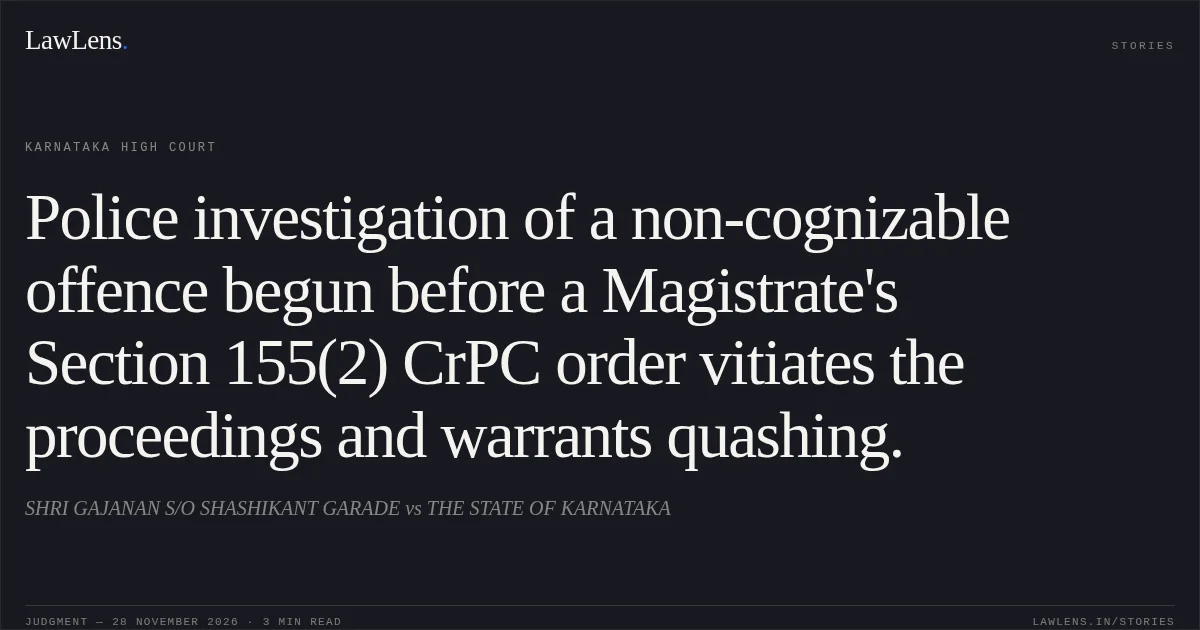
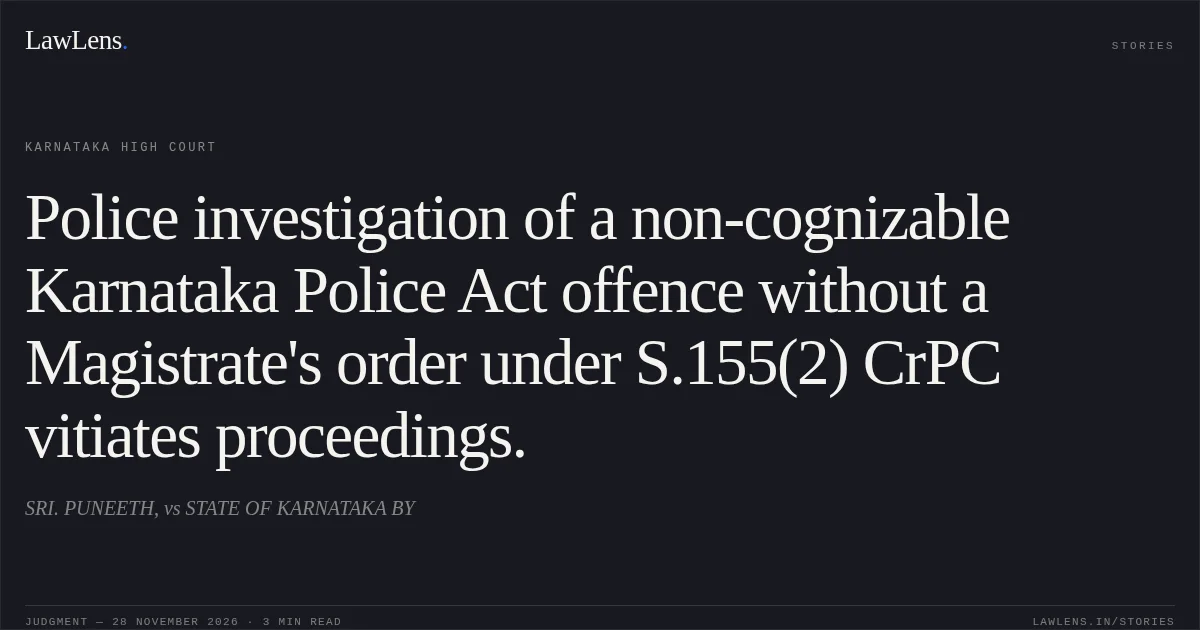
The Court held that investigation of non-cognizable offences without the jurisdictional Magistrate's order under Section 155(2) Cr.P.C. is without authority of law, and proceedings founded on such investigation are liable to be quashed.
pp. 14–15The petition is allowed, and the proceedings in C.C. No. 2737/2021 pending before the Additional Civil Judge and JMFC, Bantwal, stand quashed qua the petitioners.
p. 15Original Court PDF
SRI. PUNEETH,vsSTATE OF KARNATAKA BY
Click to open original judgment
Original judgment, available to read, download and summarize on LawLens.in