01Facts
On 16.07.2024 at about 7:00 p.m., the complainant, a police officer, received information that persons were playing Matka gambling near Old Bhaji Market, Belagavi.
pp. 2-3After obtaining permission from the Court and informing the Commissioner of Police, he conducted a raid, seized Matka chits, a ball pen and Rs. 3,100 under a seizure panchanama, and lodged a complaint leading to Crime No. 95/2024 at Belagavi Market PS for offences under Section 78(3) of the Karnataka Police Act.
pp. 2-3The Investigating Officer filed a charge-sheet against the petitioner (accused No. 5), who sought quashing of C.C. No. 2229/2024 on the file of the JMFC-II Court, Belagavi.
p. 2The petitioner contended that the offence is non-cognizable, that the police had no authority to investigate, and that there was no evidence of compliance with Section 155(1) and (2) CrPC.
pp. 3-4The State contended that all mandatory provisions were followed.
p. 4The Magistrate's order permitting investigation is recorded as passed on 16.07.2024 at 6:40 p.m., i.e., 20 minutes before the raid and seizure at 7:00 p.m.
p. 802Issues
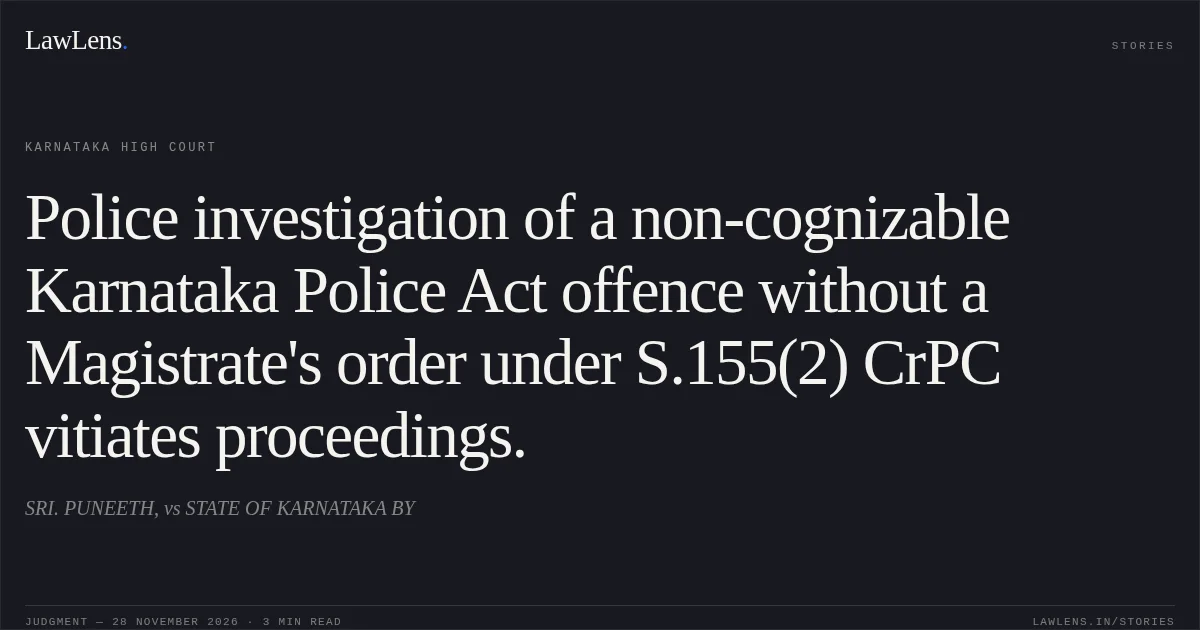
i.1. Whether an investigation of an offence under Section 78(3) of the Karnataka Police Act, which is non-cognizable, can proceed without a prior order of the jurisdictional Magistrate under Section 155(2) CrPC.
pp. 4-5 · ¶ 6-8ii.2. Whether investigation that commenced before the Magistrate's permission and before registration of the FIR vitiates the proceedings and constitutes an abuse of process warranting quashing under Section 482 CrPC.
pp. 8-9 · ¶ 11-1203Law Applied
The Court began from the settled position that an offence under Section 78(3) of the Karnataka Police Act is non-cognizable.
p. 4 · ¶ 6Section 155(1) CrPC requires the officer-in-charge to record the substance of information of a non-cognizable offence and refer the informant to the Magistrate, and Section 155(2) CrPC bars any police officer from investigating a non-cognizable case without the order of a competent Magistrate.
p. 5 · ¶ 7-8Vaggeppa Gurulingappa Jangaligi v. State of Karnataka, ILR 2020 KAR 630, holds that a "permitted" endorsement on the police requisition is not a valid order under Section 155(2), that the Magistrate must pass a reasoned order on a separate order sheet after subjective satisfaction, and that the order must specify the rank and designation of the investigating officer.
pp. 6-8 · ¶ 9-10Proceedings amounting to an abuse of the process of law may be quashed under Section 482 CrPC.
p. 9 · ¶ 12Provisions in the judgment · 3 · Linked ones open on LawLens
Code of Criminal Procedure, 1973 Section 482Section 155
KARNATAKA POLICE ACT, 1963. Section 78
04Reasoning
The Court first confirmed that the mandatory procedure under Section 155(1) and (2) applies to Section 78(3) offences and that, absent a valid Magistrate's order, the police lack jurisdiction to investigate or file a charge-sheet.
p. 6 · ¶ 8 · p. 8 · ¶ 10The Court examined the chronology: the Magistrate's permission was recorded at 6:40 p.m., but the raid, seizure and panchanama took place at 7:00 p.m.
p. 8 · ¶ 11The Court inferred that the investigative steps had been completed before the statutory permission was obtained.
p. 8 · ¶ 11The panchanama, which formed part of the charge-sheet, showed that investigation had commenced even before the FIR was registered.
pp. 8-9 · ¶ 12Because the permission under Section 155(2) did not precede the investigative acts, the Court held that continuing the proceedings would amount to an abuse of process.
p. 9 · ¶ 12The judgment does not expressly address the tension between the complainant's statement that permission was obtained before the raid and the recorded timing of the Magistrate's order, and it does not separately analyse whether the seizure itself constituted investigation of a non-cognizable offence. The decision rests on the sequence of events shown in the record.
pp. 2-3 · p. 805Holding
Investigation of a non-cognizable Section 78(3) offence without a prior, valid Section 155(2) order is impermissible.
pp. 8-9 · ¶ 10Where investigation commenced before such permission and before the FIR, the proceedings are an abuse of process.
pp. 8-9 · ¶ 11-12The petition is allowed. The entire proceedings in C.C. No. 2229/2024 (arising from Crime No. 95/2024, Belagavi Market PS, under Section 78(3) of the KP Act) are quashed insofar as they concern the petitioner/accused No. 5.
p. 9Pending interlocutory applications, if any, stand dismissed.
p. 10Original Court PDF
SHRI GAJANAN S/O SHASHIKANT GARADEvsTHE STATE OF KARNATAKA
Click to open original judgment
Original judgment, available to read, download and summarize on LawLens.in