Facts
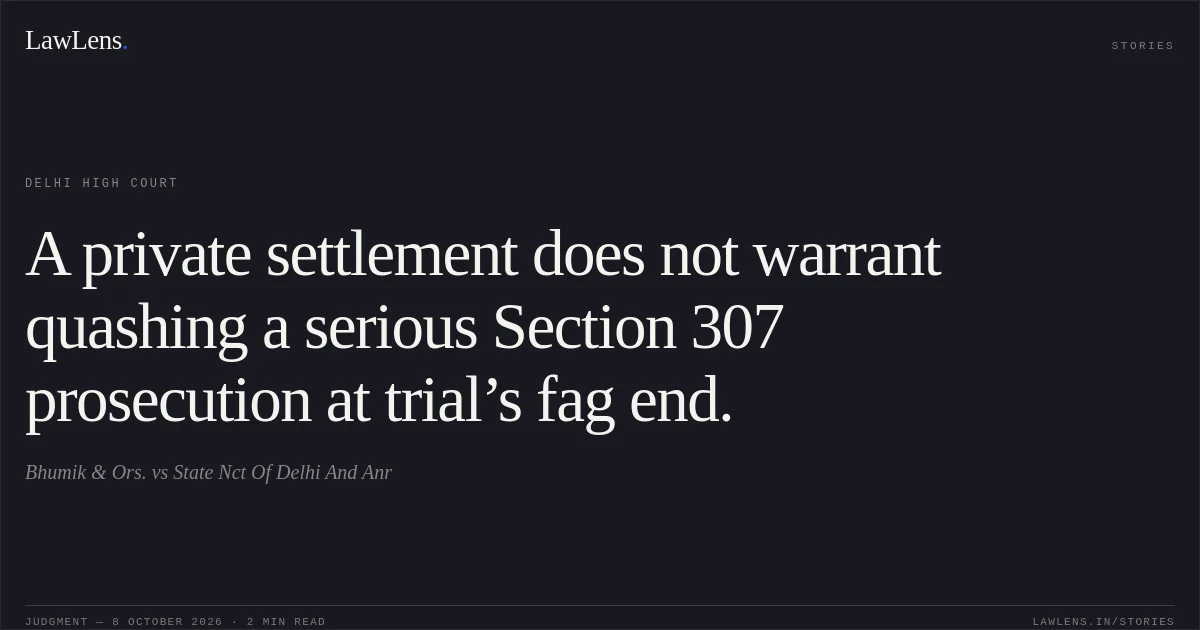
The petitioners sought to quash FIR No. 293/2020, registered under Sections 452, 307 and 34 of the Indian Penal Code, 1860, on the basis of a memorandum of understanding dated 25 August 2026.
Source reference: p. 1–2The FIR alleged that, following an earlier altercation, the accused came to the complainant’s home and repeatedly attacked him with a knife.
Source reference: p. 1–2The charge-sheet recorded multiple knife injuries, identified an eyewitness and attributed direct roles to the petitioners.
Source reference: p. 1–2The complainant supported the settlement and stated that he did not wish to pursue the prosecution.
Source reference: p. 1–2The State submitted that the trial was at its fag end and likely to conclude soon.
Source reference: p. 1–2Issues
Whether the High Court should exercise its inherent jurisdiction under Section 528 of the Bharatiya Nagarik Suraksha Sanhita, 2023, to quash proceedings for an alleged offence under Section 307 IPC on the basis of a settlement between the parties
Source reference: p. 1, 3–5Whether the nature of the alleged violence, the injuries and the advanced stage of trial warranted continuation of the prosecution despite the complainant’s support for the settlement
Source reference: p. 4–6Law Applied
Section 528 BNSS preserves the High Court’s inherent power to prevent abuse of process and secure the ends of justice.
Source reference: p. 1Under Gian Singh v. State of Punjab, (2012) 10 SCC 303, and Parbatbhai Aahir v. State of Gujarat, (2017) 9 SCC 641, serious and heinous offences affecting society are generally not to be quashed merely because the victim and accused have settled.
Source reference: p. 2–3, 6–7Narinder Singh v. State of Punjab, (2014) 6 SCC 466, as applied in State of M.P. v. Laxmi Narayan, (2019) 5 SCC 688, requires the Court to assess the nature of the injuries, the body parts affected, the weapon used and the evidence when considering a Section 307 IPC charge; the stage of the proceedings is also relevant, and quashing is ordinarily disfavoured when the trial is near completion.
Source reference: p. 3–5The Court also relied on Daxaben v. State of Gujarat, (2022) 16 SCC 117, and Arun Singh v. State of U.P., (2020) 3 SCC 736, for the principle that grave offences affecting society cannot ordinarily be terminated by private compromise.
Source reference: p. 5–6Reasoning
The Court considered the allegations of repeated knife attacks, the multiple injuries recorded in the charge-sheet, the identified eyewitness and the direct roles attributed to the petitioners.
Source reference: p. 1–2, 4In light of that material, it did not regard the case as a private dispute suitable for resolution by settlement.
Source reference: p. 1–2, 4The Court also treated the trial’s reported advanced stage as a reason against quashing, applying the principles in Laxmi Narayan concerning the timing of settlement.
Source reference: p. 4It concluded that the public interest in prosecuting serious violence outweighed the parties’ private agreement, notwithstanding the complainant’s wish not to pursue the case.
Source reference: p. 4–6Holding
The High Court declined to quash FIR No. 293/2020 and dismissed the petition, holding that the serious nature of the alleged violence and the advanced stage of trial did not warrant termination of the prosecution on the basis of the settlement.
The pending application was also disposed of.
Source reference: p. 7Acts & Sections Cited
6 provisions across 3 statutes referred to in this judgment. Each provision opens on LawLens.
Bharatiya Nagarik Suraksha Sanhita, 20231
Indian Penal Code, 18603
Code of Criminal Procedure, 19732
Original Court PDF
Bhumik & Ors.vsState Nct Of Delhi And Anr
Click to open original judgment
Original judgment, available to read, download and summarize on LawLens.in