Facts
The complainant alleged that the accused borrowed ₹3.33 crore in cash on 4 November 2011, agreeing to pay 18% interest, and later issued a cheque for ₹4,02,93,000 towards repayment.
Source reference: pp. 2–3, paras. 2–3The cheque was dishonoured with the endorsement “Payment Stopped by Drawer”; the Trial Court convicted the accused under Section 138 of the Negotiable Instruments Act, 1881, and the Appellate Court affirmed the conviction.
Source reference: pp. 2–3, paras. 2–3In revision, the accused relied on complaints made before presentation of the cheque alleging its misuse, his stop-payment instruction, his denial of the cheque signature, and evidence of a consultancy relationship between the parties.
Source reference: pp. 4–12, paras. 5–15He also challenged the complainant’s account of the loan, including the absence of security or satisfactory evidence of the source and capacity to advance the cash.
Source reference: pp. 4–12, paras. 5–15A connected Criminal Original Petition sought release of money deposited by the accused during suspension of sentence.
Source reference: pp. 1, 19, paras. 24–25Issues
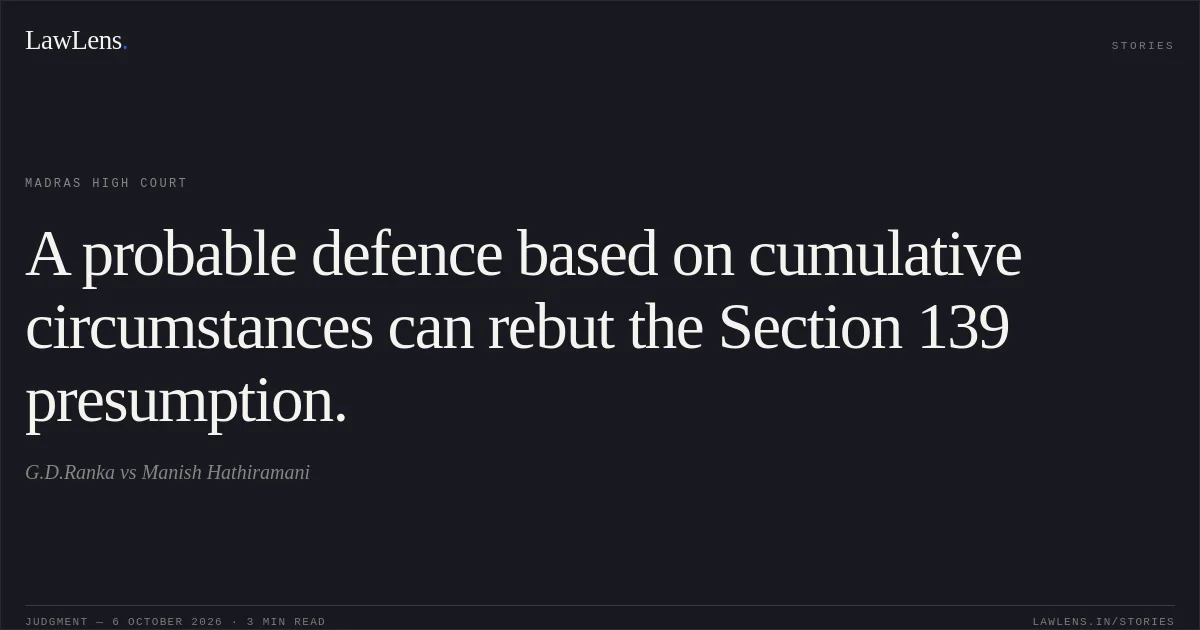
1. Whether the accused rebutted the statutory presumptions under Sections 118(a) and 139 of the NI Act by raising a probable defence that the cheque was not issued towards a legally enforceable debt or liability.
Source reference: pp. 13–18, paras. 16–222. Whether the concurrent conviction under Section 138 of the NI Act could be sustained when the complainant failed to establish the alleged loan after the statutory presumption was rebutted.
Source reference: pp. 17–19, paras. 21–233. Whether the connected petition seeking release of the deposited amount remained maintainable after the accused’s acquittal.
Source reference: p. 19, para. 24Law Applied
Section 138 of the NI Act penalises dishonour of a cheque issued for discharge, wholly or partly, of a legally enforceable debt or liability.
Source reference: pp. 13–17, paras. 16–20Sections 118(a) and 139 require presumptions of consideration and of the cheque having been received towards such debt or liability, but those presumptions are rebuttable.
Source reference: pp. 13–17, paras. 16–20The accused may rebut them on a preponderance of probabilities, either through direct evidence or by relying on circumstances on record; the accused need not disprove the debt beyond reasonable doubt.
Source reference: pp. 13–17, paras. 16–20Once a probable defence rebuts the presumption, the evidentiary burden shifts to the complainant to establish the legally enforceable debt or liability.
Source reference: pp. 13–17, paras. 16–20The judgment identifies no specific precedent as the basis of this rule.
Source reference: no citationReasoning
The Court considered the accused’s pre-presentation complaints alleging misuse of the cheque, the stop-payment instruction and the “Payment Stopped by Drawer” endorsement as circumstances supporting his defence; it also held that failure to reply to the statutory notice did not prevent him from disputing the signature at trial.
Source reference: pp. 7–9, paras. 9–11The Court further relied on the complainant’s cross-examination, including the lack of security or documentary evidence for the substantial cash loan, the absence of a satisfactory account of his financial capacity and source of funds, and the admitted consultancy relationship between the parties.
Source reference: pp. 10–12, paras. 12–15, 21Taken together, these circumstances raised a probable defence and rebutted the statutory presumptions.
Source reference: pp. 17–19, paras. 21–23The complainant then failed to prove the alleged loan by cogent evidence, so the conviction could not stand.
Source reference: pp. 17–19, paras. 21–23Holding
The Court allowed the Criminal Revision Case, set aside the judgments of the Trial and Appellate Courts, and acquitted the accused of the Section 138 offence.
It directed that he be set at liberty, cancelled any bail bond, and ordered any fine paid to be refunded.
Source reference: p. 18, para. 23The connected Criminal Original Petition was dismissed as infructuous following the acquittal; the Trial Court was nevertheless directed to permit the accused to withdraw the amount deposited, together with accrued interest, without notice to the complainant.
Source reference: p. 19, paras. 24–25Acts & Sections Cited
15 provisions across 4 statutes referred to in this judgment. Each provision opens on LawLens.
Bharatiya Nagarik Suraksha Sanhita, 20233
Negotiable Instruments Act, 18814
Code of Criminal Procedure, 19731
Indian Penal Code, 18607
Original Court PDF
G.D.RankavsManish Hathiramani
Click to open original judgment
Original judgment, available to read, download and summarize on LawLens.in