Facts
The complainant alleged that the respondent purchased a tractor, trolley and agricultural implements for ₹6,00,000 under an agreement dated 15 October 2014, paid ₹2,00,000 in cash and issued ten post-dated cheques towards the balance and interest.
Source reference: p. 2–3One cheque for ₹64,000 was dishonoured for insufficient funds; despite receiving statutory notice, the respondent did not pay.
Source reference: p. 2–3The JMFC convicted the respondent under Section 138 of the Negotiable Instruments Act, 1881 (“NI Act”), but the Sessions Court allowed his appeal and acquitted him, finding that the complainant had not proved the sale or that the cheque represented a debt or liability.
Source reference: p. 4–5The complainant appealed the acquittal under Section 378(4) CrPC.
Source reference: p. 1Issues
1. Whether the appellate court’s acquittal was legal and justified, and whether it warranted interference in the acquittal appeal.
Source reference: p. 7, para. 102. Whether the respondent rebutted the presumptions under Sections 118 and 139 of the NI Act by raising a probable defence that the cheque was not issued towards a debt or liability.
Source reference: p. 8–11, paras. 12–17Law Applied
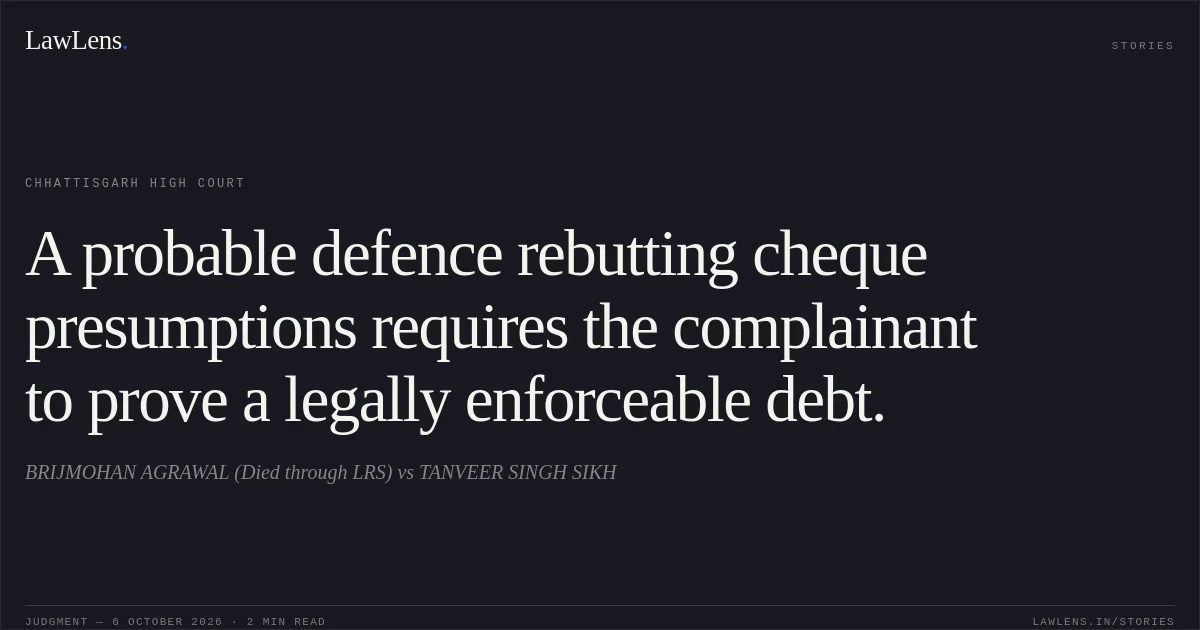
Section 138 of the NI Act applies where a cheque is issued in discharge, in whole or in part, of a legally enforceable debt or liability; Sections 118(a) and 139 raise rebuttable presumptions of consideration and of the cheque having been received in discharge of a debt or liability.
Source reference: p. 6–8, paras. 8, 12–13The accused may rebut those presumptions on a preponderance of probabilities; once a probable defence is established, the burden shifts to the complainant to prove the debt or liability as a matter of fact [*Basalingappa v. Mudibasappa*, (2019) 5 SCC 418; *Rajesh Jain v. Ajay Singh*, (2023) 10 SCC 148].
Source reference: p. 8–11, paras. 13, 16–18In an appeal against acquittal, the acquittal is not ordinarily disturbed absent perversity, illegality, or the overlooking of cogent or vital material [*Chandrappa v. State of Karnataka*, (2007) 4 SCC 415].
Source reference: p. 11–12, para. 19Reasoning
The Court held that the complainant’s admissions and the absence of supporting documents raised a probable defence: he was not the manufacturer or an authorised dealer, produced no documents establishing ownership or authority to sell the tractor and implements, and produced no registration or other records showing transfer to the respondent.
Source reference: p. 7–10, paras. 11, 14–16Despite opportunities to produce documents contemplated by Clause 9 of the agreement, none were produced.
Source reference: p. 10, para. 15The complainant also did not substantiate the alleged initial cash payment of ₹2,00,000 or otherwise prove the underlying transaction after the statutory presumptions were rebutted.
Source reference: p. 10–11, paras. 16–17The appellate court’s assessment was therefore not perverse or illegal, and the applicable standard for interfering with an acquittal was not met.
Source reference: p. 11–12, para. 19Holding
The Court answered the principal issue against the complainant, holding that the appellate court’s acquittal was justified and disclosed no ground for interference.
The acquittal appeal was dismissed.
Source reference: p. 12, para. 19Acts & Sections Cited
7 provisions across 2 statutes referred to in this judgment. Each provision opens on LawLens.
Code of Criminal Procedure, 19733
Negotiable Instruments Act, 18814
Original Court PDF
BRIJMOHAN AGRAWAL (Died through LRS)vsTANVEER SINGH SIKH
Click to open original judgment
Original judgment, available to read, download and summarize on LawLens.in