Facts
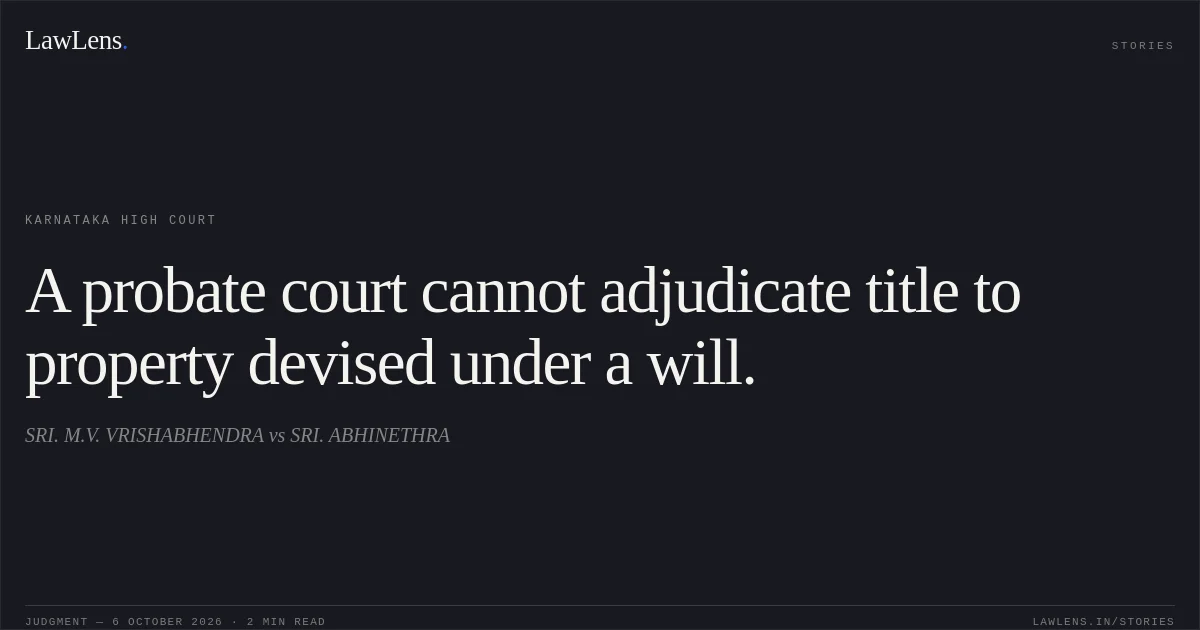
The plaintiff petitioned under Section 276 of the Indian Succession Act, 1925, for probate of a Will dated 22 October 2001, by which Smt. Gangamma allegedly bequeathed the suit property to him.
Source reference: pp. 3–4, 9–10After the defendant contested the petition, it was converted into a suit under Section 295 and numbered O.S. No. 11308/2006.
Source reference: pp. 3–4, 9–10The trial court granted probate and also declared the plaintiff the absolute owner of the property.
Source reference: pp. 3–4, 9–10The defendant appealed under Section 299, challenging the declaration of title
Source reference: pp. 3–4, 9–10Issues
1. Whether a court hearing a contentious proceeding under Sections 276 and 295 of the Indian Succession Act may declare the plaintiff owner of, and title-holder to, the property covered by the Will
Source reference: p. 92. Whether the trial court’s order required appellate interference
Source reference: p. 9Law Applied
Sections 276 and 295 of the Indian Succession Act, 1925, govern petitions for probate and the procedure in contentious probate matters; under Section 295, a contested proceeding takes, “as nearly as may be,” the form of a regular suit, but remains confined to the probate inquiry.
Source reference: pp. 11–14The court applied the principle in Ishwardeo Narain Singh v. Kamta Devi that a probate court determines whether the Will was duly executed and attested and whether the testator had a sound disposing mind—not whether a particular bequest is valid or who owns the property.
Source reference: pp. 14–15It also relied on the authorities discussed in Smt. Severine D’Souza v. Felix Ambrose D’Souza and Chiranjilal Shrilal Goenka v. Jasjit Singh: probate establishes the factum and valid execution of the Will and the legal character of the executor, but does not determine title to, or the existence of, the property.
Source reference: pp. 15–20Section 9 of the Code of Civil Procedure, 1908, concerns the civil courts’ jurisdiction over civil suits, but does not enlarge the scope of a probate proceeding.
Source reference: pp. 11–14Reasoning
Although Section 295 requires a contested probate proceeding to take the form of a regular suit as nearly as possible, the court held that conversion does not expand the probate court’s substantive jurisdiction beyond deciding the Will’s validity and the entitlement to probate.
Source reference: pp. 12–14, 27–29The trial court therefore exceeded that jurisdiction by declaring the plaintiff the absolute owner of the property.
Source reference: pp. 27–30The probate grant could stand, but it did not resolve any rival claim of title; such claims must be determined in appropriate proceedings.
Source reference: pp. 27–30Holding
The High Court answered the jurisdictional issue in the negative and allowed the appeal in part.
It set aside the decree declaring the plaintiff the absolute owner and title-holder, while confirming the grant of probate of the Will dated 22 October 2001.
Source reference: pp. 29–31It reserved liberty to both parties to pursue their respective claims concerning title and possession in appropriate proceedings in accordance with law
Source reference: pp. 29–31Acts & Sections Cited
6 provisions across 2 statutes referred to in this judgment. Each provision opens on LawLens.
Indian Succession Act, 19255
Code of Civil Procedure, 19081
Original Court PDF
SRI. M.V. VRISHABHENDRAvsSRI. ABHINETHRA
Click to open original judgment
Original judgment, available to read, download and summarize on LawLens.in