Facts
The plaintiff was appointed as a probationary unarmed constable in 1999 and sent for training. Following an alleged incident of misconduct at the training centre, he was returned to his parent company and discharged by an order dated 28 September 1999, without notice or departmental inquiry.
Source reference: paras. 5–8, 13.1–13.2His representations to senior authorities were rejected. The Trial Court dismissed his suit challenging the discharge; the First Appellate Court set aside the discharge and related orders and directed reinstatement with continuity of service but without back wages. The State appealed under Section 100 CPC.
Source reference: paras. 5–8, 13.1–13.2Issues
Whether the First Appellate Court was justified in setting aside the Trial Court’s judgment and decree.
Source reference: p. 5 / para. 9Whether the Civil Court had jurisdiction to grant the relief ordered by the First Appellate Court.
Source reference: p. 5 / para. 9Law Applied
Under Section 100 CPC, a High Court may interfere in second appeal only where a substantial question of law arises; it cannot ordinarily disturb the First Appellate Court’s findings of fact unless, for example, they are perverse, contrary to mandatory law, or unsupported by admissible evidence.
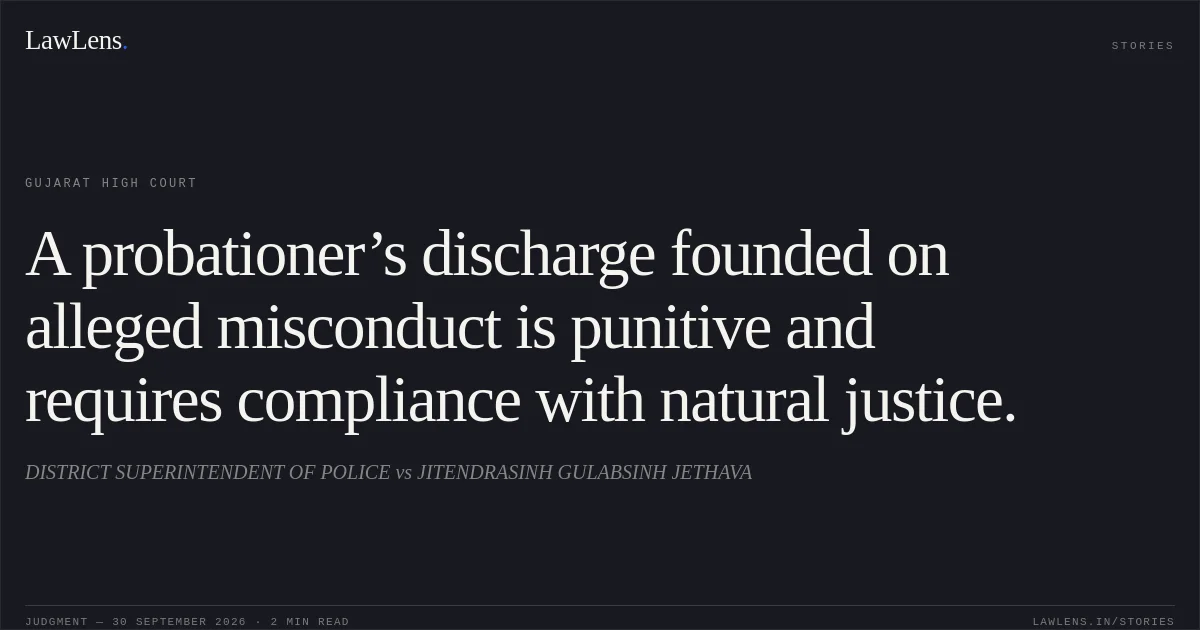
Source reference: paras. 18, 20–20.1A probationer’s service may be terminated for general unsuitability without an inquiry, but where alleged misconduct is the foundation of a stigmatic or punitive termination, the principles of natural justice must be observed.
Source reference: para. 14The Court relied on SBI v. Palak Modi, (2013) 3 SCC 607, for this distinction.
Source reference: para. 15Reasoning
The discharge order expressly relied on alleged misconduct at the training centre and the training-centre head’s recommendation, rather than merely on the plaintiff’s unsuitability or failure to complete training. The order was therefore stigmatic and punitive; because no notice or inquiry preceded it, the First Appellate Court was justified in setting it aside.
Source reference: paras. 16–17The State showed no basis for disturbing that factual conclusion under Section 100 CPC.
Source reference: paras. 18, 20–20.1On jurisdiction, the State identified no special tribunal with exclusive authority over the dispute, and the Trial Court’s finding that the Civil Court had jurisdiction had not been challenged before the First Appellate Court.
Source reference: para. 19Holding
The High Court answered the substantial questions against the appellants, holding that the First Appellate Court had properly set aside the discharge and related orders and that the Civil Court had jurisdiction.
The second appeal was dismissed; the appellate decree, including reinstatement with continuity of service but without back wages, was confirmed. No order as to costs was made.
Source reference: para. 22Acts & Sections Cited
1 provisions across 1 statute referred to in this judgment. Each provision opens on LawLens.
Code of Civil Procedure, 19081
Original Court PDF
DISTRICT SUPERINTENDENT OF POLICEvsJITENDRASINH GULABSINH JETHAVA
Click to open original judgment
Original judgment, available to read, download and summarize on LawLens.in