Facts
The petitioner sought anticipatory bail in FIR No. 110/2022, registered under Section 376 IPC and later supplemented by Sections 4 and 6 of the POCSO Act, in relation to an alleged sexual assault of a minor.
Source reference: paras. 1–3, pp. 1–2The charge-sheet was filed before the Principal Sessions Judge, Kathua, and the petitioner was declared a proclaimed offender; proceedings under Section 335 BNSS were also initiated.
Source reference: para. 5, p. 3The petitioner relied on inconsistencies in the prosecutrix’s identification of the offender and asserted that his residence outside the Union Territory justified approaching the High Court directly.
Source reference: paras. 6–7, pp. 3–4He had not first sought anticipatory bail from the Sessions Court.
Source reference: paras. 9, 12, pp. 4–5Issues
Whether the High Court should entertain the anticipatory-bail application directly, without the petitioner first approaching the Sessions Court, in the absence of a special circumstance.
Source reference: paras. 9–12, pp. 4–5Whether the petitioner’s proclaimed-offender status and the asserted discrepancy in the offender’s identity justified granting anticipatory bail.
Source reference: paras. 13–18, pp. 5–8Law Applied
The Court relied on Jagdeo Prasad v. State of Bihar, 2025 Online SC 2108, and Mohammed Rasal C. v. State of Kerala, 2025 SCC OnLine 2728, for the principle that although the High Court and Sessions Court have concurrent jurisdiction over anticipatory bail, an applicant should ordinarily approach the Sessions Court first; direct recourse to the High Court requires special circumstances.
Source reference: paras. 10–11, p. 4Applying Lavesh v. State (NCT of Delhi), (2012) 8 SCC 730; State of Madhya Pradesh v. Pradeep Sharma, (2014) 2 SCC 171; Prem Shankar Prasad v. State of Bihar, (2022) 14 SCC 516; and Srikant Upadhyay v. State of Bihar, 2024 INSC 202, the Court stated that a person who is absconding or declared a proclaimed offender is ordinarily not entitled to anticipatory bail, save in extreme exceptional circumstances.
Source reference: paras. 15–17, pp. 6–7Reasoning
The petitioner’s stated residence outside the Union Territory did not establish a special circumstance for bypassing the Sessions Court, particularly because he had not disclosed a different present address and had given his address as Village Kohag, District Kathua.
Source reference: para. 12, p. 5The Court also found that the Sessions Judge had declared him an absconder after considering investigation material, including police witnesses’ statements concerning search efforts and notices; his claim that he was unaware of the case was therefore not accepted.
Source reference: paras. 13–14, p. 5Finally, the variation between “Laddo” and “Ashok alias Laddo” in the prosecutrix’s accounts did not establish an exceptional basis for bail: witness statements recorded during the investigation identified the offender as Rajat alias Laddo, whose particulars matched the petitioner’s.
Source reference: para. 18, p. 8Holding
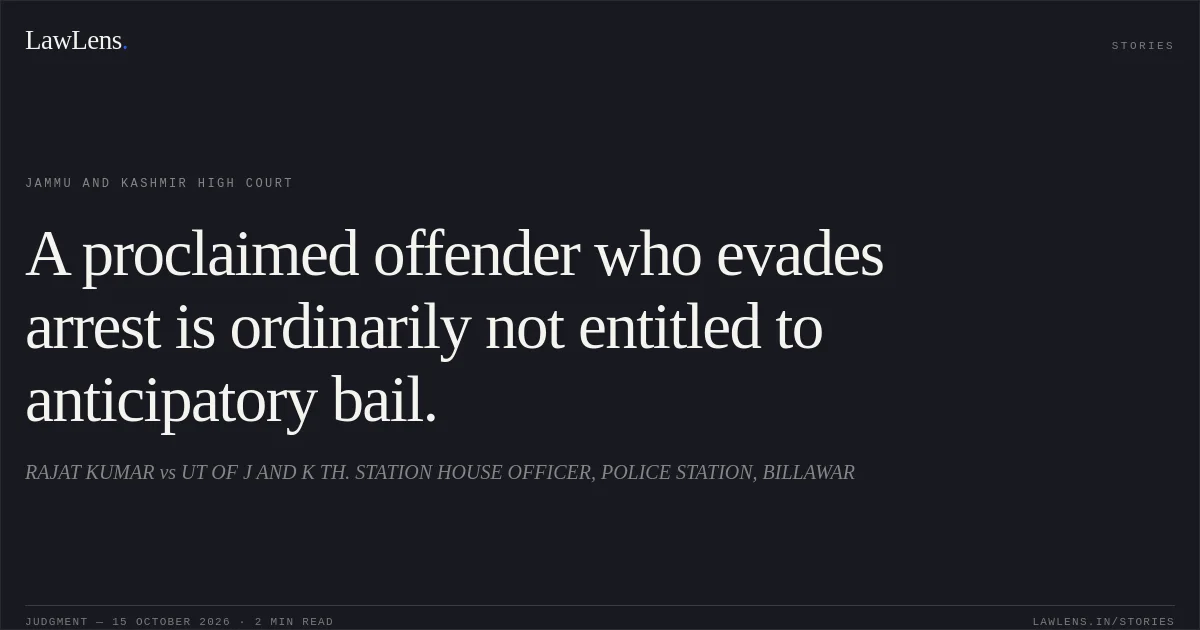
The High Court declined to entertain the application directly because no special circumstance justified bypassing the Sessions Court. It further held that the petitioner’s proclaimed-offender status, continued non-appearance, and the material identifying him as the alleged offender defeated his claim for anticipatory bail; the asserted identity discrepancy did not warrant exceptional relief.
The petition was dismissed.
Source reference: para. 19, p. 8Acts & Sections Cited
9 provisions across 4 statutes referred to in this judgment. Each provision opens on LawLens.
Indian Penal Code, 18601
Code of Criminal Procedure, 19735
Bharatiya Nagarik Suraksha Sanhita, 20231
Original Court PDF
RAJAT KUMARvsUT OF J AND K TH. STATION HOUSE OFFICER, POLICE STATION, BILLAWAR
Click to open original judgment
Original judgment, available to read, download and summarize on LawLens.in
![The competent authority must decide the appeal by a reasoned, speaking order within four weeks.. DR NISHANT GOYAL vs HEALTH. CAT - ['Delhi']. LawLens](/stories/thumbnails/the-competent-authority-must-decide-the-appeal-by-a-reasoned-speaking-order-within-four-we-51ef3c532385466483f4156703e7e0bc.webp)
![Competent authority must decide the pending representation by a reasoned order within four weeks.. AJAY YADAV vs MUNICIPAL CORPORATION OF DELHI (GNCTD). CAT - ['Delhi']. LawLens](/stories/thumbnails/competent-authority-must-decide-the-pending-representation-by-a-reasoned-order-within-four-1bec6310839148709c127f0a0c64e2b5.webp)
