Facts
The petitioners, Md. Kamil Khan and his father, Md. Arif Khan, sought quashing of G.R. Case No. 387 of 2023 arising from Newtown Police Station Case No. 25 of 2023, registered under Sections 376, 417, 313, 506 and 34 of the Indian Penal Code, and the subsequent charge-sheet under Sections 417, 376, 506 and 34 IPC.
Source reference: para. 1The de facto complainant alleged that she had been in a live-in relationship with petitioner no. 1 since 2020 and had cohabited with him from April to November 2022. She alleged that petitioner no. 1 repeatedly promised to marry her, that she became pregnant and was forced to undergo abortions, and that after she disclosed another pregnancy and insisted upon marriage, he left and ceased communication.
Source reference: para. 2The case diary indicated that the complainant was approximately 31 years old at the relevant time.
Source reference: para. 4The High Court noted that both parties were majors and had admittedly maintained a prolonged consensual physical relationship.
Source reference: paras. 5–6Issues
Whether the allegations, taken at their face value, disclosed the offence of rape under Section 376 IPC where the parties had maintained a prolonged consensual relationship and the alleged promise of marriage was not shown to have been false from its inception or to have directly caused the sexual relationship
Source reference: paras. 5–11Whether the allegations disclosed the offences under Sections 417, 313, 506 and 34 IPC against petitioner no. 1
Source reference: paras. 1–2, 11Whether petitioner no. 2 could be prosecuted on the allegation that he helped petitioner no. 1 conceal himself and threatened the complainant
Source reference: para. 12Whether continuation of the criminal proceedings would constitute an abuse of the process of court warranting exercise of the High Court’s quashing jurisdiction
Source reference: paras. 8–9, 13–14Law Applied
The Court considered Sections 376, 417, 313, 506 and 34 IPC and applied the principle that a promise to marry vitiates consent only where it was false from the inception, made in bad faith, and had a direct nexus with the woman’s decision to engage in the sexual act, as stated in Pramod Suryabhan Pawar v. State of Maharashtra and reiterated in Prashant v. State of NCT of Delhi.
Source reference: para. 9Relying on Mahesh Damu Khare v. State of Maharashtra, the Court held that a prolonged physical relationship, knowingly maintained by an adult woman, cannot ordinarily be treated as having been induced solely by an alleged promise of marriage unless a direct causal connection is established.
Source reference: para. 7The Court also relied on Samadhan v. State of Maharashtra, Rajnish Singh v. State of Uttar Pradesh, State of Haryana v. Bhajan Lal, Md. Wajid v. State of U.P., and State of Karnataka v. Muniswamy for the principles that consensual relationships cannot be retrospectively criminalised merely because marriage does not occur and that proceedings may be quashed where their continuation would amount to an abuse of process.
Source reference: paras. 8–9Reasoning
The Court found that the complainant was a major, approximately 31 years old, and had participated in a long-term live-in and physical relationship with petitioner no. 1.
Source reference: paras. 4–6Applying the rule in Pramod Suryabhan Pawar and Mahesh Damu Khare, it held that the materials did not establish that the alleged promise of marriage was false from the beginning or that the complainant’s consent was caused solely by that promise.
Source reference: paras. 7, 9–10The Court further observed that, according to the case diary, the complainant was aware that petitioner no. 1 was not interested in marrying her but nevertheless continued the relationship.
Source reference: para. 10Accordingly, the essential ingredients of rape and the connected offences were prima facie absent, and the breakdown of the relationship could not by itself convert a consensual relationship into a criminal offence.
Source reference: para. 11As against petitioner no. 2, the allegation that he helped his son hide from the complainant did not disclose the necessary ingredients of the offences charged.
Source reference: para. 12Holding
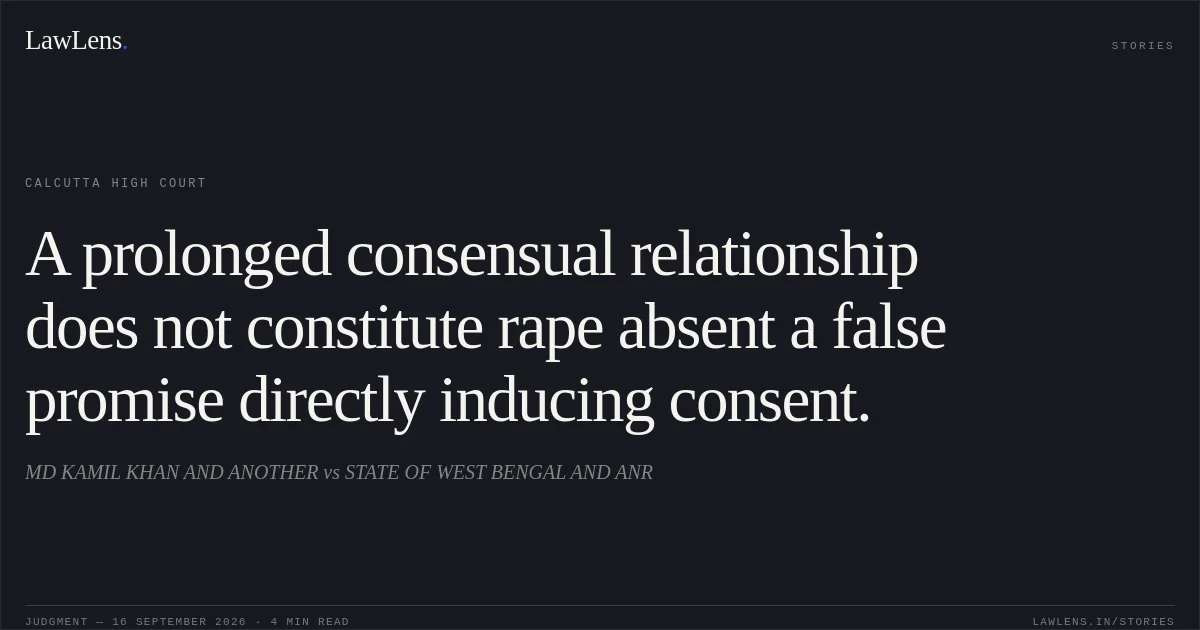
The High Court held that the relationship between the complainant and petitioner no. 1 was prima facie consensual and that the materials did not disclose the ingredients of the offences alleged against either petitioner.
The criminal revision was allowed, and the proceedings in G.R. Case No. 387 of 2023, arising from Newtown Police Station Case No. 25 of 2023, together with Charge-Sheet No. 110 of 2023, were quashed in respect of Md. Kamil Khan and Md. Arif Khan.
Source reference: paras. 13–14Connected applications were disposed of, any interim order was vacated, and the trial court was directed to be informed of the judgment.
Source reference: paras. 15–18Acts & Sections Cited
9 provisions across 2 statutes referred to in this judgment. Each provision opens on LawLens.
Indian Penal Code, 18607
Code of Criminal Procedure, 19732
Original Court PDF
MD KAMIL KHAN AND ANOTHERvsSTATE OF WEST BENGAL AND ANR
Click to open original judgment
Original judgment, available to read, download and summarize on LawLens.in