Facts
Respondent No. 2 lodged FIR No. 0169 of 2019 at Police Station Kotwali, Pithoragarh, alleging offences under Sections 312, 376 and 506 IPC.
Source reference: paras. 2–3She alleged that she and the applicant had been in a relationship since 2011–12, that the applicant established physical relations with her on the promise of marriage, that she became pregnant and was allegedly forced to abort, and that they married at Ulka Devi Temple, Pithoragarh, on 27 November 2019.
Source reference: paras. 2–3After investigation, the allegation under Section 312 IPC was not substantiated, but a charge-sheet was filed under Sections 376 and 506 IPC.
Source reference: para. 3The Chief Judicial Magistrate, Pithoragarh, took cognizance on 18 February 2020 in Criminal Case No. 331 of 2020.
Source reference: para. 3The applicant invoked Section 482 Cr.P.C. seeking quashing of the charge-sheet, cognizance order and entire criminal proceedings.
Source reference: para. 1Issues
1. Whether the allegations in the FIR and the material collected during investigation disclosed an offence under Section 376 IPC, particularly where the parties had maintained a long-standing relationship and claimed to have married?
Source reference: paras. 16–192. Whether continuation of the proceedings under Sections 376 and 506 IPC would amount to an abuse of the process of law warranting interference under Section 482 Cr.P.C.?
Source reference: paras. 20–21Law Applied
The Court applied Section 482 Cr.P.C., which empowers the High Court to quash criminal proceedings to prevent abuse of process or secure the ends of justice.
Source reference: paras. 5–6It considered Section 375 IPC and Exception 2, under which sexual intercourse or sexual acts by a man with his own wife, where the wife is not below eighteen years, do not constitute rape, as read down in Independent Thought v. Union of India, (2017) 10 SCC 800.
Source reference: paras. 5–6The Court relied on the principle that consensual sexual relations pursuant to a promise to marry constitute rape only where the promise was false from its inception, was made solely to obtain sexual consent, and directly caused the woman’s consent, as stated in Jaspal Singh Kaural v. State of NCT of Delhi, (2025) 5 SCC 756.
Source reference: para. 11It also relied on Ravish Singh Rana v. State of Uttarakhand, 2025 SCC OnLine SC 1055, concerning the inference of valid consent from a prolonged relationship, and on the coordinate Bench decisions in Dr. Kirti Bhushan Mishra v. State of Uttarakhand and Sachin Kumar Singh Chauhan v. State of Uttarakhand regarding consensual relationships and the abuse of criminal process.
Source reference: paras. 5–7, 17–20Reasoning
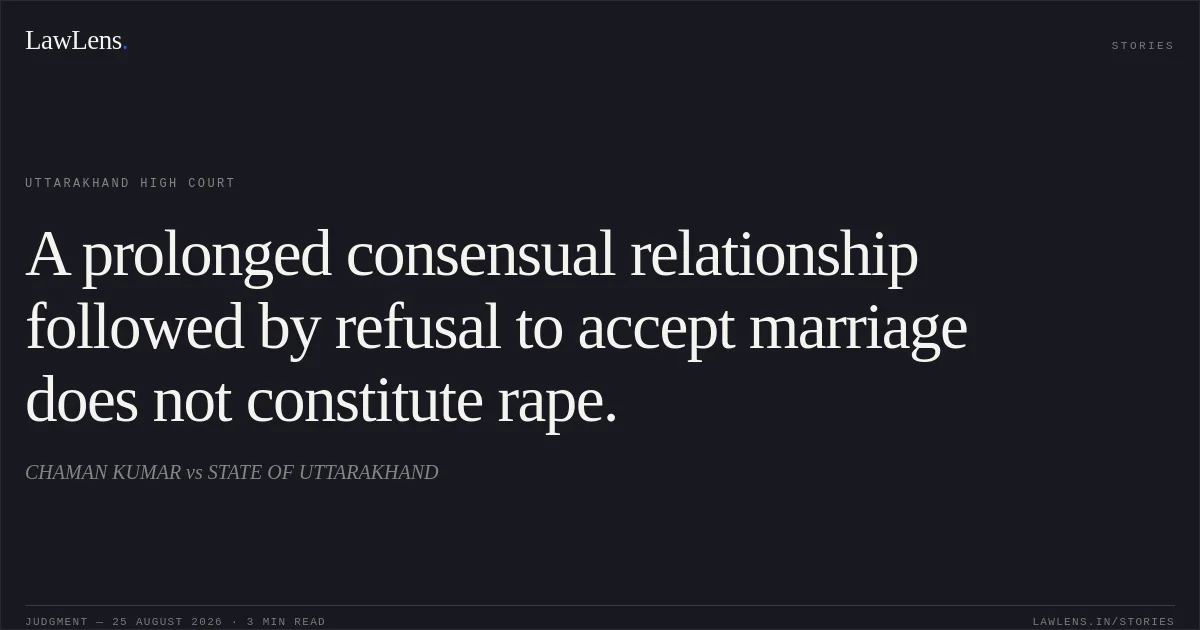
The Court found that the FIR itself described an eight-year love relationship, repeated physical relations at different places and times, and the parties’ marriage on 27 November 2019.
Source reference: paras. 16, 18–19It held that, if the complainant’s assertion that the applicant was her husband was accepted, Exception 2 to Section 375 IPC would operate; conversely, even if the alleged marriage was not recognised, the admitted long-standing relationship and repeated consensual intimacy indicated valid consent rather than consent obtained through a false promise made from the outset.
Source reference: paras. 17–19The complainant was treated as a mature woman aware of the consequences of the relationship, and the Court considered the FIR to have been lodged only after the applicant allegedly declined to accept her as his wife.
Source reference: paras. 18–19Applying the principles governing false promises of marriage and the High Court’s inherent jurisdiction, the Court concluded that the essential ingredients of rape were not apparent even from the FIR and that continuation of the prosecution would constitute an abuse of process.
Source reference: para. 20Holding
The Court answered the issues in favour of the applicant and held that the offence under Section 376 IPC was not made out on the admitted facts and allegations.
In exercise of its powers under Section 482 Cr.P.C., it quashed the charge-sheet under Sections 376 and 506 IPC, the cognizance order dated 18 February 2020, and the entire proceedings in Criminal Case No. 331 of 2020, State v. Chaman Kumar, pending before the Chief Judicial Magistrate, Pithoragarh.
Source reference: paras. 20–22The criminal miscellaneous application was accordingly allowed.
Source reference: para. 22Acts & Sections Cited
9 provisions across 2 statutes referred to in this judgment. Each provision opens on LawLens.
Code of Criminal Procedure, 19732
Indian Penal Code, 18607
Original Court PDF
CHAMAN KUMARvsSTATE OF UTTARAKHAND
Click to open original judgment
Original judgment, available to read, download and summarize on LawLens.in