Facts
The complainant alleged that, from 2006 to February 2009, accused No. 1 induced her to believe they were lawfully married by obtaining her signature on a blank form represented as a marriage-registration form.
Source reference: para. 4–5She said they lived together and had sexual relations on that basis, and that his parents and brother later threatened her when she objected to his engagement to another woman.
Source reference: para. 4–5She lodged an FIR on 3 April 2009; the accused were charged under Sections 493, 506(2), and 376 read with Section 114 of the IPC.
Source reference: para. 4–5The Sessions Court acquitted them, finding the relationship consensual and the charges unproved beyond reasonable doubt.
Source reference: para. 8–9The complainant appealed under Section 413 of the Bharatiya Nagarik Suraksha Sanhita, 2023.
Source reference: para. 1–2Issues
1. Whether the Sessions Court was justified in acquitting the accused, or whether the acquittal disclosed perversity or another basis for appellate interference.
Source reference: para. 15, 172. Whether the evidence established that accused No. 1 deceived the complainant into believing she was lawfully married to him, or made a false promise of marriage from the outset to obtain her consent to sexual relations.
Source reference: para. 18–20Law Applied
Under Section 493 IPC, the prosecution must prove that the accused practised deceit, thereby induced a woman who was not his wife to believe she was lawfully married to him, and that she consequently cohabited or had sexual intercourse with him.
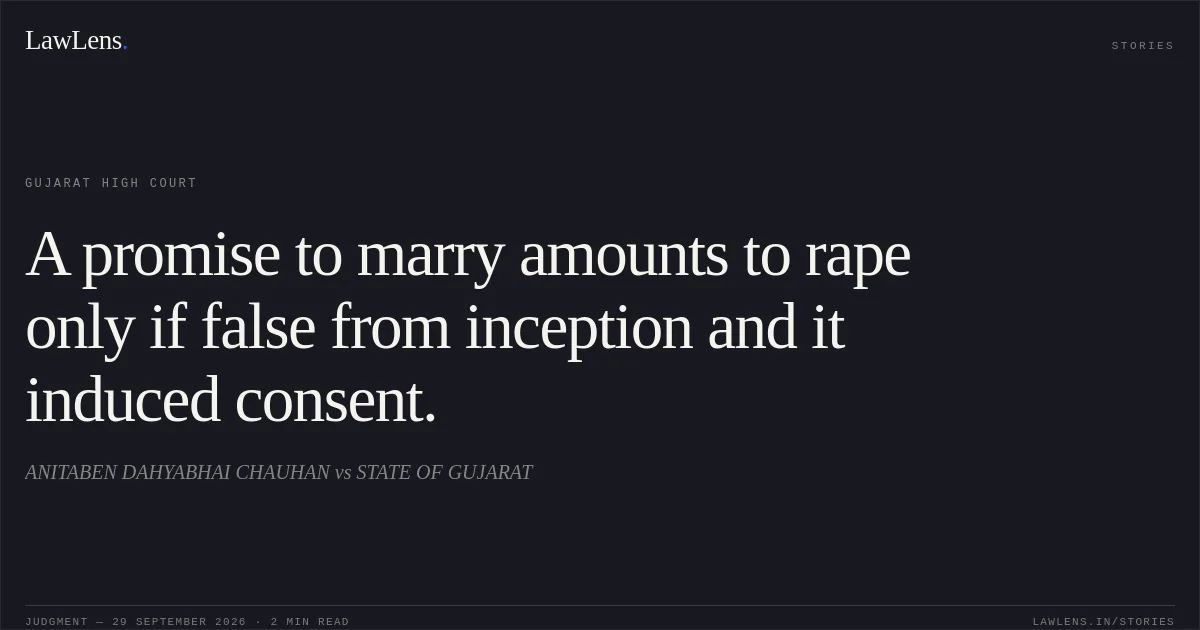
Source reference: para. 19For rape on the basis of a false promise of marriage, the promise must have been false from the beginning, made without intent to fulfil it, and have directly influenced the complainant’s consent; a sexual relationship pursuant to a promise to marry does not, by itself, constitute rape.
Source reference: para. 20; Pramodkumar Navratna v. State of Chhattisgarh, 2026 INSC 124A consensual relationship ending without marriage does not alone justify criminal proceedings.
Source reference: para. 21; Prasant v. State of NCT of Delhi, 2025 (5) SCC 764In an appeal against acquittal, the appellate court should respect the reinforced presumption of innocence and interfere only where compelling circumstances, including perversity, justify it; where another view is reasonably possible, it should not interfere routinely.
Source reference: para. 17Reasoning
The Court found no reliable supporting evidence that the parties had stayed together at hotels or rented premises, or that the complainant had been introduced there as the accused’s wife; the investigation had not obtained hotel records, rental documents, or statements from the landlords.
Source reference: para. 19It therefore upheld the finding that deceit and induced belief of lawful marriage were not proved.
Source reference: para. 19On the rape charge, the evidence did not establish that the promise or representation of marriage was false from the outset; the record instead supported the Trial Court’s finding of a consensual relationship.
Source reference: para. 20Applying the restrictive standard for appeals against acquittal, the Court found no perversity or compelling reason to disturb the Trial Court’s conclusions.
Source reference: para. 17, 22–23Holding
The High Court held that the prosecution had failed to prove the charged offences beyond reasonable doubt and that the acquittal disclosed no perversity warranting appellate interference.
The appeal was dismissed at the admission stage.
Source reference: para. 24Acts & Sections Cited
8 provisions across 3 statutes referred to in this judgment. Each provision opens on LawLens.
Bharatiya Nagarik Suraksha Sanhita, 20231
Code of Criminal Procedure, 19732
Indian Penal Code, 18605
Original Court PDF
ANITABEN DAHYABHAI CHAUHANvsSTATE OF GUJARAT
Click to open original judgment
Original judgment, available to read, download and summarize on LawLens.in