Facts
The complainant–victim alleged that the accused contacted her through Facebook/Instagram in March 2023, developed a relationship with her, and repeatedly had sexual intercourse with her between 27 July 2023 and 23 March 2024 on the promise of marriage. She alleged that he subsequently refused to marry her because she was a divorcee with two minor children.
Source reference: para. 4, p. 2An FIR was registered at Atladara Police Station for offences under Sections 406 and 376(2)(N) of the IPC, and the accused was prosecuted for offences under Sections 323, 294(B), 406 and 376(2)(N) of the IPC.
Source reference: para. 4, p. 2The Sessions Court examined seven prosecution witnesses and relied upon documents including the FIR, the victim’s Section 164 statement, medical certificates, call-detail records and forensic evidence.
Source reference: para. 6, p. 2By judgment dated 5 May 2026, the Sessions Court acquitted the accused, holding that the relationship was consensual and that the prosecution was a counterblast to a prior complaint lodged by the accused against the victim.
Source reference: paras. 8, 14, p. 3 and p. 5The victim preferred the present appeal against acquittal under Section 413 of the Bharatiya Nagarik Suraksha Sanhita, 2023, corresponding to Section 372 of the CrPC.
Source reference: para. 1, p. 1Issues
1. Whether the Sessions Court was justified in acquitting the accused of the offences under Sections 323, 294(B), 406 and 376(2)(N) of the IPC?
Source reference: para. 12, p. 42. Whether the evidence established that the victim’s consent to sexual relations was obtained through a false promise of marriage, thereby constituting rape under Section 375/Section 376(2)(N) of the IPC, rather than a consensual relationship?
Source reference: paras. 17–19, pp. 6–73. Whether the appellate court should interfere with the judgment of acquittal in the absence of perversity, substantial grounds or compelling circumstances?
Source reference: para. 15, p. 5Law Applied
The Court applied Section 413 of the Bharatiya Nagarik Suraksha Sanhita, 2023, corresponding to the victim’s statutory right of appeal against acquittal under Section 372 of the CrPC.
Source reference: para. 1, p. 1It reiterated that an appellate court ordinarily exercises restraint while reviewing an acquittal because the acquittal reinforces the accused’s presumption of innocence; interference is justified only where there are compelling reasons or the judgment is perverse, and not merely because another view is possible.
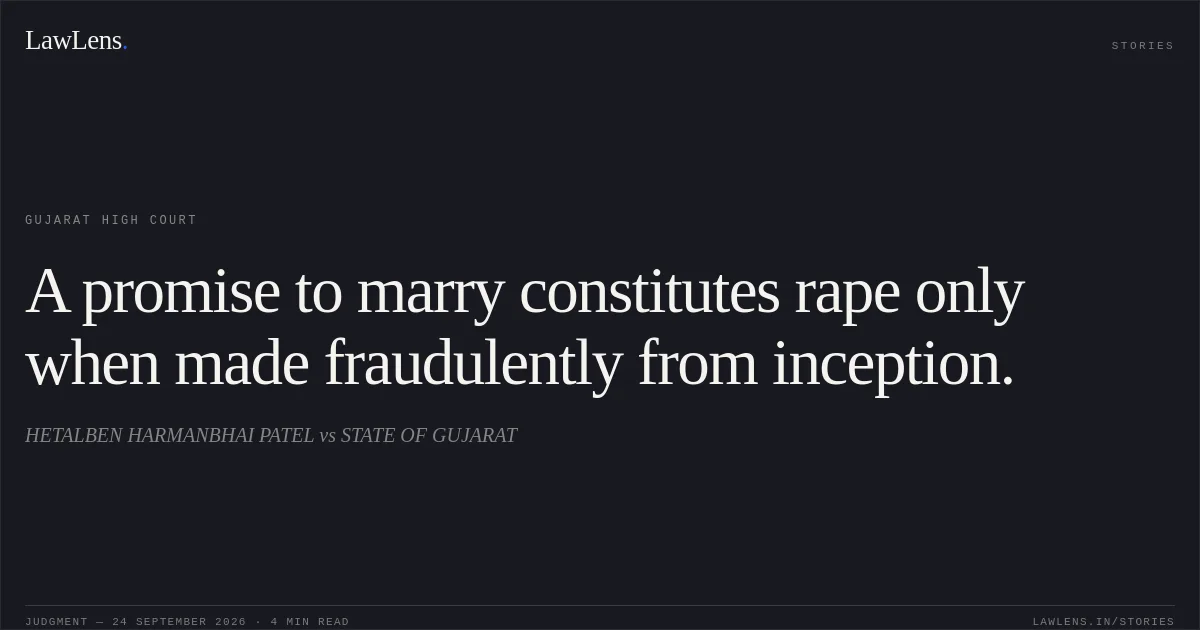
Source reference: para. 15, p. 5On the substantive offence, the Court relied on Pramodkumar Navratna v. State of Chhattisgarh, 2026 INSC 124, for the principle that consensual sexual relations following a promise to marry constitute rape only where the promise was false from the inception, was made solely to obtain sexual consent, and directly influenced the complainant’s consent.
Source reference: para. 17, p. 6It also referred to Prasant v. State of NCT of Delhi, 2025 (5) SCC 764, and Samadhan v. State of Maharashtra, 2025 SCC OnLine 2528, for the principle that a mere breakdown of a consensual relationship does not ordinarily constitute rape and that the offence should not be invoked absent genuine sexual violence, coercion or lack of consent.
Source reference: para. 18, p. 6Reasoning
The High Court found no perversity in the Sessions Court’s assessment of the evidence.
Source reference: paras. 14, 17, pp. 5–6The victim was an adult of approximately 40–41 years, had two minor children, and had continued the relationship with the accused for about a year while he visited her residence.
Source reference: paras. 14, 17, pp. 5–6The Court considered significant that the accused had lodged a prior complaint against the victim and that the present FIR followed the recording of her statement in that proceeding, supporting the finding that the prosecution was a counterblast arising from a subsequently strained relationship.
Source reference: paras. 17–19, pp. 6–7The Court further noted that the victim had not obtained a divorce from her husband, maintained the relationship openly, and that the alleged promise of marriage was not shown to have been made with no intention of fulfilment from the outset.
Source reference: para. 18, p. 6The medical evidence did not establish the alleged hearing loss or an injury caused by the accused.
Source reference: para. 16, p. 5Applying the rule that a subsequent refusal or failure to marry does not retrospectively convert consensual sexual relations into rape, the Court held that the prosecution failed to prove absence of free consent or a fraudulent promise of marriage beyond reasonable doubt.
Source reference: paras. 17–19, pp. 6–7Holding
The High Court answered the issues against the appellant.
It held that the relationship was consensual, that the prosecution failed to establish that the accused had made a false promise of marriage from the inception to obtain sexual relations, and that the Sessions Court’s acquittal was neither perverse nor legally unsustainable.
Source reference: paras. 18–20, pp. 6–7Finding no substantial or compelling reason to interfere, the Court dismissed the victim’s appeal at the admission stage and affirmed the acquittal of the accused.
Source reference: para. 21, p. 8Acts & Sections Cited
9 provisions across 3 statutes referred to in this judgment. Each provision opens on LawLens.
Bharatiya Nagarik Suraksha Sanhita, 20231
Code of Criminal Procedure, 19733
Indian Penal Code, 18605
Original Court PDF
HETALBEN HARMANBHAI PATELvsSTATE OF GUJARAT
Click to open original judgment
Original judgment, available to read, download and summarize on LawLens.in