Facts
The petitioners challenged private complaints referred to the police under Section 156(3) of the Code of Criminal Procedure (CrPC), and the resulting proceedings, alleging that the complaints arose from business transactions involving dishonoured cheques.
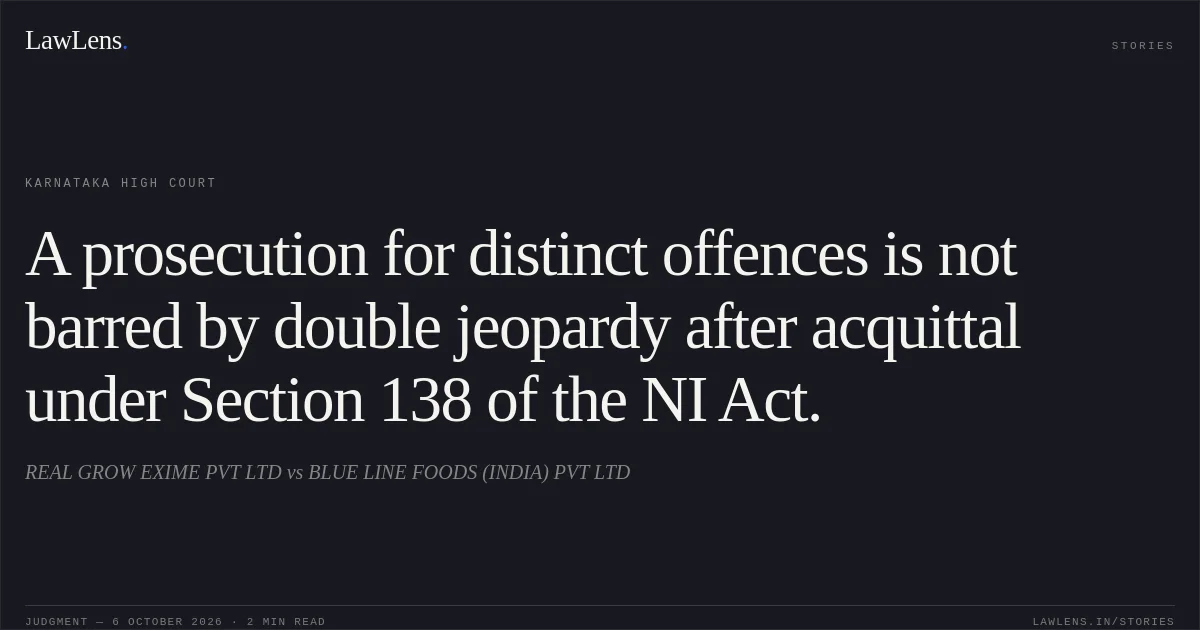
Source reference: no citationThe petitioners had been acquitted in prosecutions under Section 138 of the Negotiable Instruments Act, 1881, and argued that the later proceedings on the same facts amounted to double jeopardy.
Source reference: no citationThey also contended that the complainant had not filed the affidavit contemplated in Priyanka Srivastava v. State of Uttar Pradesh.
Source reference: p. 7–8The police had investigated and filed charge sheets, and the cases were pending before the trial court.
Source reference: p. 7Issues
Whether the private complaints and resulting proceedings were barred as double jeopardy because the petitioners had been acquitted of offences under Section 138 of the Negotiable Instruments Act
Source reference: p. 7; p. 9Whether the referral of the complaints for investigation under Section 156(3) CrPC was invalid because the complainant had not filed an affidavit as discussed in Priyanka Srivastava
Source reference: p. 8–9Law Applied
Section 156(3) CrPC permits a Magistrate to refer a complaint to the police for investigation.
Source reference: no citationIn Priyanka Srivastava v. State of Uttar Pradesh, (2015) 6 SCC 287, the Supreme Court addressed the filing of an affidavit with an application seeking such a referral, to ensure responsibility for allegations made.
Source reference: no citationAn acquittal under Section 138 of the Negotiable Instruments Act does not, by itself, bar proceedings alleging a distinct and separate offence on the relevant facts.
Source reference: p. 8–9Reasoning
The Court found that the charge-sheet material alleged a distinct and separate offence, so the acquittal under Section 138 did not make the pending proceedings double jeopardy.
Source reference: p. 9On the affidavit objection, it noted that the Magistrate had referred the complaints to the police under Section 156(3) CrPC and treated the affidavit requirement as serving to make the complainant more responsible for the complaint.
Source reference: p. 9–10It further observed that the complainant could be held responsible for malicious prosecution if the petitioners succeeded in the pending cases.
Source reference: p. 9–10The Court considered that the petitioners could pursue discharge or raise their defences before the trial court.
Source reference: p. 9Holding
The Court dismissed both petitions, finding no merit in the grounds advanced.
It left the petitioners’ available defences open, including the right to seek discharge by an appropriate application before the trial court.
Source reference: p. 10Acts & Sections Cited
3 provisions across 2 statutes referred to in this judgment. Each provision opens on LawLens.
Code of Criminal Procedure, 19732
Negotiable Instruments Act, 18811
Original Court PDF
REAL GROW EXIME PVT LTDvsBLUE LINE FOODS (INDIA) PVT LTD
Click to open original judgment
Original judgment, available to read, download and summarize on LawLens.in