Facts
The appellant was prosecuted under Sections 376, 448 and 506 of the Indian Penal Code for allegedly entering the victim’s house on the night of 20 August 2014, restraining and threatening her, committing rape against her will, and thereafter fleeing when she raised an alarm.
Source reference: no citationThe victim lodged a written complaint the following day, and an FIR was registered; the appellant was arrested and charge-sheeted.
Source reference: no citationThe prosecution examined 11 witnesses, including the victim and her mother-in-law, while the defence consisted of denial and an allegation that the appellant had been falsely implicated due to a monetary dispute arising from his work as a carpenter for the victim’s husband.
Source reference: paras. 5–6The Trial Court convicted the appellant under Sections 376, 448 and 506 IPC and sentenced him, inter alia, to seven years’ rigorous imprisonment and a fine of ₹10,000 for the offence under Section 376 IPC.
Source reference: para. 6The appellant challenged the conviction, principally contending that the victim’s testimony was unreliable, that the medical evidence disclosed no injuries, and that the supporting witnesses had not seen the alleged rape.
Source reference: para. 1Issues
1. Whether the conviction for rape could be sustained principally on the uncorroborated testimony of the prosecutrix, in the absence of injuries on her private parts.
Source reference: paras. 7–92. Whether the alleged inconsistencies concerning lighting, the eyesight and investigation of PW 2, and the possibility of false implication due to a monetary dispute created reasonable doubt regarding the prosecution case.
Source reference: paras. 1, 7–93. Whether the convictions under Sections 376, 448 and 506 IPC suffered from perversity or any other legal infirmity warranting appellate interference.
Source reference: paras. 6, 9Law Applied
The Court applied Sections 376, 448 and 506 IPC concerning rape, house-trespass and criminal intimidation, respectively, and considered the victim’s statement recorded under Section 164 CrPC.
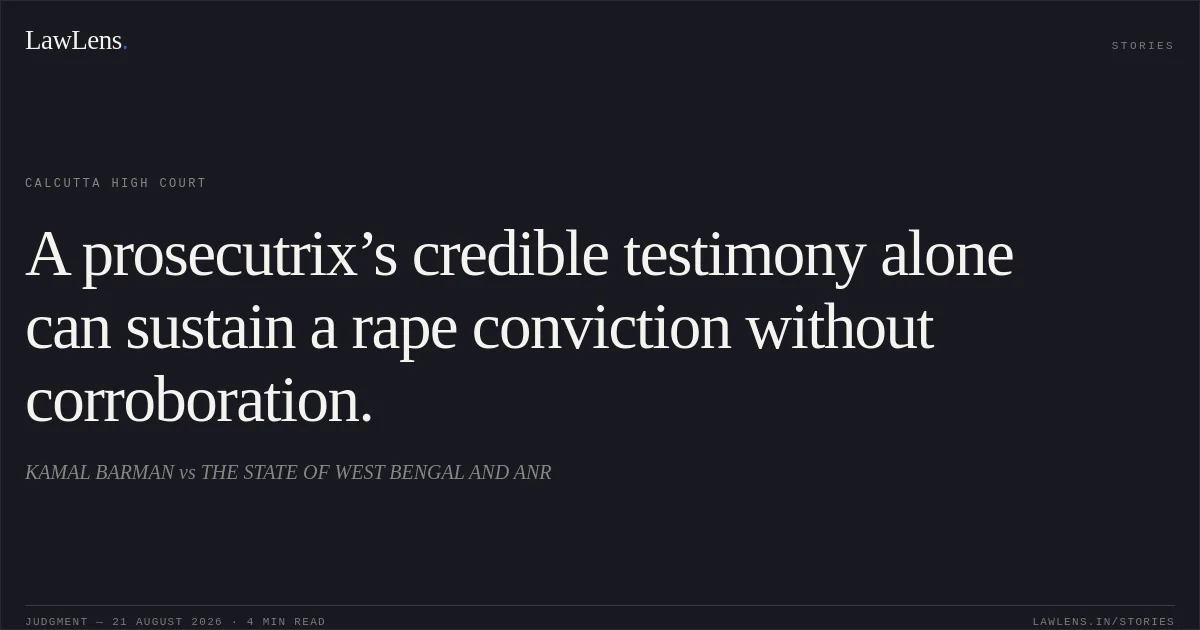
Source reference: para. 8It relied on the settled principle that the credible and trustworthy testimony of a prosecutrix can, by itself, sustain a conviction for rape and does not require corroboration as an inflexible rule; corroborative evidence merely lends additional assurance.
Source reference: paras. 3–4, 8Relying on State of Rajasthan v. Babu Mina, (2013) 4 SCC 206, the Court held that conviction on the sole testimony of the prosecutrix is permissible where that testimony is creditworthy and reliable.
Source reference: para. 8It also applied the principle, recognised in the precedent cited by the Trial Court, that the absence of injuries on the victim’s private parts neither disproves rape nor establishes consent, and that the doctor’s failure to find evidence of forceful intercourse is not by itself sufficient to reject the victim’s testimony.
Source reference: para. 8The Court further referred to Ram Singh v. State of Himachal Pradesh, 2026 INSC 830, for the requirement that the entire prosecution evidence be assessed before reaching a conclusion, and to State of Himachal Pradesh v. Hakimchand alias Manu, 2026 INSC 290, regarding the sufficiency of the prosecutrix’s credible evidence.
Source reference: paras. 2, 4, 8Reasoning
The Court found that the victim gave a consistent account of the appellant’s presence in the house, his restraint and threats, and the commission of rape, both in her testimony before the Trial Court and in her statement under Section 164 CrPC.
Source reference: paras. 7–8Her prompt lodging of the FIR on the following day, the supporting evidence of her mother-in-law, and the absence of any established motive for false implication strengthened the prosecution case.
Source reference: para. 9The Court rejected the argument based on the absence of injuries, observing that the victim was a mother of three children and that the absence of physical injuries does not negate non-consensual sexual intercourse.
Source reference: para. 8The objections relating to PW 2’s non-examination during investigation, her eyesight and the alleged inconsistency regarding lighting were not considered sufficient to discredit the victim’s evidence or render the Trial Court’s appreciation perverse.
Source reference: paras. 1, 9The defence suggestion of a monetary dispute was not substantiated, and the appellant’s prior acquaintance and access to the household did not furnish a credible basis for false implication.
Source reference: para. 9Accordingly, applying the rule that reliable testimony of the prosecutrix is sufficient for conviction, the Court found no perversity or legal infirmity in the Trial Court’s judgment.
Source reference: para. 9Holding
The Court answered the issues against the appellant and held that the victim’s testimony was trustworthy and sufficient to establish the offence of rape, notwithstanding the absence of injuries or independent eyewitnesses.
It found no ground to interfere with the convictions under Sections 376, 448 and 506 IPC and affirmed the judgment and order dated 25/28 September 2020 passed by the Additional Sessions Judge, Mathabhanga, Cooch Behar.
Source reference: para. 9As the appellant was on bail, he was directed to surrender before the Trial Court within one month to serve the sentence; failing surrender, the Trial Court was directed to issue a warrant of arrest and commit him to the concerned correctional home.
Source reference: para. 10Acts & Sections Cited
5 provisions across 2 statutes referred to in this judgment. Each provision opens on LawLens.
Indian Penal Code, 18603
Code of Criminal Procedure, 19732
Original Court PDF
KAMAL BARMANvsTHE STATE OF WEST BENGAL AND ANR
Click to open original judgment
Original judgment, available to read, download and summarize on LawLens.in