Facts
The appellant, then Sub-Registrar at Durg, was convicted under Section 13(1)(d) read with Section 13(2) of the Prevention of Corruption Act, 1988, and Sections 420 and 120-B IPC, for registering sale deeds executed by Nirmala Devi Agrawal under a power of attorney made in Pennsylvania, allegedly without proper Indian stamp duty.
Source reference: para. 1, 3–4, 11The prosecution alleged that this caused the State a loss of ₹6,08,115.
Source reference: para. 1, 3–4, 11The Collector of Stamps had ordered recovery of additional duty from Nirmala Agrawal, but the Board of Revenue set that order aside.
Source reference: para. 12, 22, 32Netam died while his appeal was pending; his wife was granted leave under Section 394(2) CrPC to continue it.
Source reference: para. 2Issues
Whether the evidence proved that Netam committed criminal misconduct under Section 13(1)(d) read with Section 13(2) of the Prevention of Corruption Act, rather than merely an administrative or procedural lapse
Source reference: para. 26–30, 42Whether the evidence established the ingredients of cheating under Section 420 IPC and criminal conspiracy under Section 120-B IPC
Source reference: para. 37–40, 43Law Applied
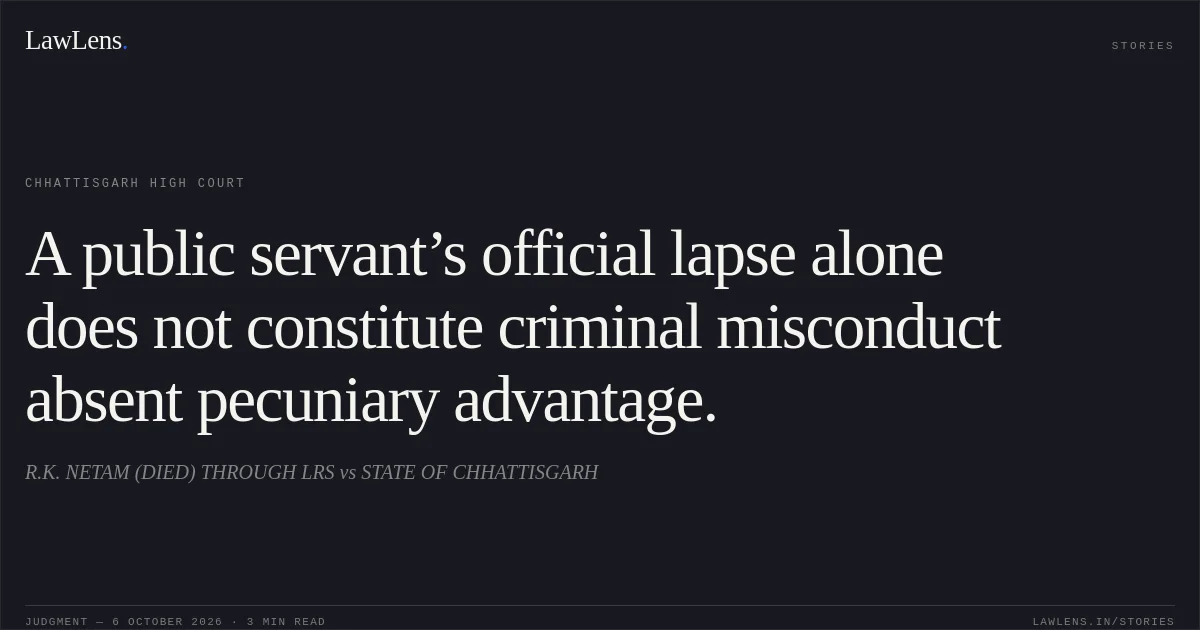
Section 13(1)(d) of the Prevention of Corruption Act, 1988, as applicable to the case, required proof of the statutory elements of criminal misconduct, including the relevant abuse of official position and obtaining of a valuable thing or pecuniary advantage; an official irregularity alone was insufficient.
Source reference: para. 28–30In A. Sivaprakash v. State of Kerala, (2016) 12 SCC 273, the Supreme Court explained that abuse of position and the resulting obtainment of a valuable thing or pecuniary advantage must be proved.
Source reference: para. 29C.K. Damodaran Nair v. Government of India, (1997) 9 SCC 477, addressed “obtainment” and the requirement to prove that the advantage was obtained by corrupt or illegal means or abuse of office.
Source reference: para. 31Cheating under Section 420 IPC requires deception, dishonest or fraudulent inducement, and the requisite dishonest intention; V.Y. Jose v. State of Gujarat, (2009) 3 SCC 78, states that such intention must exist at the inception of the transaction.
Source reference: para. 37Criminal conspiracy under Section 120-B IPC requires proof of an agreement or meeting of minds to commit an illegal act or a legal act by illegal means.
Source reference: para. 39–40C. Chenga Reddy v. State of A.P., (1996) 10 SCC 193, establishes that procedural or departmental irregularities and suspicion, without proof beyond reasonable doubt, do not establish criminal guilt.
Source reference: para. 35–36, 44Reasoning
The Court found no evidence that Netam demanded or received money, obtained a pecuniary benefit, or knowingly registered the deeds as part of a corrupt arrangement; any failure to scrutinise the power of attorney more closely could, at most, amount to an official lapse.
Source reference: para. 27, 30, 34–36The alleged stamp-duty loss was also uncertain because the Collector’s recovery order had been set aside by the Board of Revenue.
Source reference: para. 32–33The investigation had not seized the original power of attorney or recorded statements from the landowner and other material witnesses, while a key complainant admitted that he had not seen the document and could not establish the actual loss.
Source reference: para. 41The evidence did not show that Netam deceived or dishonestly induced anyone, or that he had reached an agreement with Nirmala Agrawal to commit an offence; registration of the deeds alone could not establish cheating or conspiracy.
Source reference: para. 38–40Holding
The Court held that the prosecution had not proved the charges beyond reasonable doubt.
It allowed the appeal, set aside Netam’s conviction and sentences, and acquitted him of all offences.
Source reference: para. 45–47Acts & Sections Cited
9 provisions across 4 statutes referred to in this judgment. Each provision opens on LawLens.
Code of Criminal Procedure, 19734
Prevention of Corruption Act, 19881
Indian Penal Code, 18602
Indian Stamp Act, 18992
Original Court PDF
R.K. NETAM (DIED) THROUGH LRSvsSTATE OF CHHATTISGARH
Click to open original judgment
Original judgment, available to read, download and summarize on LawLens.in