Facts
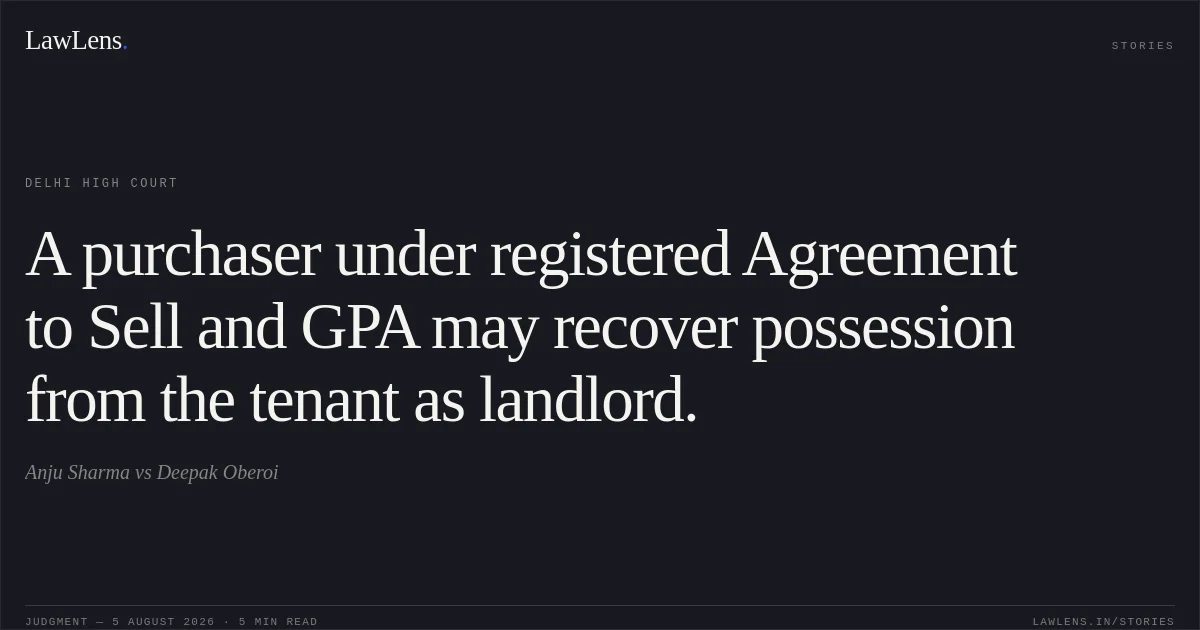
The suit property, bearing No. 4/19, West Patel Nagar, New Delhi, originally belonged to Ram Nath Nijhawan under a registered perpetual lease deed. After the deaths of Ram Nath Nijhawan, his wife Basanti Devi and their son Yogesh Kumar Nijhawan, ownership devolved upon the two surviving daughters, Suraksha Malik and Sanjokta Vij. Sanjokta executed a registered relinquishment deed in favour of Suraksha, who was thereafter treated as the exclusive owner. Suraksha transferred the property to Anju Sharma through registered Agreement to Sell, GPA, Will and related documents dated 21 March 2005.
Source reference: paras. 3–6, 57–64Deepak Oberoi had been inducted as a tenant by Yogesh Kumar Nijhawan and admitted the tenancy and last-paid rent of ₹3,000 per month under the lease dated 1 October 1996. Sharma served notices dated 27 July 2009 and 31 July 2012, enhancing the rent under Section 6A of the Delhi Rent Control Act and terminating the tenancy. She thereafter filed a suit for possession, arrears of rent, damages and mesne profits.
Source reference: paras. 6, 7–9, 26, 58, 79–80Oberoi challenged Sharma’s title, alleged fabrication of the title documents, pleaded non-joinder and limitation, and claimed that he had acquired title by adverse possession after expiry of the lease in 1997. The District Court dismissed the suit, holding that Sharma had not established ownership and was not entitled to rent or mesne profits. Sharma preferred the present first appeal under Section 96 read with Order XLI CPC.
Source reference: paras. 1, 10–30, 40–42Issues
Whether the appellant, on the basis of the registered Agreement to Sell, GPA, Will and related documents, had sufficient proprietary and landlordship rights to maintain the suit for possession against the respondent-tenant?
Source reference: paras. 56–78Whether the respondent could challenge the appellant’s title despite having entered the premises as a tenant under the erstwhile owner?
Source reference: paras. 79–81Whether the respondent had perfected title to the suit property by adverse possession after the expiry of the lease in 1997?
Source reference: paras. 82–91Whether the appellant was entitled to arrears of rent, and if so, at what rate and for what period?
Source reference: paras. 92–97Whether the appellant was entitled to mesne profits or user and occupation charges after termination of the tenancy, and at what rate?
Source reference: paras. 98–114Law Applied
The Court applied Section 108 of the Evidence Act concerning the presumption of death of a person not heard of for seven years.
Source reference: para. 57Section 116 of the Evidence Act embodying tenant estoppel against denial of the landlord’s title at the commencement of tenancy.
Source reference: para. 80Sections 6A and 14 of the Delhi Rent Control Act concerning enhancement of rent and the consequences of rent exceeding the statutory threshold.
Source reference: paras. 7–9, 94–97Under Section 54 of the Transfer of Property Act, an Agreement to Sell does not by itself convey absolute title; however, relying on Suraj Lamp & Industries Pvt. Ltd. v. State of Haryana, the Court held that registered transfer documents may confer proprietary and possessory rights superior to those of a tenant, particularly where the transferee is authorised to collect rent and seek eviction.
Source reference: paras. 65–69, 75Section 109 of the Transfer of Property Act recognises the transferee-landlord’s entitlement to the rights of the predecessor landlord.
Source reference: para. 50A plea of adverse possession requires clear proof of actual, open, continuous, exclusive and hostile possession for the statutory period, satisfying nec vi, nec clam, nec precario, as explained in Konda Lakshmana Bapuji v. Government of A.P., Karnataka Board of Wakf v. Government of India, Ravinder Kaur Grewal v. Manjit Kaur and M.R. Sawhney v. Doris Randhawa.
Source reference: paras. 84–88Mesne profits are governed by Section 2(12) CPC and represent compensation for wrongful possession; their assessment may be based on prevailing market rent or, absent evidence, the last contractual rent with a reasonable enhancement, in accordance with Sections 73–74 of the Contract Act and Atma Ram Properties v. Federal Motors and M/s Sahara India v. M.C. Agrawal HUF.
Source reference: paras. 98–110Reasoning
The Court found that the registered relinquishment deed in favour of Suraksha had not been challenged by Sanjokta and was supported by mutation records, establishing Suraksha’s ownership for the purposes of the dispute.
Source reference: paras. 59–61The registered Agreement to Sell, GPA, Will and related documents executed in favour of Sharma, particularly the GPA’s express authority to collect rent and evict tenants, placed Sharma in the position of the erstwhile landlord and gave her a title superior to that of Oberoi, even though the documents did not constitute an absolute conveyance under Section 54 TPA.
Source reference: paras. 64–78The alleged error in the date of the attornment letter did not invalidate the underlying registered transaction.
Source reference: paras. 70–74Since Oberoi admitted induction as a tenant by Yogesh, he was estopped under Section 116 of the Evidence Act from disputing the landlord’s title and could not convert permissive possession into adverse possession merely because the lease had expired.
Source reference: paras. 79–90His replies to the legal notices continued to acknowledge the tenancy and contained no clear assertion of hostile ownership. The Court therefore rejected the adverse-possession defence.
Source reference: paras. 89–91The rent was validly enhanced from ₹3,000 to ₹3,300 and subsequently to ₹3,630 per month under the notices. Applying the three-year limitation period, the Court awarded arrears from November 2009 to August 2012, totalling ₹1,12,200, with 6% interest.
Source reference: paras. 94–97After termination of tenancy, Oberoi became an unauthorised occupant. Since Sharma produced no reliable evidence of the prevailing market rent or of the claimed ₹40,000 monthly damages, the Court adopted the last rent of ₹3,630 per month and granted a 15% annual enhancement as mesne profits.
Source reference: paras. 106–114Holding
The appeal was allowed and the District Court’s judgment and decree dated 13 May 2024 were set aside.
The High Court held that Sharma had sufficient proprietary and landlordship rights to seek possession, that Oberoi remained a tenant and had not acquired title by adverse possession, and that the tenancy had been validly terminated.
Source reference: paras. 77–91The suit was decreed for possession of the first-floor premises, arrears of rent of ₹1,12,200 from November 2009 to August 2012 at the applicable enhanced rates, with pendente lite and future interest at 6% per annum, and mesne profits/user and occupation charges at ₹3,630 per month from 1 September 2012, with an annual enhancement of 15% and interest at 6% per annum until delivery of possession.
Source reference: paras. 115–118Original Court PDF
Anju SharmavsDeepak Oberoi
Click to open original judgment
Original judgment, available to read, download and summarize on LawLens.in