Facts
The petitioner was serving as Gram Rozgar Sahayak in Gram Panchayat Tonga, Janpad Panchayat Sabalgarh, District Morena, during the execution of development works under MGNREGA, the Fifteenth Finance Scheme and other governmental schemes.
Source reference: no citationFollowing a district-level enquiry, the Chief Executive Officer, Zila Panchayat, Morena issued a show-cause notice dated 25 July 2024 alleging financial irregularities and non-execution of works.
Source reference: no citationThe petitioner submitted a detailed reply denying the allegations and raising factual and legal grounds.
Source reference: no citationDespite this, the CEO passed an order dated 7 August 2024 under Section 89 of the Madhya Pradesh Panchayat Raj Evam Gram Swaraj Adhiniyam, 1993, imposing a joint recovery of ₹46,40,220, of which ₹11,60,055 was directed to be recovered from the petitioner.
Source reference: para. 2; p. 2The petitioner’s appeal was rejected by the Commissioner, Chambal Division, through orders dated 6 July 2026. He thereafter invoked Article 226 of the Constitution, challenging both the original recovery order and the appellate order on the ground that they were non-speaking and failed to consider his reply.
Source reference: paras. 2–4; pp. 2–3Issues
1. Whether the recovery order dated 7 August 2024, passed by the CEO, Zila Panchayat, was invalid for want of adequate reasons and failure to consider the petitioner’s reply and grounds
Source reference: paras. 6–8; pp. 4–52. Whether the appellate authority could validly affirm the recovery order despite the absence of proper reasons in the original quasi-judicial order
Source reference: paras. 11–12; pp. 5–83. Whether the impugned orders were liable to be quashed and the matter remanded for fresh consideration after providing the petitioner a personal hearing.
Source reference: para. 13; p. 8Law Applied
The Court exercised judicial review under Article 226 of the Constitution and applied the requirement that a quasi-judicial authority must pass a reasoned and speaking order after considering the affected party’s defence.
Source reference: paras. 6–8; pp. 4–5The Court referred to Section 89 of the Madhya Pradesh Panchayat Raj Evam Gram Swaraj Adhiniyam, 1993, under which the recovery proceedings were initiated, and noted the coercive consequences contemplated under Section 92(2) for non-payment.
Source reference: para. 5; pp. 3–4Relying on State of Punjab v. Bandip Singh, (2016) 1 SCC 724, the Court held that every administrative or executive decision affecting rights must be self-contained and supported by reasons.
Source reference: paras. 9–10; p. 5It further relied on Kranti Associates Pvt. Ltd. v. Masood Ahmed Khan, (2010) 9 SCC 496, and Oryx Fisheries Pvt. Ltd. v. Union of India, (2010) 13 SCC 427, for the principles that reasons are an essential component of fair decision-making, facilitate judicial review, restrain arbitrary exercise of power, and that reasons in an appellate order cannot cure the absence of reasons in the original order.
Source reference: paras. 11–12; pp. 5–8Reasoning
The Court examined the CEO’s order and found that it merely recorded the enquiry’s conclusion that the works were not found at the site and that the respondents had allegedly committed negligence, financial irregularity and acted for personal benefit.
Source reference: paras. 5–8; pp. 3–5It did not meaningfully analyse the petitioner’s reply dated 26 July 2024, the specific grounds raised by him, or the basis for fixing the petitioner’s individual liability at ₹11,60,055.
Source reference: paras. 5–8; pp. 3–5Since the CEO was exercising quasi-judicial power, the order was required to disclose an application of mind and provide cogent reasons.
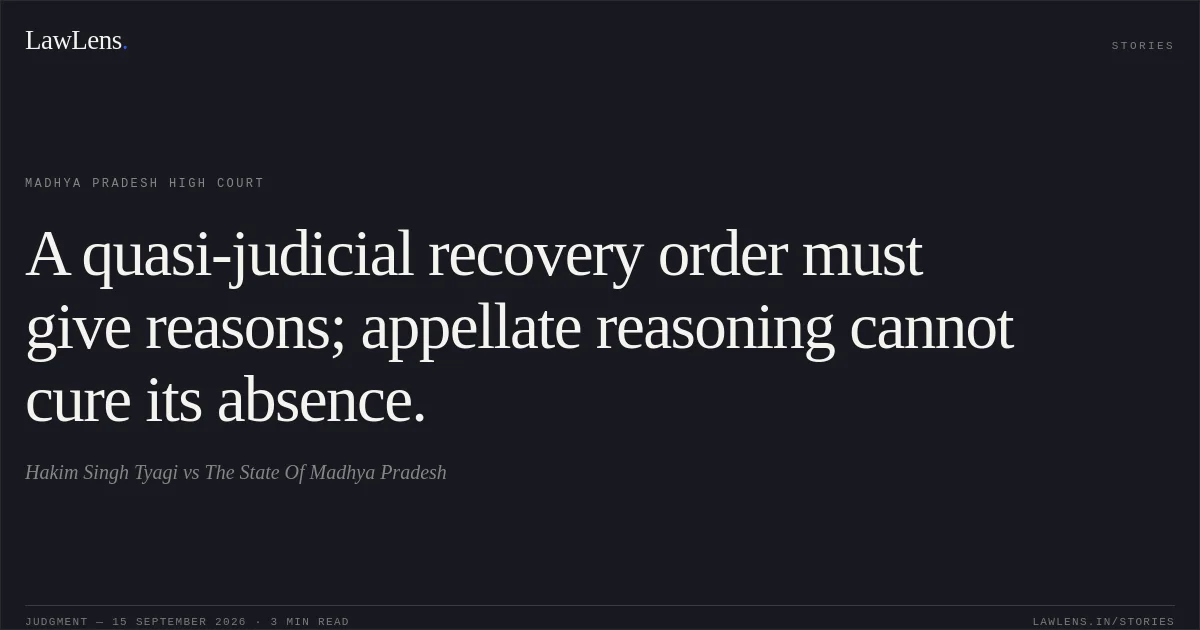
Source reference: paras. 5–8; pp. 3–5The appellate authority’s subsequent affirmation could not rectify the foundational defect in the original order, because an appellate proceeding is not a substitute for a properly reasoned initial adjudication.
Source reference: paras. 11–12; pp. 5–8The Court therefore concluded that both orders suffered from non-application of mind and violation of the requirement of reasoned decision-making.
Source reference: no citationHolding
The Court allowed the petition to the extent of quashing the CEO’s recovery order dated 7 August 2024 and the Commissioner’s appellate order dated 6 July 2026.
The matter was remanded to the CEO, Zila Panchayat, Morena, for fresh decision in accordance with law, after considering each fact and ground raised in the petitioner’s reply dated 26 July 2024, within two months from receipt of the certified copy of the judgment.
Source reference: para. 13(ii); p. 8The CEO was directed to provide the petitioner a personal hearing before passing the fresh speaking and reasoned order.
Source reference: para. 13(iii); p. 8The Court clarified that it had expressed no opinion on the merits of the recovery allegations.
Source reference: para. 14; p. 9Original Court PDF
Hakim Singh TyagivsThe State Of Madhya Pradesh
Click to open original judgment
Original judgment, available to read, download and summarize on LawLens.in