Facts
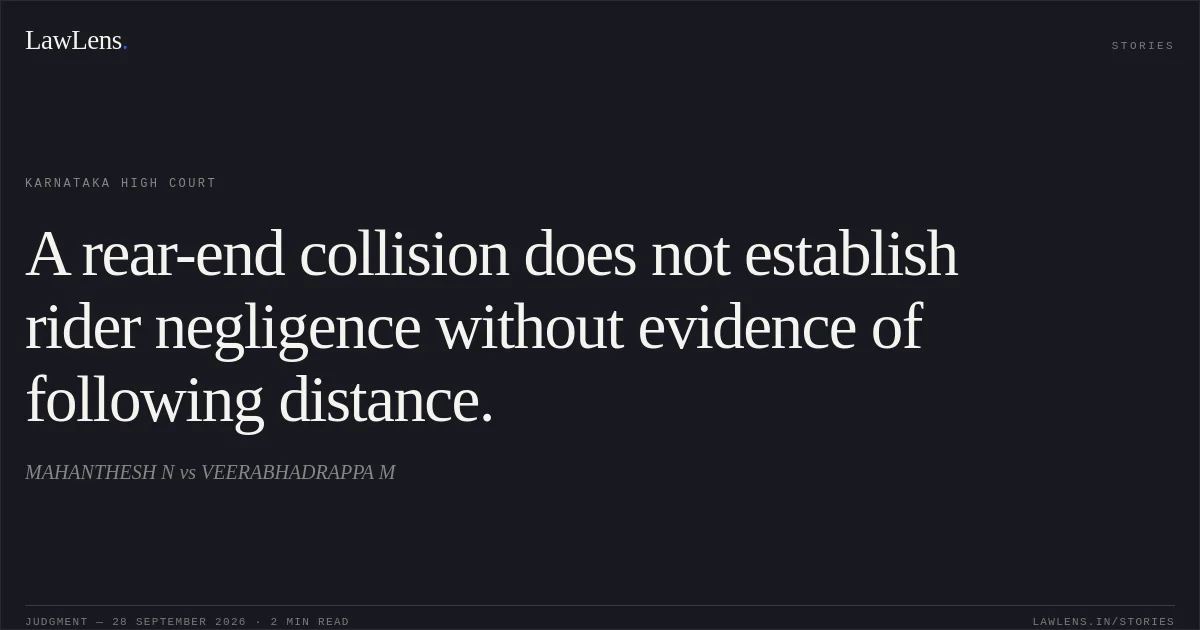
On 15 October 2023, the claimant, riding a motorcycle, collided with the rear of a lorry that had stopped suddenly at night. He sustained a displaced fracture of the left clavicle and sought compensation under the Motor Vehicles Act.
Source reference: pp. 4–5, paras. 2–4The Tribunal awarded ₹5,45,800 with interest at 6% per annum. The claimant appealed for enhancement, while the insurer challenged liability and the quantum awarded
Source reference: pp. 4–5, paras. 2–4Issues
Whether the accident was caused by the rash and negligent driving of the lorry driver
Source reference: p. 9, para. 12(i)Whether the compensation awarded by the Tribunal was just and proper
Source reference: p. 9, para. 12(ii)Law Applied
Appeals against awards of the Motor Accident Claims Tribunal lie under Section 173(1) of the Motor Vehicles Act
Source reference: pp. 2–3In assessing negligence in a rear-end collision, the circumstances and evidence concerning the vehicles’ movements and distance between them are relevant; Nishan Singh v. Oriental Insurance Co. Ltd., (2018) 6 SCC 765, and Oriental Insurance Co. Ltd. v. TATA AIG General Insurance Co. Ltd., 2026 INSC 208, were considered in that context
Source reference: pp. 6, 10–11, paras. 6, 14–16Compensation for loss of future income was calculated using the claimant’s annual income, the applicable multiplier and assessed whole-body disability; the Court applied the 2023 Karnataka State Legal Services Authority notional income of ₹16,250 per month and multiplier 17
Source reference: p. 13, paras. 19–20Reasoning
The Court upheld the finding of negligence because the claimant testified that the lorry stopped suddenly at night without its brake lights on, and the insurer and insured adduced no evidence that the motorcyclist was negligent.
Source reference: pp. 10–12, paras. 13–17The record did not establish the distance between the vehicles, distinguishing the cited precedents, which involved evidence on that point; the charge sheet and the lorry driver’s guilty plea and conviction further supported the Tribunal’s finding.
Source reference: pp. 10–12, paras. 13–17On quantum, the Court retained the awards for pain and suffering, amenities, and attendant and related expenses, but revised loss of future income using the prescribed notional income and multiplier, increased laid-up-period income to two months, and enhanced future medical expenses for implant removal.
Source reference: pp. 12–15, paras. 18–24It rejected the additional medical bills in Ex. P11 because they were unsupported by evidence
Source reference: pp. 12–15, paras. 18–24Holding
The Court dismissed the insurer’s appeal and allowed the claimant’s appeal in part.
It enhanced the total compensation to ₹5,77,349, granting an additional ₹31,549 with interest at 6% per annum from the date of the petition until realisation.
Source reference: pp. 15–16, paras. 25–28The insurer was directed to deposit the enhanced amount with interest before the Tribunal within six weeks, and the claimant was permitted to withdraw it
Source reference: pp. 15–16, paras. 25–28Acts & Sections Cited
4 provisions across 2 statutes referred to in this judgment. Each provision opens on LawLens.
Motor Vehicles Act, 19881
Indian Penal Code, 18603
Original Court PDF
MAHANTHESH NvsVEERABHADRAPPA M
Click to open original judgment
Original judgment, available to read, download and summarize on LawLens.in