Facts
On 6 December 2021, Ranjitbhai Sureshbhai Parmar was riding his motorcycle on Sarsa–Bhalej Road when it collided with a truck parked on the road. He died at the scene.
Source reference: paras. 4–5; pp. 1–3His legal heirs filed a claim under Section 166 of the Motor Vehicles Act, 1988. The Motor Accident Claims Tribunal, Kheda at Nadiad, dismissed the claim petition, attributing the accident entirely to the deceased, relying on the panchnama, the FIR and the abated summary.
Source reference: paras. 4–5; pp. 1–3The claimants appealed under Section 173 of the Act.
Source reference: para. 3; p. 1Issues
1. Whether the Tribunal was justified in finding the deceased solely negligent on the evidence before it, including the panchnama, FIR and abated summary
Source reference: paras. 5–6; pp. 2–42. Whether the Tribunal’s dismissal of the claim petition required appellate interference and, if so, what relief should follow
Source reference: paras. 10–11.5; pp. 7–8Law Applied
Section 166 of the Motor Vehicles Act provides the basis for a claim for compensation arising from a motor-vehicle accident, while Section 173 provides for an appeal against the Tribunal’s award. Sections 122 and 126 of the Act, read with Rule 15 of the Rules of the Road Regulations, 1989, are relevant to the precautions required when a vehicle is stopped or parked on a road.
Source reference: para. 6; p. 4Negligence and contributory negligence must be assessed from the evidence and surrounding circumstances; a rear-end collision, by itself, does not establish that the following vehicle’s driver was solely negligent. Contributory negligence requires conduct by the claimant that materially contributed to the damage and amounted to a failure to take reasonable care (*Pramodkumar Rasikbhai Jhaveri v. Karmasey Kunvargi Tak*, (2002) 6 SCC 455, paras. 8–10).
Source reference: pp. 5–7The Court also referred to *Oriental Insurance Co. Ltd. v. Kalu Ram*, 2026 INSC 653, on assessing the circumstances of a stationary truck and the absence of evidence from its driver, and to *Municipal Corporation of Greater Bombay v. Laxman Iyer*, (2003) 8 SCC 731, on negligence and contributory negligence.
Source reference: paras. 7–9; pp. 4–7Reasoning
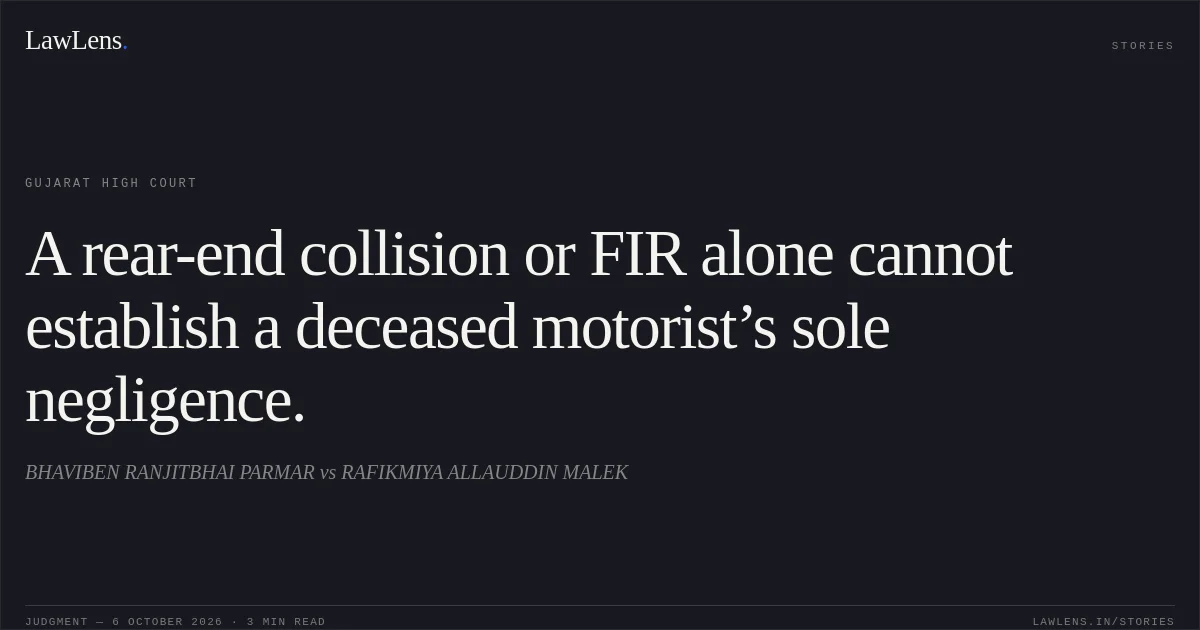
The Tribunal inferred sole negligence from the collision, the panchnama, the FIR and the abated summary, despite the complainant not being an eyewitness. The High Court held that an FIR against the deceased or an abated summary could not, without more, establish his sole negligence, and that a collision from behind was not conclusive.
Source reference: paras. 5–6; pp. 2–4The truck driver had not entered the witness box, and the Tribunal had not properly assessed the evidence in light of the applicable negligence principles or considered the statutory provisions governing vehicles stopped on a road.
Source reference: paras. 6, 10; pp. 4, 7Finding the Tribunal’s approach unsustainable, the Court set aside the award but directed a fresh determination on the evidence and law, without being influenced by its observations.
Source reference: paras. 10–11.3; pp. 7–8Holding
The appeal was allowed, and the Tribunal’s judgment and award dismissing MACP No. 620 of 2022 were quashed and set aside.
The claim petition was restored to the Tribunal for fresh consideration; the parties were permitted to lead further evidence, if advised.
Source reference: paras. 11–11.5; pp. 7–8The Tribunal was directed to decide the petition within six months from 21 October 2026, without being influenced by the earlier award or the High Court’s observations. The parties were directed to appear before the Tribunal on 21 October 2026, and the Registry was directed to transmit the record before that date.
Source reference: paras. 11–11.5; pp. 7–8Acts & Sections Cited
4 provisions across 1 statute referred to in this judgment. Each provision opens on LawLens.
Motor Vehicles Act, 19884
Original Court PDF
BHAVIBEN RANJITBHAI PARMARvsRAFIKMIYA ALLAUDDIN MALEK
Click to open original judgment
Original judgment, available to read, download and summarize on LawLens.in