Facts
The prosecution alleged that, on 26 July 2012, the accused formed an unlawful assembly, assaulted the complainant and his sons, and that accused No. 1 abetted the complainant’s daughter to commit suicide.
Source reference: para. 4The accused were charged under Sections 143, 147, 323 and 306 read with Section 149 of the Indian Penal Code. At trial, the prosecution examined 18 witnesses and produced 16 exhibits; the accused were acquitted by the Sessions Court.
Source reference: paras. 5–7The State appealed under Section 378 of the Code of Criminal Procedure.
Source reference: p. 2Issues
1. Whether the State had established grounds to interfere with the trial court’s judgment of acquittal.
Source reference: para. 92. What order should follow from the Court’s determination of the appeal.
Source reference: para. 9Law Applied
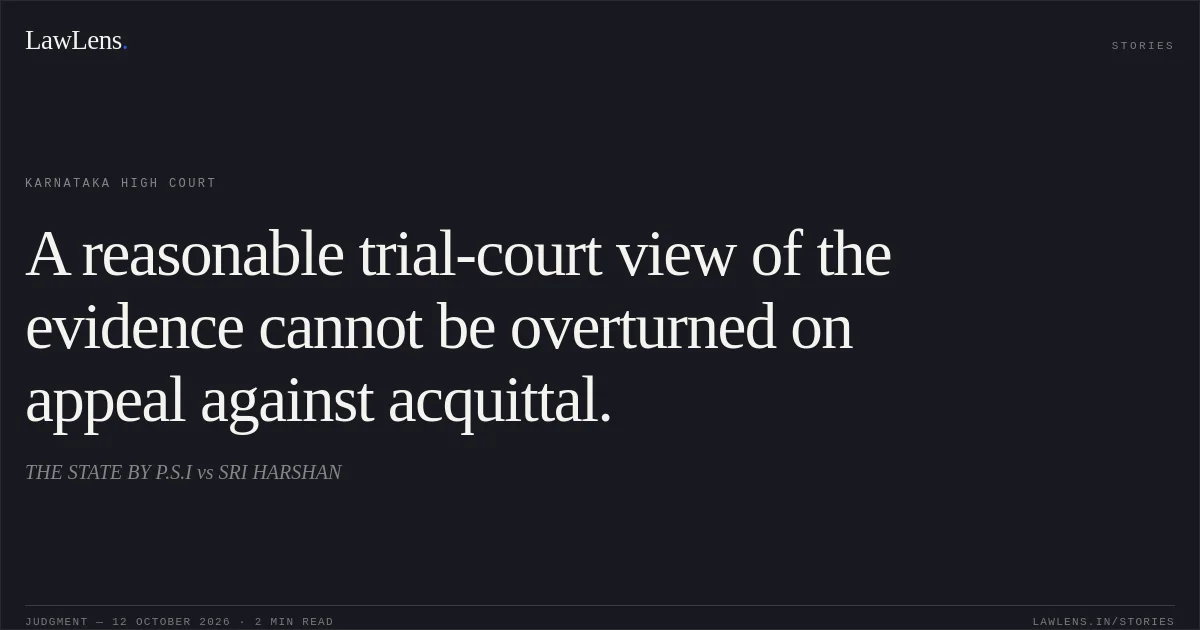
The Court applied the principles governing appeals against acquittal under Section 378 of the Code of Criminal Procedure: an appellate court may reappreciate the evidence, but an acquittal strengthens the presumption of innocence; if the trial court’s view is a reasonably possible view on the evidence, it cannot be displaced merely because another view is available. Interference is warranted where the acquittal is perverse, rests on a misreading or omission of material evidence, or where the only reasonable conclusion is guilt beyond reasonable doubt.
Source reference: para. 11The Court relied on Constable 907 Surendra Singh v. State of Uttarakhand, (2025) 5 SCC 433; Babu Sahebgouda Rudragoudar v. State of Karnataka, (2024) 8 SCC 149; Chandrappa v. State of Karnataka, (2007) 4 SCC 415; and H.D. Sundara v. State of Karnataka, (2023) 9 SCC 581.
Source reference: para. 11Reasoning
The Sessions Court found insufficient material to establish that accused Nos. 2–5 shared an intention to abet the deceased’s suicide, or that accused No. 1 intended to do so.
Source reference: para. 14It also found the evidence insufficient to establish the alleged unlawful assembly and the incident as charged, noting the absence of a medical certificate and cogent evidence.
Source reference: para. 14On reappreciating the record, the High Court found no legal or factual error in those conclusions and held that the trial court’s view did not warrant appellate interference under the governing acquittal principles.
Source reference: paras. 15–16Holding
The Court answered the issue of interference in the negative.
The Court dismissed the State’s appeal, leaving the acquittal of all respondents undisturbed.
Source reference: paras. 15–16Acts & Sections Cited
7 provisions across 2 statutes referred to in this judgment. Each provision opens on LawLens.
Code of Criminal Procedure, 19732
Indian Penal Code, 18605
Original Court PDF
THE STATE BY P.S.IvsSRI HARSHAN
Click to open original judgment
Original judgment, available to read, download and summarize on LawLens.in