Facts
The plaintiff sued for specific performance and permanent injunction, alleging an agreement to purchase the suit property for ₹2 crore and payment of ₹1.98 crore, together with stamp duty and TDS; the defendant allegedly failed to execute the sale deed.
Source reference: paras. 2–4, p. 2After the defendant died, his son, daughter, and grandson Utkarsh Madan were substituted as legal representatives.
Source reference: paras. 5–8, pp. 2–3The grandson relied on a Will dated 18 July 2019 in his favour and sought impleadment also in his independent capacity, as well as permission to place his written statement on record.
Source reference: paras. 5–8, pp. 2–3; para. 1, p. 1He argued that his testamentary claim was distinct from his capacity as a legal representative; the plaintiff opposed the application, submitting that the Will did not itself establish title.
Source reference: paras. 9–17, pp. 3–6Issues
1. Whether a person already substituted as a legal representative may also be impleaded in an independent capacity on the basis of an alleged testamentary interest in the suit property.
Source reference: paras. 19–22, p. 6–72. Whether the applicant’s existing status as a legal representative sufficiently protected his asserted interest under the Will so as to make separate impleadment unnecessary.
Source reference: paras. 20–24, pp. 6–8Law Applied
Order XXII Rule 4(2) CPC permits a legal representative to raise defences available to the deceased, except those personal to the deceased; Section 2(11) CPC defines a legal representative as a person who in law represents the deceased’s estate, including a person on whom the estate devolves.
Source reference: paras. 11, 16, pp. 4–6Order I Rule 10 CPC permits a person claiming an independent right, title, or interest to seek joinder in a personal capacity.
Source reference: no citationIn Vidyawati v. Man Mohan, the Supreme Court recognised that a legal representative may, in addition to defending as representative of the estate, seek impleadment in a personal capacity to assert an independent title; it also referred to Bal Kishan v. Om Parkash and Jagdish Chander Chatterjee v. Sri Kishan on the defences available to legal representatives.
Source reference: para. 11, pp. 4–5Reasoning
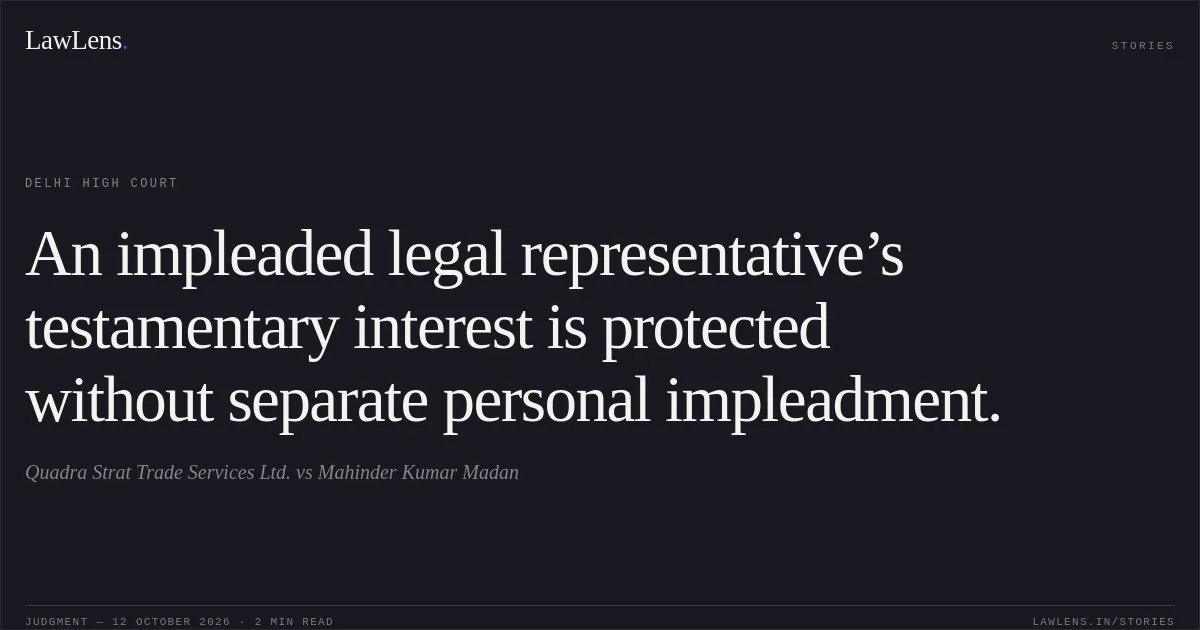
The Court accepted that the applicant’s claim under the alleged Will was distinct from his status as a legal representative and noted that Vidyawati recognises the possibility of asserting an independent interest.
Source reference: paras. 20–22, p. 6–7However, the applicant had already been substituted as a legal representative, and the Court considered that status sufficient to represent the deceased’s estate and protect his position as a claimed successor under the Will.
Source reference: paras. 20, 23–24, pp. 6–8It further observed that the applicant was a legal representative under Section 2(11) CPC, although not a legal heir, and concluded that his independent status was protected without separate impleadment in a personal capacity.
Source reference: paras. 20, 23–24, pp. 6–8Holding
The Court dismissed the application, finding no substance in the request for separate impleadment in the applicant’s independent capacity.
The suit was directed to be listed before the Joint Registrar on 20 November 2026 for completion of pleadings.
Source reference: para. 25, p. 8Acts & Sections Cited
3 provisions across 2 statutes referred to in this judgment. Each provision opens on LawLens.
Code of Civil Procedure, 19082
Hindu Succession Act, 19561
Original Court PDF
Quadra Strat Trade Services Ltd.vsMahinder Kumar Madan
Click to open original judgment
Original judgment, available to read, download and summarize on LawLens.in