Facts
The prosecution alleged that on 24 August 2013, Raja drove a tipper truck rashly and negligently near Lighthouse Hill junction, striking two people, both of whom later died.
Source reference: p. 1–3He was charged under Sections 279 and 304A of the Indian Penal Code.
Source reference: p. 1–3The JMFC acquitted him on 19 March 2016. The State appealed against the acquittal under Section 378 CrPC.
Source reference: p. 1–3At trial, seven witnesses were examined.
Source reference: p. 3–4, 7–8The alleged eyewitnesses and mahazar witnesses did not support the prosecution, and the accused denied the allegations in his Section 313 CrPC statement.
Source reference: p. 3–4, 7–8Issues
1. Whether the trial court’s acquittal of the accused for offences under Sections 279 and 304A IPC was liable to be set aside on the evidence on record
Source reference: p. 2, 4–52. Whether the trial court’s assessment of the evidence disclosed a basis for appellate interference with the acquittal
Source reference: p. 5–7Law Applied
The appeal arose under Section 378 CrPC, which permits an appeal against acquittal.
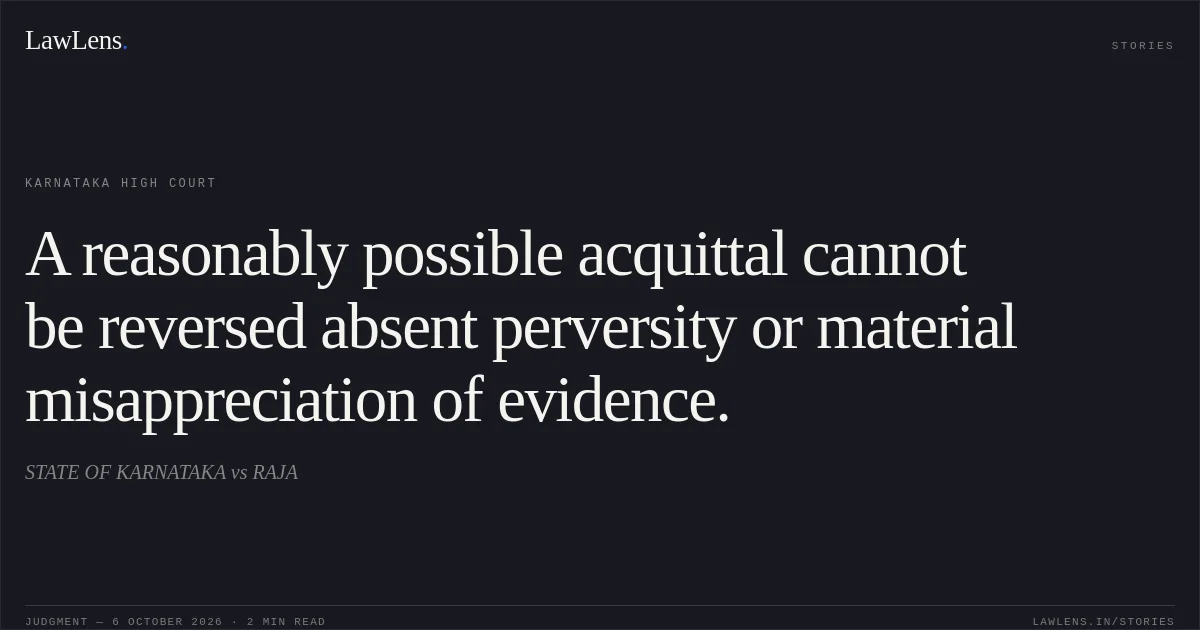
Source reference: p. 5–7Relying on *Constable 907 Surendra Singh v. State of Uttarakhand*, (2025) 5 SCC 433; *Babu Sahebgouda Rudragoudar v. State of Karnataka*, (2024) 8 SCC 149; *Chandrappa v. State of Karnataka*, (2007) 4 SCC 415; and *H.D. Sundara v. State of Karnataka*, (2023) 9 SCC 581, the Court stated that an acquittal strengthens the presumption of innocence and that, although an appellate court may reappreciate the evidence, it must not overturn an acquittal if the trial court’s view is a possible one.
Source reference: p. 5–7Interference is warranted where the acquittal is patently perverse, rests on a misreading or omission of material evidence, or where the evidence permits no reasonable conclusion other than guilt.
Source reference: p. 5–7Reasoning
The Court found that PW2, described as an eyewitness, did not support the prosecution, as did other witnesses to the incident or mahazar.
Source reference: p. 7–8PW1’s evidence was not substantiated by PW2; PW1 also admitted that he was not the scribe of the complaint, and the scribe was not examined.
Source reference: p. 7–8The Court considered the trial court’s treatment of this evidence a proper assessment and concluded that the State had not shown perversity or another ground warranting interference under the applicable acquittal-appeal standard.
Source reference: p. 7–8Holding
The Court held that the State had not established grounds to disturb the trial court’s acquittal.
The criminal appeal was dismissed, leaving the acquittal of Raja for the alleged offences under Sections 279 and 304A IPC undisturbed.
Source reference: p. 8Acts & Sections Cited
3 provisions across 2 statutes referred to in this judgment. Each provision opens on LawLens.
Code of Criminal Procedure, 19732
Indian Penal Code, 18601
Original Court PDF
STATE OF KARNATAKAvsRAJA
Click to open original judgment
Original judgment, available to read, download and summarize on LawLens.in