Facts
The Union of India challenged the Central Administrative Tribunal’s interim order staying disciplinary proceedings against Indresh Kumar Pandey.
Source reference: pp. 1–2The Tribunal noted that first-stage advice from the CVC had not been obtained before the charge-sheet was issued; that the Disciplinary Authority had decided to drop the charges and convey displeasure under Rule 14(5) of the CCS (CCA) Rules; and that an Inquiry Officer was later appointed to inquire into the same charges.
Source reference: pp. 1–2It considered the later appointment prima facie impermissible and stayed the proceedings.
Source reference: pp. 1–2Issues
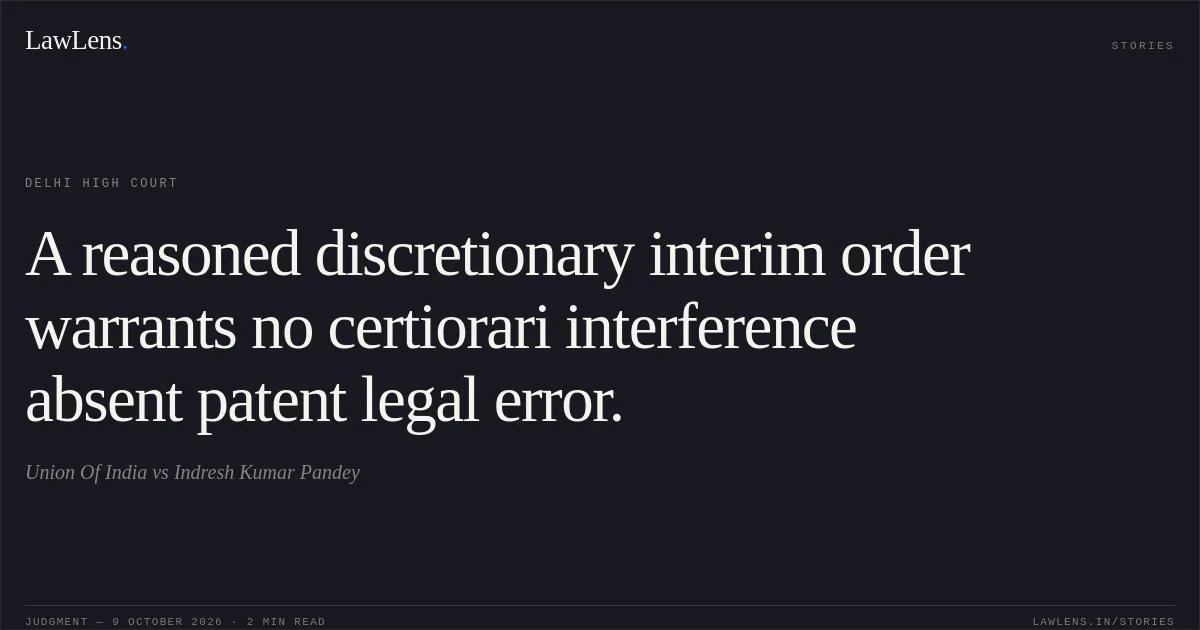
Whether the Tribunal’s discretionary interim order staying the disciplinary proceedings disclosed an error warranting interference under Article 226
Source reference: pp. 3–4, 7Whether the appointment of an Inquiry Officer, by itself, justified setting aside the Tribunal’s stay
Source reference: p. 3Law Applied
Under Syed Yakoob v. K.S. Radhakrishnan, certiorari is supervisory, not appellate: a High Court may correct jurisdictional errors, procedural illegality, or an error of law apparent on the face of the record, but ordinarily may not reassess factual findings or substitute its view on the merits.
Source reference: pp. 3–5Under Wander Ltd. v. Antox (India) Pvt. Ltd., a discretionary interim order should not be disturbed unless discretion was exercised arbitrarily, capriciously, perversely, or contrary to settled principles.
Source reference: pp. 5–6The Court noted that Article 226 review is even more circumscribed than appellate review of a discretionary order.
Source reference: p. 6Reasoning
The Tribunal’s stay was reasoned and based on relevant circumstances: the absence of prior CVC advice, the Disciplinary Authority’s decision to drop the charges, and the subsequent appointment of an Inquiry Officer to inquire into those same charges.
Source reference: pp. 3–4The Union identified no error in the Tribunal’s order; its sole submission—that an Inquiry Officer had been appointed—did not establish a basis for interference, particularly because the legality of that appointment was the very matter underlying the Tribunal’s interim relief.
Source reference: p. 3; para. 6Applying the restricted certiorari standard and the restraint applicable to discretionary orders, the Court found no ground to intervene.
Source reference: pp. 6–7; paras. 10–11Holding
The High Court held that no case for interference under Article 226 had been made out.
The Union’s writ petition was dismissed in limine, leaving the Tribunal’s interim stay in place.
Source reference: p. 7; para. 12Original Court PDF
Union Of IndiavsIndresh Kumar Pandey
Click to open original judgment
Original judgment, available to read, download and summarize on LawLens.in