Facts
The appellant was convicted by the Sessions Judge, Diphu, in Sessions Case No. 18/2007 under Sections 302 and 436 IPC for murdering the village Gaonburah, Talbor Amsi, and his two daughters, Jun Maslai and Manjuli Maslai, and for setting fire to several houses and a school building.
Source reference: p.2He was sentenced to life imprisonment for each murder and five years’ rigorous imprisonment under Section 436 IPC, with the sentences running concurrently.
Source reference: p.2During the appeal, the High Court found that material injured witnesses and an alleged eyewitness had not been examined.
Source reference: p.3Exercising powers under Sections 311 and 391 CrPC and Section 165 of the Evidence Act, it directed the recording of additional evidence; four injured witnesses were subsequently examined as Court Witnesses.
Source reference: pp.3–4The appellant had pleaded guilty at the stage of framing of charge, made a statement under Section 164 CrPC, and admitted the offences during examination under Section 313 CrPC.
Source reference: pp.6–7, 13–14The medical evidence established fatal sharp-cut injuries on all three deceased persons.
Source reference: pp.10–12CW-1, an injured eyewitness and son of the Gaonburah, testified that he saw the appellant strike his father’s head with a dao.
Source reference: p.15Issues
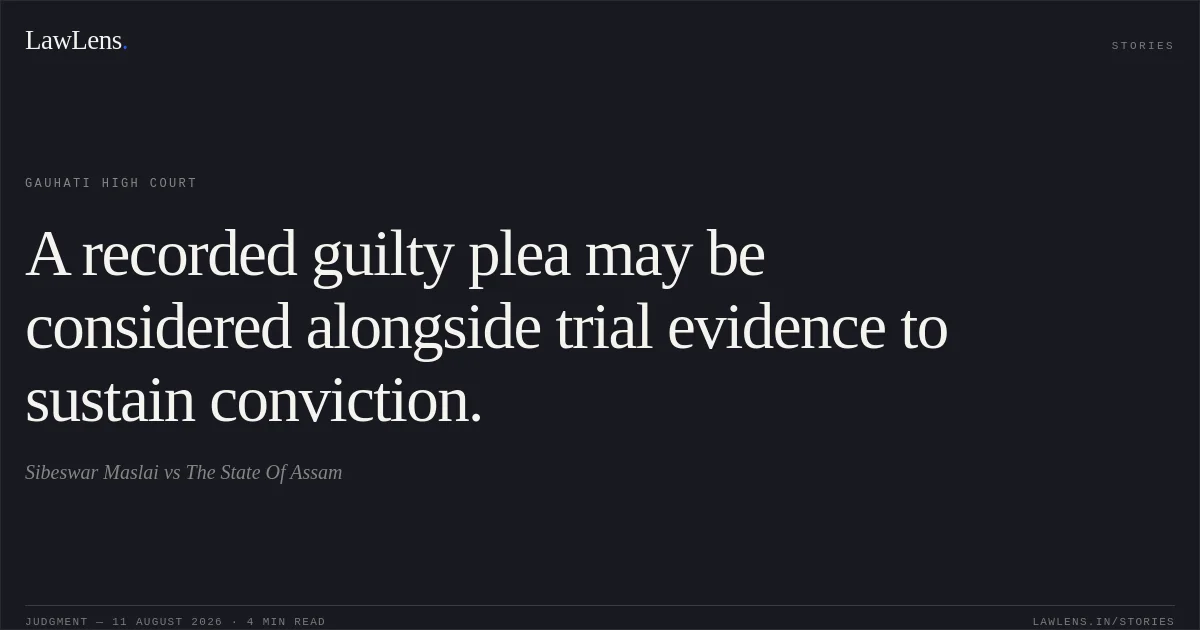
Whether the appellant’s plea of guilt recorded at the stage of framing of charge could be relied upon even though the Sessions Court proceeded to record evidence and conduct a full trial.
Source reference: pp.6–7, 16–17Whether the appellant’s statement under Section 164 CrPC was voluntary and recorded in compliance with the statutory and procedural safeguards so as to be acted upon.
Source reference: pp.17–18Whether the prosecution proved beyond reasonable doubt that the appellant murdered the Gaonburah and his two daughters and committed the offence under Section 436 IPC.
Source reference: pp.15–18Whether the evidence on record, particularly the testimony of the injured eyewitness and the appellant’s admissions under Sections 229 and 313 CrPC, was sufficient to sustain the conviction.
Source reference: pp.13–16Law Applied
Section 229 CrPC permits a Sessions Judge to record a plea of guilty and, in the Court’s discretion, convict the accused on that plea; the provision does not prevent the Court from conducting a trial or considering the plea together with other evidence.
Source reference: p.17A confession under Section 164 CrPC is admissible only when the Magistrate is satisfied that it was made voluntarily and after complying with the safeguards prescribed by the CrPC and applicable High Court Rules; Shivappa v. State of Karnataka, (1995) 2 SCC 76, was applied on this point.
Source reference: pp.17–18An accused’s statement under Section 313 CrPC is intended to provide an opportunity to explain adverse circumstances, and a plausible defence must be assessed by the Court on the standard of preponderance of probabilities; the Court relied on Jai Prakash Tiwari v. State of Madhya Pradesh, 2022 SCC OnLine SC 966, and Parminder Kaur v. State of Punjab, (2020) 8 SCC 811.
Source reference: pp.14–15Ocular testimony must be assessed as a whole for its “ring of truth”; the credible testimony of an injured eyewitness may, by itself, sustain a conviction where it remains unshaken, as recognised in Shahaja @ Shahajan Ismail Mohd. Shaikh v. State of Maharashtra, 2022 LiveLaw (SC) 596, and Ravasaheb @ Ravasahebgouda v. State of Karnataka, 2023 LiveLaw (SC) 225.
Source reference: pp.15–16Sections 302 and 436 IPC governed the offences of murder and mischief by fire or explosive substance with intent to destroy a building, respectively.
Source reference: pp.2, 18Reasoning
The Court held that the appellant’s plea of guilt could be considered notwithstanding the subsequent trial because Section 229 CrPC does not make a recorded plea unusable merely because the Court elects to obtain corroborative evidence.
Source reference: pp.16–17Although the Section 164 CrPC statement expressly referred to the appellant hacking the Gaonburah and “his daughter,” it did not clearly confess to killing both of the appellant’s daughters; the Court therefore declined to infer words not contained in the statement.
Source reference: pp.7–9Nevertheless, the appellant’s unequivocal admissions during plea-taking and under Section 313 CrPC, together with the medical evidence and surrounding circumstances, supported the prosecution case.
Source reference: pp.13–16In particular, CW-1 was an injured eyewitness who directly saw the appellant strike the Gaonburah’s head with a dao, and his testimony was not shaken in cross-examination.
Source reference: pp.13, 15–16The Magistrate’s evidence showed that the Section 164 confession was recorded after the appellant was informed of the consequences, assured that he was not compelled, given reflection time, and questioned regarding voluntariness; the prescribed Form (M) 34 safeguards were also complied with.
Source reference: p.18The evidence regarding the burning of houses and the school, read with the appellant’s admissions and the witness testimony, established the offence under Section 436 IPC.
Source reference: pp.12–15, 18Holding
The High Court answered the issues in favour of the prosecution.
It held that the appellant’s recorded plea of guilt, voluntary Section 164 CrPC confession, Section 313 CrPC admissions, credible injured-eyewitness testimony, and medical evidence cumulatively proved the offences beyond reasonable doubt.
Source reference: pp.15–18The conviction under Sections 302 and 436 IPC and the sentences imposed by the Sessions Court were upheld.
Source reference: p.19The criminal appeal was dismissed, the Trial Court Record was directed to be returned, and the Amicus Curiae’s fees were ordered to be paid by the High Court Legal Services Committee.
Source reference: p.19Acts & Sections Cited
8 provisions across 2 statutes referred to in this judgment. Each provision opens on LawLens.
Indian Penal Code, 18603
Code of Criminal Procedure, 19735
Original Court PDF
Sibeswar MaslaivsThe State Of Assam
Click to open original judgment
Original judgment, available to read, download and summarize on LawLens.in