Facts
The petitioner-plaintiff challenged the Trial Court’s order on his application under Order XXXIX Rules 1 and 2 of the Code of Civil Procedure, 1908 (CPC). The Trial Court considered the material, declined to grant an ex parte ad interim injunction against the respondent media organisations, and ordered emergent notice.
Source reference: para. 1, para. 5The suit had been instituted in 2019, and the application remained pending. An interim injunction granted by the High Court on 20 January 2020 was stated to continue, but the Trial Court proceedings had not advanced to a decision on the application. The petitioner invoked Articles 226 and 227 of the Constitution to challenge the Trial Court’s order.
Source reference: para. 1, para. 7–9Issues
Whether the petitioner could invoke the High Court’s jurisdiction under Articles 226 and 227 when an appeal was available under Order XLIII Rule 1(r) CPC against the Trial Court’s order concerning interim injunction.
Source reference: para. 2, para. 4–6Whether the High Court’s continuing interim order prevented the Trial Court from proceeding with the suit and deciding the pending application under Order XXXIX Rules 1 and 2 CPC.
Source reference: para. 7–10, para. 15Law Applied
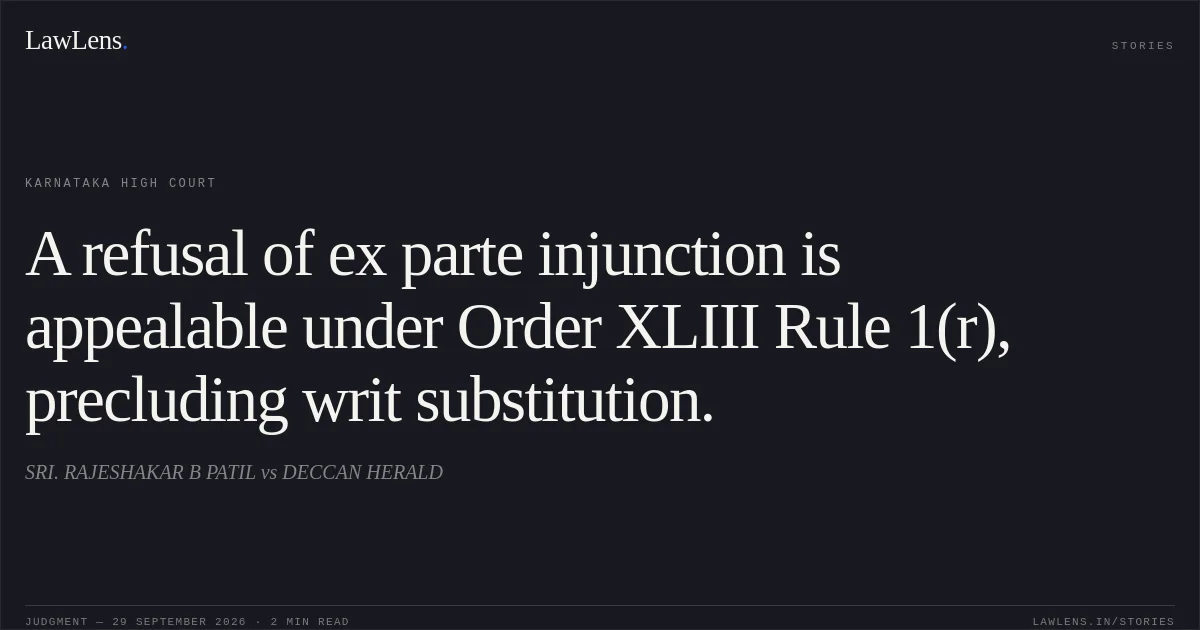
Order XXXIX Rules 1 and 2 CPC govern applications for temporary injunctions, and an order made under those provisions is appealable under Order XLIII Rule 1(r) CPC.
Source reference: para. 5The existence of an efficacious statutory appellate remedy ordinarily weighs against invoking the High Court’s extraordinary jurisdiction under Articles 226 and 227 to challenge the correctness of an interlocutory order, absent exceptional circumstances.
Source reference: para. 4, para. 6An interim order is intended to preserve the subject matter of the dispute; it does not, by itself, stay further proceedings unless that effect is expressly stated in the order.
Source reference: para. 8, para. 15The respondents relied on Raju B.V. v. Gemini Shares and Stocks Private Limited, W.P. No. 13889/2022, decided on 22 January 2026, in support of the alternative-remedy objection.
Source reference: para. 2Reasoning
The High Court found that the Trial Court had considered the material and declined ex parte relief, rather than merely postponing consideration by mechanically issuing notice. The resulting order was therefore appealable under Order XLIII Rule 1(r) CPC, and the petitioner had not shown exceptional circumstances justifying writ or supervisory intervention.
Source reference: para. 5–6The High Court also held that its 20 January 2020 interim order did not suspend the suit or relieve the petitioner of the need to pursue the pending application before the Trial Court. The parties should assist the Trial Court in bringing the interlocutory proceedings to a conclusion.
Source reference: para. 8–10Holding
The writ petition was dismissed because the petitioner had an efficacious statutory appellate remedy and no exceptional basis for invoking the High Court’s extraordinary jurisdiction.
The Court expressed no opinion on the merits of the injunction application or the parties’ rights in the suit.
Source reference: para. 12It reserved liberty to the petitioner to seek an early hearing of the pending application; directed the parties to address arguments without unnecessary adjournments; and clarified that the High Court’s 20 January 2020 interim order was not a stay of the suit proceedings.
Source reference: para. 13–15Original Court PDF
SRI. RAJESHAKAR B PATILvsDECCAN HERALD
Click to open original judgment
Original judgment, available to read, download and summarize on LawLens.in