Facts
The partition suit was dismissed after the trial court found the parties to be co-sharers but held that the plaintiffs, being out of possession, were not entitled to partition without seeking possession under Section 34 of the Specific Relief Act.
Source reference: para. 6–7The plaintiffs’ appeal succeeded: the Division Bench set aside the findings on issues 5 and 6 and remitted the suit for determination of shares, directing the trial court to pass a preliminary decree on the basis of its findings on issues 3 and 4.
Source reference: para. 6–7, 19, 25After remand, defendants 36–38 applied under Section 151 CPC, alleging that the plaintiffs had relied on a fraudulent death certificate and seeking to amend their written statement and adduce further evidence based on a deed discovered after the appeal.
Source reference: para. 20–22The trial court allowed the application and directed the defendants to obtain an order from the appropriate forum. Both sides challenged that order in these revisions.
Source reference: para. 2–3, 32–34Issues
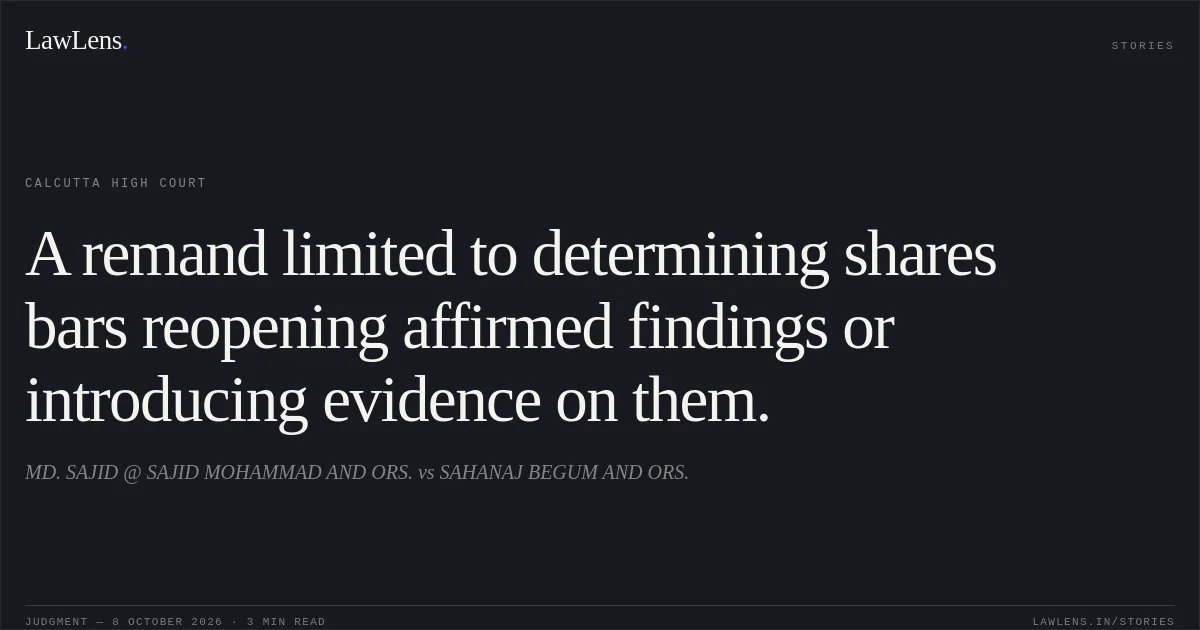
Whether, following a remand limited to determining the parties’ shares on the basis of findings on issues 3 and 4, the trial court could permit further evidence and pleadings seeking to reopen those findings.
Source reference: para. 25, 32Whether the defendants’ allegation of fraud concerning the death certificate justified the trial court’s order allowing the application under Section 151 CPC.
Source reference: para. 26–30, 32Law Applied
Section 151 CPC preserves inherent powers to secure the ends of justice, but those powers cannot be used to circumvent the governing procedure or reopen matters concluded by a binding adjudication; the court relied on Brij Lal & Sons v. Delhi Development Authority for that principle.
Source reference: para. 29S.P. Chengalvaraya Naidu v. Jagannath establishes that fraud on the court may vitiate an adjudication and that finality cannot protect fraud, while MCD v. State of Delhi concerns a litigant’s obligation to disclose relevant documents.
Source reference: para. 26–27Under R.V.E. Venkatachala Gounder v. Arulmigu Viswesaraswami & V.P. Temple, failure to object to the mode of proof when evidence is tendered may be fatal to a later objection; Bipin Shantilal Panchal v. State of Gujarat addresses the procedure for recording evidentiary objections for determination at the appropriate stage.
Source reference: para. 30–31A trial court must comply with the scope and directions of the appellate remand.
Source reference: para. 25, 32–33Reasoning
The Division Bench had affirmed the findings that the parties were co-sharers and had unity of possession, set aside only the decision on issues 5 and 6, and remitted the case for determination of shares.
Source reference: para. 25, 32The alleged fraud was not a new matter left open by the remand: the death certificate had been admitted without objection, and the trial court had already considered the challenge to its authenticity when deciding issues 3 and 4.
Source reference: para. 17, 28, 30Although fraud may undermine finality, the defendants’ application sought further evidence and pleadings that would reopen findings the appellate court had left undisturbed. Permitting that course would exceed the limited remand and effectively produce a de novo trial; Section 151 CPC could not justify it.
Source reference: para. 26–30, 32Holding
The High Court set aside the impugned order, holding that the trial court could not reopen issues 3 and 4 or permit further evidence having a direct bearing on those findings.
The trial court was directed to proceed strictly in accordance with the Division Bench’s order in F.A.T. No. 346 of 2019; both revisional applications were disposed of.
Source reference: para. 32–34Acts & Sections Cited
3 provisions across 3 statutes referred to in this judgment. Each provision opens on LawLens.
Code of Civil Procedure, 19081
Specific Relief Act, 19631
Registration of Births and Deaths Act, 19691
Original Court PDF
MD. SAJID @ SAJID MOHAMMAD AND ORS.vsSAHANAJ BEGUM AND ORS.
Click to open original judgment
Original judgment, available to read, download and summarize on LawLens.in