Facts
The appellant/plaintiff instituted a representative suit concerning 0.699 hectares of land bearing Survey No. 1713 at Village Mohna, Gwalior, seeking a declaration that the land was Government land reserved for public use and injunctions against alleged encroachment and unauthorized use.
Source reference: para. 10–11The State admitted that the land was Government land but denied that it was reserved for public use, stating that it was proposed to be allotted to the Health Department.
Source reference: para. 12Defendant No. 6 claimed that 0.418 hectares had been allotted to him by settlement order dated 28 August 2001.
Source reference: para. 13The Trial Court dismissed the suit, holding that although the land was Government land, the plaintiff failed to establish that it was reserved for public use; it further held that the settlement was limited to agricultural use and that the land could not be diverted or sold.
Source reference: para. 14The First Appellate Court affirmed the decree and additionally held that the suit was not maintainable under Section 91 of the Code of Civil Procedure, 1908.
Source reference: para. 16In the second appeal, the appellant also contended that the settlement had subsequently been cancelled and that a mobile tower continued to exist on the land.
Source reference: para. 17, 23Issues
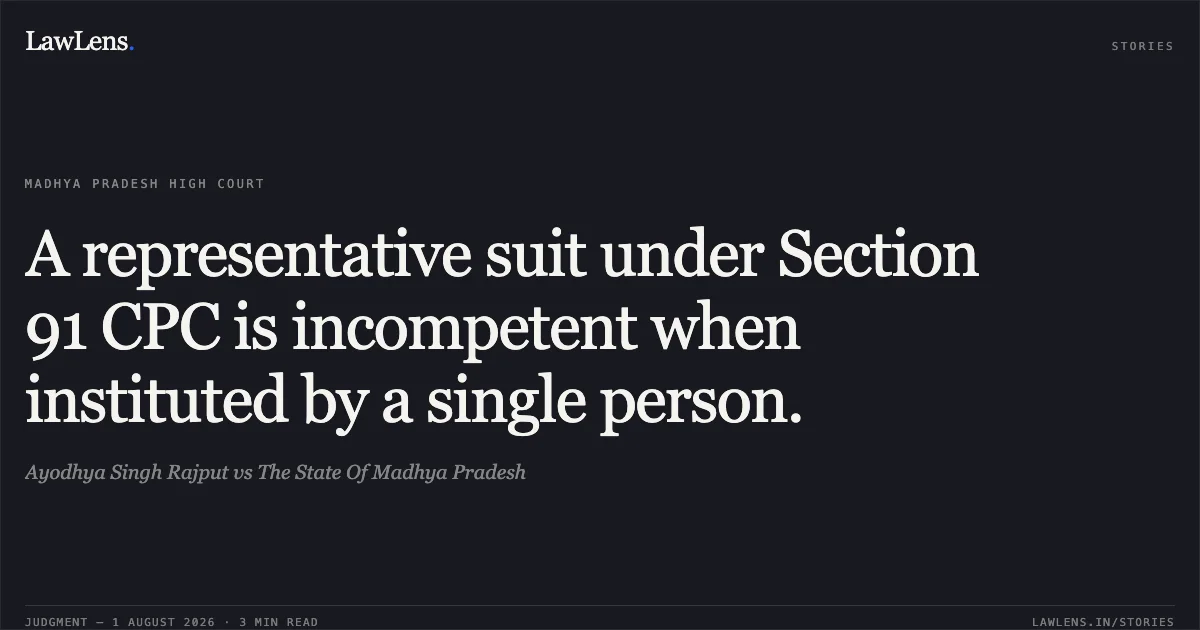
Whether the representative suit instituted by a single plaintiff was maintainable under Section 91 of the Code of Civil Procedure, 1908?
Source reference: para. 19–20Whether the plaintiff proved that the Government land was reserved for public use and was therefore entitled to declaratory and injunctive relief?
Source reference: para. 21Whether any substantial question of law arose warranting interference under Section 100 of the Code of Civil Procedure, 1908?
Source reference: para. 9, 24Whether the alleged subsequent cancellation of Defendant No. 6’s settlement and the continued existence of the mobile tower justified relief in the second appeal?
Source reference: para. 22–23Law Applied
Section 91(1) of the Code of Civil Procedure, 1908 permits a suit concerning a public nuisance or other wrongful act affecting or likely to affect the public to be instituted by the Advocate-General, or, with the leave of the Court, by two or more persons, even without proof of special damage.
Source reference: para. 19A second appeal under Section 100 CPC lies only where a substantial question of law arises; concurrent findings of fact ordinarily cannot be disturbed in the absence of such a question.
Source reference: para. 9, 21, 24A party seeking a declaration that land is reserved for public use must establish that factual and legal basis through appropriate evidence.
Source reference: para. 21Reasoning
The Court held that the suit was instituted by the plaintiff alone in a representative capacity, whereas Section 91(1)(b) requires two or more persons acting with the leave of the Court; consequently, the First Appellate Court correctly found the suit not maintainable on that ground.
Source reference: para. 20Independently, the concurrent findings established only that the land was Government land, not that it was reserved for public use.
Source reference: para. 21The appellant could not identify any document proving such reservation, and therefore failed to establish entitlement to the declaration or injunction sought.
Source reference: para. 21The challenge to Defendant No. 6’s settlement did not create a basis for interference because the Collector had already restricted the settlement to agricultural use and prohibited diversion or sale.
Source reference: para. 22The appellant’s assertion that the settlement was subsequently cancelled was unsupported by material on record; in any event, the Court observed that the appellant could approach the Collector regarding the continuing mobile tower.
Source reference: para. 23These matters involved no substantial question of law warranting exercise of jurisdiction under Section 100 CPC.
Source reference: para. 24Holding
The Court condoned the actual delay of approximately 35 days in filing the appeal, treating the apparent delay of 409 days as arising from an incorrect date recorded in the lower appellate judgment.
On merits, it dismissed the second appeal, affirming the judgments and decrees of both subordinate courts.
Source reference: para. 20–24It held that the single-plaintiff representative suit was not maintainable under Section 91 CPC, that the plaintiff had failed to prove that the land was reserved for public use, and that no substantial question of law arose under Section 100 CPC.
Source reference: para. 20–24The appellant was left at liberty to approach the Collector concerning the mobile tower.
Source reference: para. 23Acts & Sections Cited
3 provisions across 2 statutes referred to in this judgment. Each provision opens on LawLens.
Limitation Act, 19631
Code of Civil Procedure, 19082
Original Court PDF
Ayodhya Singh RajputvsThe State Of Madhya Pradesh
Click to open original judgment
Original judgment, available to read, download and summarize on LawLens.in