Facts
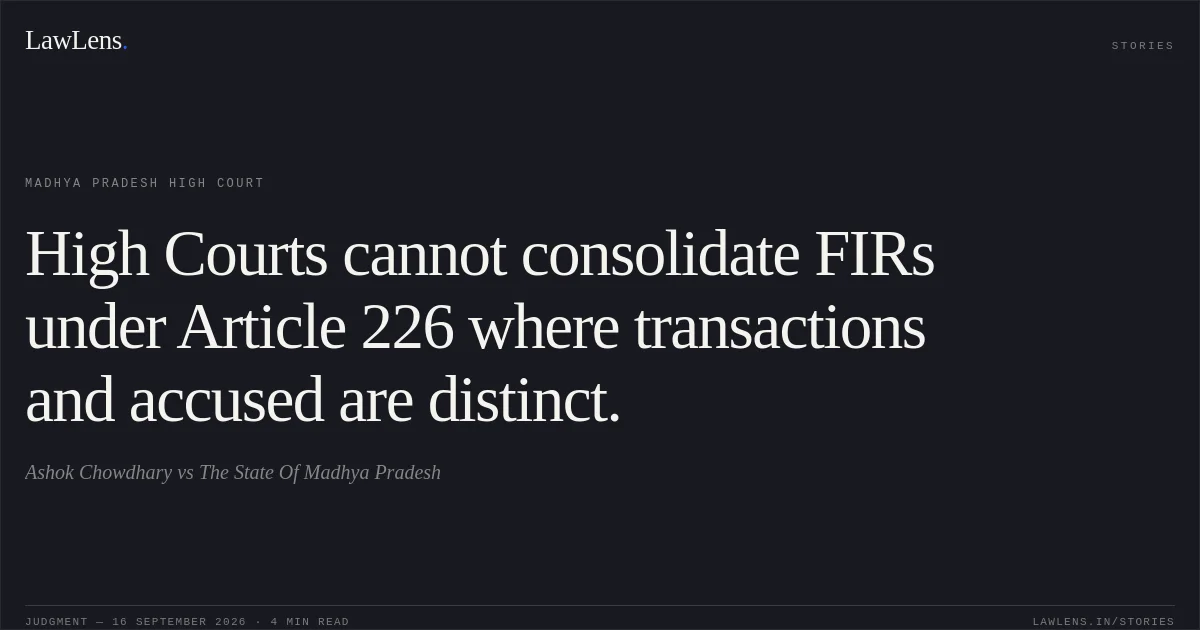
The appellant challenged the dismissal of his writ petition seeking clubbing or consolidation of several FIRs registered against him and other office-bearers of Arth Nidhi Private Limited in different districts of Madhya Pradesh.
Source reference: para. 1The FIRs concerned alleged non-payment of deposits or investments to different depositors upon maturity and invoked overlapping offences under the IPC and the Madhya Pradesh Depositors Act, though they involved different complainants, amounts, dates, maturity periods and, in some cases, different accused persons.
Source reference: paras. 16–17The appellant contended that Crime No. 662/2020 registered at Police Station Dunda, District Seoni, was the principal FIR and that the subsequent FIRs arose from the same financial scheme and modus operandi.
Source reference: paras. 2–8The State opposed consolidation on the ground that each FIR disclosed an independent transaction and separate grievance requiring individual investigation.
Source reference: paras. 9–13The learned Single Judge dismissed the writ petition, holding that the FIRs did not arise from the “same transaction” merely because they concerned the same company and similar allegations.
Source reference: paras. 14–15Issues
Whether multiple FIRs lodged by different depositors against the same company and overlapping accused persons, concerning separate deposits and alleged non-payment, arose from the same transaction so as to warrant clubbing or consolidation with Crime No. 662/2020?
Source reference: paras. 2–8, 14, 17Whether the High Court could direct consolidation of the FIRs under Articles 226 and 227 of the Constitution in the absence of an express statutory provision and where the FIRs involved different accused persons, complainants and transactions?
Source reference: paras. 19–24Whether the multiplicity of investigations and proceedings violated the appellant’s rights under Articles 14 and 21 of the Constitution or otherwise justified interference with the Single Judge’s order?
Source reference: paras. 3, 15, 25Law Applied
The Court applied the “same transaction” principle governing multiple FIRs, under which subsequent FIRs may not ordinarily be treated as separate FIRs where they arise from the same occurrence or a continuing and substantially identical transaction; however, distinct offences arising from separate transactions, even if connected by a common company, accused persons or modus operandi, may be investigated independently.
Source reference: paras. 17–18The Court considered the principles discussed in T.T. Antony v. State of Kerala, Radhey Shyam v. State of Haryana, Abhishek Singh Chauhan v. Union of India, Ravinder Singh Sidhu v. State of Punjab, and Ravi Shankar Tiwari v. State of M.P., but held that decisions directing consolidation were fact-specific and did not establish an absolute rule.
Source reference: paras. 4, 16, 18, 24It further relied on State (NCT of Delhi) v. Khimji Bhai Jadeja, 2026 SCC OnLine SC 19, and Rutvij Bhagat Singh Wakhare v. State of Maharashtra, 2026 LiveLaw (SC) 716, for the proposition that distinct transactions and independent offences cannot be clubbed merely because they involve a common company or modus operandi.
Source reference: para. 17The Court noted that neither the Cr.P.C. nor the BNSS contains a general provision for consolidating multiple FIRs, and that the Supreme Court’s consolidation directions in certain cases were issued under the extraordinary power of Article 142, which the High Court could not exercise in the same manner.
Source reference: paras. 19, 23Section 219 Cr.P.C., permitting joint trial of certain offences committed within one year by the same accused, was held not to confer power to consolidate FIRs registered against different accused persons.
Source reference: para. 22Reasoning
The Court found that the FIRs concerned separate deposits made by different persons on different dates, involving distinct amounts, maturity periods and alleged instances of non-payment.
Source reference: para. 17Although the FIRs shared the same company, some common accused and a broadly similar modus operandi, they lacked the requisite live link, proximity and continuity of action to constitute one “same transaction”.
Source reference: para. 17The fact that Crime No. 662/2020 was the earliest FIR did not automatically make it the principal FIR for all later complaints.
Source reference: para. 17Consolidation would also potentially prejudice other accused persons and witnesses because the FIRs were not registered against an identical set of accused and related to proceedings in different jurisdictions.
Source reference: paras. 20–21The Court held that the appellant could not invoke Articles 226 and 227 to obtain a power of consolidation that was not provided by the Cr.P.C. or BNSS, particularly when the Supreme Court’s Article 142 orders were exceptional and fact-dependent.
Source reference: paras. 19–24Mere inconvenience, repeated appearances or multiplicity of proceedings, without manifest illegality, abuse of process or exceptional circumstances, did not establish a violation of Articles 14 or 21.
Source reference: para. 25Holding
The writ appeal was dismissed.
The Court affirmed the Single Judge’s refusal to club or consolidate the FIRs with Crime No. 662/2020, holding that they disclosed distinct transactions and independent offences and that the High Court lacked power to order their consolidation on the facts of the case.
Source reference: paras. 17, 23–25The appellant was granted liberty to pursue remedies available in law in relation to each individual FIR.
Source reference: para. 26The investigating agencies were directed to proceed expeditiously and lawfully and to ensure that the appellant was not subjected to unnecessary or repeated harassment due to the multiplicity of proceedings.
Source reference: para. 26All merits-based contentions were left open for determination by the competent courts, with no order as to costs.
Source reference: para. 26Acts & Sections Cited
6 provisions across 2 statutes referred to in this judgment. Each provision opens on LawLens.
Indian Penal Code, 18605
Code of Criminal Procedure, 19731
Original Court PDF
Ashok ChowdharyvsThe State Of Madhya Pradesh
Click to open original judgment
Original judgment, available to read, download and summarize on LawLens.in