Facts
The petitioner, a Self-Help Group, had been entrusted with the distribution of mid-day meals at a school in District Shivpuri.
Source reference: p.2Following a complaint dated 29 January 2024 alleging that meals were not being supplied according to the prescribed menu, the authorities issued a show-cause notice dated 9 February 2024 and conducted an enquiry, including recording statements of children and obtaining a certificate from the Head Master.
Source reference: p.2The Chief Executive Officer, Zila Panchayat, by order dated 24 June 2024, directed that the matter be placed before the Block Level Committee.
Source reference: p.2The Committee thereafter decided to withdraw the mid-day meal distribution work from the petitioner, pursuant to which the Chief Executive Officer, Janpad Panchayat, passed the impugned order dated 8 July 2024.
Source reference: pp.2–3The petitioner challenged the order under Article 226 of the Constitution, alleging violation of natural justice, non-supply of the complaint, denial of an effective opportunity to respond, reliance on statements recorded behind its back, and lack of competence of the Janpad Panchayat authority.
Source reference: pp.1–2The State maintained that the prescribed procedure had been followed and that the action was supported by the complaint, enquiry report, show-cause notice, and committee decision.
Source reference: pp.2–3Issues
1. Whether the withdrawal of the mid-day meal distribution work from the petitioner violated the principles of natural justice by being based on an undisclosed complaint and an enquiry allegedly conducted without an effective opportunity of hearing.
Source reference: pp.1–2, 42. Whether the impugned order suffered from jurisdictional or procedural illegality because it was passed by the Chief Executive Officer, Janpad Panchayat, instead of the Chief Executive Officer, Zila Panchayat, who was stated to be the competent authority under the applicable policy.
Source reference: p.23. Whether the High Court should exercise writ jurisdiction under Article 226 to re-examine disputed allegations concerning the quality and conformity of the mid-day meals supplied by the petitioner.
Source reference: pp.4–6Law Applied
The Court applied the limited scope of judicial review under Article 226, holding that disputed questions of fact requiring appreciation of evidence—such as the correctness of allegations, reliability of statements, service of notice, and adequacy of opportunity—should not ordinarily be adjudicated in writ proceedings.
Source reference: pp.4–6It relied on the Division Bench decision in Neha Swa-sahayata Samooth, Datia v. State of Madhya Pradesh and Others, W.A. No.1836/2019, decided on 21 January 2020, which held that disputes concerning withdrawal of mid-day meal work from a Self-Help Group are substantially factual and contractual, and that courts should ordinarily avoid interference where the health and welfare of school-going children are involved.
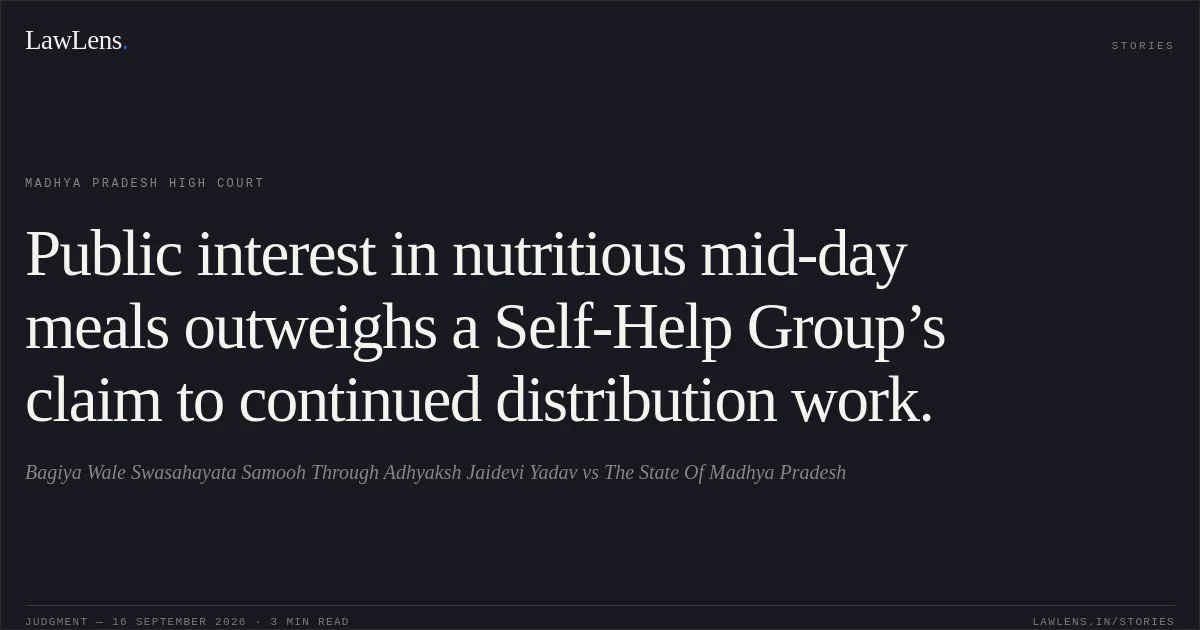
Source reference: pp.5–6The Court further applied the principle that the public interest in ensuring nutritious, fresh, and hygienic mid-day meals, linked to the right to life and health under Article 21, takes precedence over the Self-Help Group’s interest in continuing the assignment.
Source reference: p.5Reasoning
The Court found that the respondents had placed material showing that the impugned action followed a complaint, show-cause notice, enquiry, consideration by the competent authorities, and deliberation at the committee level.
Source reference: pp.2–3, 5Although the petitioner disputed the allegations and the manner in which the enquiry was conducted, determining whether the meals complied with the prescribed menu and whether the statements and certificates were reliable would require a factual and evidentiary inquiry beyond the normal scope of Article 226.
Source reference: pp.4–6Applying Neha Swa-sahayata Samooth, the Court held that even the petitioner’s objection regarding the authority competent to pass the order could not justify equitable writ interference in a matter directly affecting children’s nutrition and health, absent patent illegality, perversity, or jurisdictional error.
Source reference: pp.5–6The petitioner therefore failed to establish grounds warranting interference.
Source reference: no citationHolding
The Court held that the disputed factual allegations and procedural objections did not justify exercise of extraordinary writ jurisdiction.
Finding no patent illegality, perversity, or jurisdictional error in the decision to withdraw the mid-day meal distribution work, the Court dismissed the writ petition and declined to restore the petitioner’s assignment.
Source reference: pp.6–7Original Court PDF
Bagiya Wale Swasahayata Samooh Through Adhyaksh Jaidevi YadavvsThe State Of Madhya Pradesh
Click to open original judgment
Original judgment, available to read, download and summarize on LawLens.in