Facts
Respondent No. 2 alleged that she married Mayur Jain on 23 April 2024 with the consent of both families and that, after the marriage, her matrimonial family demanded ₹15,00,000 in cash and a four-wheeler as dowry.
Source reference: para. 2She further alleged that on 5 October 2024, her stridhan was taken away and she was sent to her parental home with a direction to return only after fulfilling the alleged demand.
Source reference: para. 2On the basis of her complaint dated 18 August 2025, FIR No. 65/2025 was registered for offences under Sections 85, 316(2) and 3(5) of the Bharatiya Nyaya Sanhita, 2023, read with Sections 3 and 4 of the Dowry Prohibition Act, 1961.
Source reference: para. 2After investigation, a charge-sheet was filed and proceedings in RCT No. 3600/2025 were initiated against the applicants and other co-accused persons.
Source reference: para. 2The applicants, stated to be relatives/brothers-in-law of the husband, sought quashing of the FIR and consequential criminal proceedings, contending that the allegations against them were general and omnibus and that no specific role or act of cruelty or dowry demand was attributed to them.
Source reference: para. 3Issues
Whether the FIR and consequential criminal proceedings against the applicants were liable to be quashed because the allegations against them were general, omnibus, and unsupported by specific instances or attribution of individual roles?
Source reference: paras. 3, 6, 10Whether continuation of the prosecution against the applicants, who were relatives of the husband, would amount to an abuse of the process of law in the absence of specific allegations of their active involvement?
Source reference: paras. 6–10Law Applied
The Court considered the offences alleged under Sections 85, 316(2) and 3(5) of the Bharatiya Nyaya Sanhita, 2023, read with Sections 3 and 4 of the Dowry Prohibition Act, 1961.
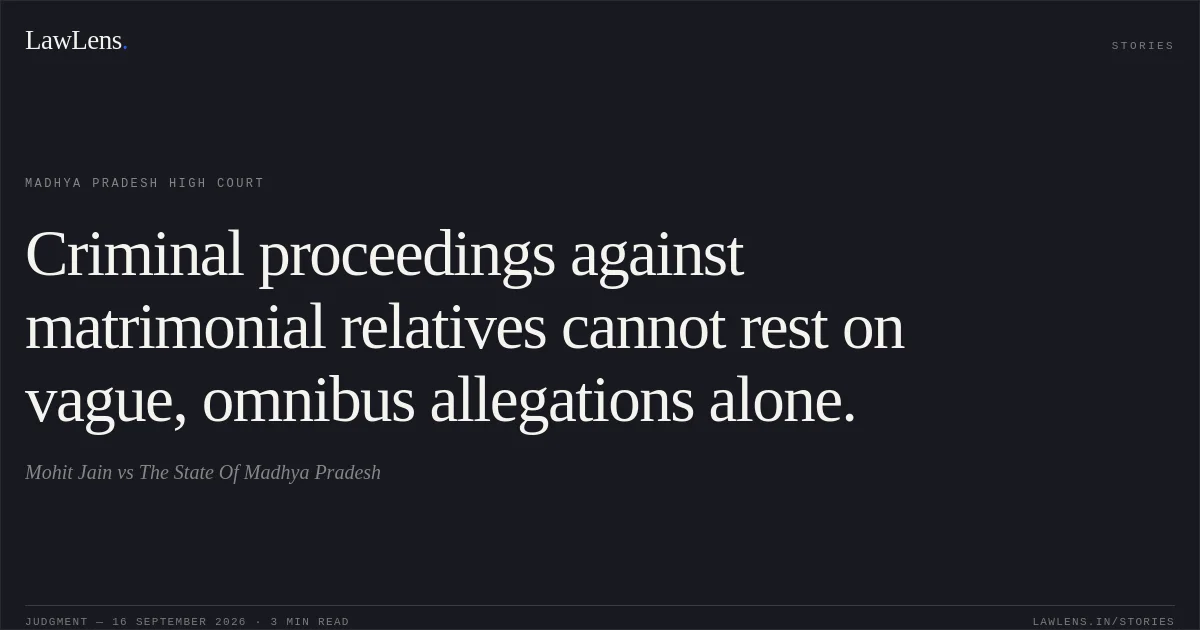
Source reference: para. 11Applying its inherent/extraordinary jurisdiction to prevent abuse of process, the Court held that relatives of the husband should not be prosecuted on the basis of vague or omnibus allegations without specific instances demonstrating their involvement.
Source reference: para. 7Relying on Kahkashan Kausar @ Sonam v. State of Bihar, particularly the principle drawn from K. Subba Rao v. State of Telangana, the Court reiterated that distant relatives should not be implicated unless specific instances of involvement are disclosed.
Source reference: para. 7It also relied on Preeti Gupta v. State of Jharkhand, which requires courts to scrutinise allegations in matrimonial complaints with care and circumspection because of the tendency to implicate the husband’s close relatives.
Source reference: para. 8The Court further relied on Dara Lakshmi Narayana & Others, which held that vague and sweeping allegations, without details of the time, place, manner, or individual role of each accused, cannot sustain criminal prosecution.
Source reference: para. 9Reasoning
The Court found that the allegations against the applicants were general and omnibus and that no specific or distinct act, instance, or role had been attributed to either applicant.
Source reference: para. 6The record did not disclose concrete allegations of cruelty or dowry demand against the applicants individually, including in the statements recorded during investigation.
Source reference: para. 3Applying the principles in Kahkashan Kausar, Preeti Gupta, and Dara Lakshmi Narayana, the Court held that merely naming relatives in a matrimonial dispute, without particularised allegations showing active involvement, was insufficient to continue a criminal prosecution.
Source reference: paras. 7–10Since the material did not enable the Court to ascertain the individual role allegedly played by the applicants, continuation of the proceedings against them was considered an abuse of the process of law.
Source reference: paras. 6, 10Holding
The Court answered the issues in favour of the applicants and allowed the petition.
FIR No. 65/2025 and the proceedings in RCT No. 3600/2025, insofar as they concerned the applicants, were quashed for the offences under Sections 85, 316(2) and 3(5) of the BNS, 2023, read with Sections 3 and 4 of the Dowry Prohibition Act, 1961.
Source reference: para. 11The applicants were discharged from the said charges, and their bail and surety bonds, if any, were discharged.
Source reference: para. 11The order was expressly confined to the applicants and was not to affect the proceedings against the other accused persons.
Source reference: para. 11Acts & Sections Cited
7 provisions across 4 statutes referred to in this judgment. Each provision opens on LawLens.
Bharatiya Nyaya Sanhita, 20233
Bharatiya Nagarik Suraksha Sanhita, 20231
Code of Criminal Procedure, 19731
Original Court PDF
Mohit JainvsThe State Of Madhya Pradesh
Click to open original judgment
Original judgment, available to read, download and summarize on LawLens.in