Facts
On 27 April 2020, during the COVID-19 lockdown, the appellant allegedly took the victim, a child born on 7 August 2012 and therefore below twelve years of age, into his room.
Source reference: p.2, para. 2PW-2 Anu saw the appellant taking the child inside and later saw the child emerge with difficulty in walking and cleaning his anal area after removing his pants.
Source reference: p.11, para. 27The child subsequently disclosed to his parents that the appellant had made him lie on a bed, removed his pants, and inserted his private part into the child’s anus.
Source reference: p.2, para. 2The matter was promptly reported to the landlord’s son, who informed the police; the FIR was registered under Sections 377 and 506 IPC and Sections 3, 4 and 6 of the POCSO Act.
Source reference: pp.3–4, paras. 5–7The Trial Court convicted the appellant under Section 6 of the POCSO Act and Section 377 IPC, sentencing him to rigorous imprisonment for 20 years and 10 years respectively, with concurrent sentences.
Source reference: p.1, para. 1The appellant challenged the conviction, principally contending that the absence of physical injuries, alleged inconsistencies, and supposed enmity with PW-2 rendered the prosecution case unreliable.
Source reference: pp.8–9, paras. 20–23Issues
Whether the prosecution proved beyond reasonable doubt that the appellant committed penetrative sexual assault upon the child, despite the absence of anal injuries or other conclusive medical signs of penetration.
Source reference: pp.8–9, paras. 20–23; p.16, para. 36Whether the evidence of the child, his parents, neighbouring witnesses, and the medical and forensic evidence was sufficiently reliable and corroborative to sustain the conviction.
Source reference: pp.10–13, paras. 24–33Whether the alleged enmity between PW-2 Anu and the appellant created a reasonable possibility of false implication.
Source reference: pp.11–12, paras. 29–31Whether the offence amounted to aggravated penetrative sexual assault under Sections 3, 5(m) and 6 of the POCSO Act, attracting the statutory minimum sentence of 20 years.
Source reference: pp.14–16, paras. 35–38Law Applied
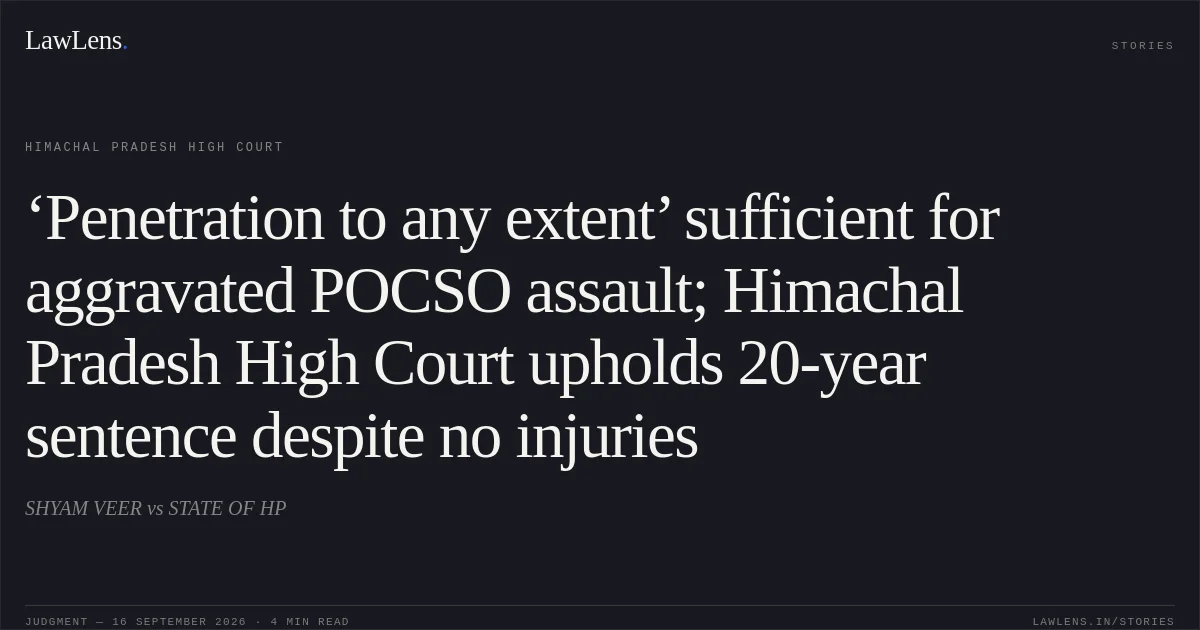
The Court applied Section 3 of the POCSO Act, which defines penetrative sexual assault to include penetration of the penis, to any extent, into the anus of a child.
Source reference: pp.14–16, paras. 35–38Section 5(m), which classifies penetrative sexual assault upon a child below twelve years as aggravated penetrative sexual assault; and Section 6, which prescribes a minimum sentence of 20 years’ rigorous imprisonment for aggravated penetrative sexual assault.
Source reference: pp.14–16, paras. 35–38The Court also considered Section 377 IPC in relation to the alleged carnal intercourse against the order of nature.
Source reference: p.1, para. 1The absence of injuries is not by itself fatal where the testimony of the victim and surrounding circumstances are credible and are corroborated by other evidence.
Source reference: pp.8–9, paras. 21–23; p.16, para. 36The Court further relied on the statutory presumption and evidentiary framework of the POCSO Act, though no specific provision was expressly discussed in the judgment, and assessed the prompt reporting, natural testimony, medical evidence, and DNA evidence cumulatively.
Source reference: pp.10–13, paras. 24–33Reasoning
The Court found the testimony of the child and the surrounding witnesses credible and consistent.
Source reference: pp.10–13, paras. 24–31PW-2 had directly observed the appellant taking the child into his room and had seen the child emerge in a frightened condition, walking abnormally and cleaning his anal area; PW-6, PW-7, the landlord, and the child’s parents provided natural and prompt corroboration.
Source reference: pp.10–13, paras. 24–31The child’s age was established through his school birth certificate, proving that he was below twelve years of age.
Source reference: p.11, para. 27Although the medical examination revealed no anal tear, abrasion, bleeding, or other visible injury, the Court held that penetration “to any extent” falls within Section 3 of the POCSO Act and that the absence of injury does not negate the offence.
Source reference: pp.7–8, para. 18; p.16, para. 36The forensic evidence further supported the prosecution: semen was detected on the victim’s pants and the appellant’s underwear, and the DNA profile from the victim’s pants matched the appellant’s blood sample.
Source reference: p.13, paras. 32–33The alleged motive for false implication was rejected because it rested only on inconsistent defence suggestions and was not supported by evidence; there was also no demonstrated enmity between the appellant and the victim’s family or PW-6.
Source reference: pp.11–12, paras. 29–31On the cumulative assessment of the oral, medical, and forensic evidence, the Court held that the prosecution had established aggravated penetrative sexual assault beyond reasonable doubt.
Source reference: pp.13–16, paras. 32–38Holding
The appeal was dismissed.
The Court affirmed the appellant’s conviction under Section 6 of the POCSO Act and Section 377 IPC, holding that the victim’s age, the credible ocular evidence, prompt reporting, and forensic corroboration established aggravated penetrative sexual assault notwithstanding the absence of visible injuries.
Source reference: pp.13–16, paras. 32–38The sentence of 20 years’ rigorous imprisonment and a fine of ₹5,000 under Section 6 of the POCSO Act, together with 10 years’ rigorous imprisonment and a fine of ₹3,000 under Section 377 IPC, with substantive sentences running concurrently, was affirmed.
Source reference: p.1, para. 1; p.16, para. 38The record was directed to be returned to the Trial Court, and pending miscellaneous applications were disposed of.
Source reference: p.17, paras. 39–41Acts & Sections Cited
10 provisions across 3 statutes referred to in this judgment. Each provision opens on LawLens.
Indian Penal Code, 18602
Code of Criminal Procedure, 19734
Original Court PDF
SHYAM VEERvsSTATE OF HP
Click to open original judgment
Original judgment, available to read, download and summarize on LawLens.in