Facts
The petitioner-wife sought maintenance under Section 125 Cr.P.C., alleging dowry-related cruelty and that she had been compelled to leave the matrimonial home.
Source reference: no citationThe respondent-husband denied the allegations, asserting that she lived separately without sufficient reason and that he was willing to keep her with him.
Source reference: no citationThe Family Court found that the wife could not maintain herself and that the husband had sufficient means, but dismissed her application because she had not complied with an ex parte decree for restitution of conjugal rights.
Source reference: para. 2–6, 14The wife challenged that order in revision.
Source reference: no citationThe record showed that she complained to the police on 2 October 2010, the husband sought restitution of conjugal rights on 4 October 2010, and an ex parte decree was passed on 29 March 2011; the husband later filed for divorce.
Source reference: para. 18–19The husband also relied on the subsequent acquittal in the criminal case.
Source reference: para. 12Issues
1. Whether the decree for restitution of conjugal rights, and the wife’s non-compliance with it, was by itself sufficient to disentitle her to maintenance under Section 125(4) Cr.P.C.
Source reference: para. 15–182. Whether the wife had sufficient reason to live separately, notwithstanding the acquittal in the criminal case arising from her allegations of cruelty.
Source reference: para. 22–26Law Applied
Section 125 Cr.P.C. provides a summary remedy to prevent destitution and vagrancy; a wife seeking maintenance must establish that she is unable to maintain herself, that her husband has sufficient means and neglects or refuses to maintain her, and that she has sufficient reason to live separately.
Source reference: para. 27–31Under Section 125(4), a decree for restitution of conjugal rights obtained by the husband, coupled with the wife’s non-compliance, does not automatically disentitle her to maintenance; the question depends on the facts and evidence of the case (Kirtikant D. Vadodaria v. State of Gujarat, (1996) 4 SCC 479; Rina Kumari @ Rina Devi @ Reena v. Dinesh Kumar Mahto @ Dinesh Kumar Mahato, 2025 (3) SCC 33).
Source reference: para. 16–17An acquittal in a prosecution under Section 498-A IPC does not, by itself, negate the wife’s sworn account of cruelty or remove her reasonable ground to live separately.
Source reference: para. 22–25Maintenance is a measure of social justice intended to prevent destitution (Chaturbhuj v. Sita Bai, (2008) 2 SCC 316; Bhuwan Mohan v. Meena, (2015) 6 SCC 353; Rajnesh v. Neha, (2021) 2 SCC 324).
Source reference: para. 27–29Reasoning
The Family Court treated non-compliance with the restitution decree as determinative and, on that basis, rejected the wife’s account of why she lived separately.
Source reference: para. 18–21The High Court held that this approach was legally unsustainable: the decree was passed ex parte after the wife’s police complaint, and the husband made no recorded attempt to enforce it before filing for divorce.
Source reference: para. 18–21The wife’s prosecution of the husband under Section 498-A IPC, together with her testimony of cruelty, provided a reasonable basis for separate residence; the later acquittal did not, by itself, erase that evidence.
Source reference: para. 22–26Since the Family Court had already found that the wife could not maintain herself and that the husband had sufficient means, it erred in denying maintenance solely on the restitution decree and its non-compliance.
Source reference: para. 14, 31–33Holding
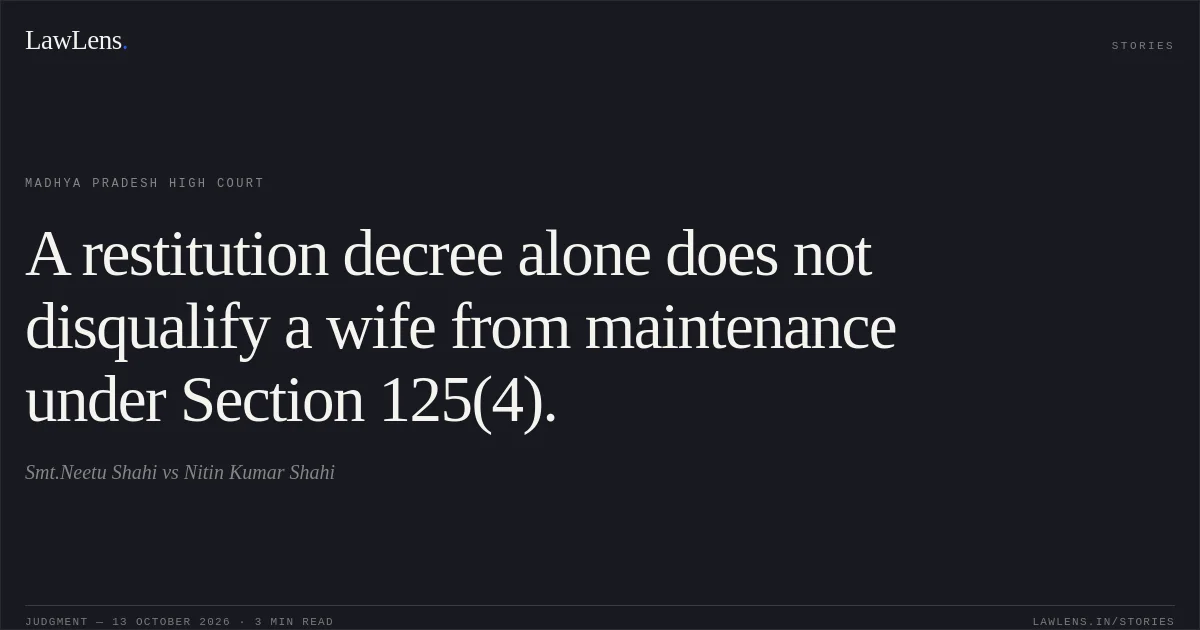
The High Court held that a restitution decree and the wife’s failure to comply with it do not, by themselves, attract the disqualification under Section 125(4) Cr.P.C.; the circumstances must be assessed on the evidence in each case.
It allowed the revision, set aside the Family Court’s order, and remanded the matter for determination of the quantum of maintenance in accordance with law and the guidelines in Rajnesh v. Neha.
Source reference: para. 34–36Acts & Sections Cited
9 provisions across 4 statutes referred to in this judgment. Each provision opens on LawLens.
Code of Criminal Procedure, 19733
Indian Penal Code, 18603
Hindu Marriage Act, 19551
Original Court PDF
Smt.Neetu ShahivsNitin Kumar Shahi
Click to open original judgment
Original judgment, available to read, download and summarize on LawLens.in

![Railway pensioners qualify for additional pension only upon completing 80 years of age.. OM PRAKASH MISHRA vs NORTH EASTERN RAILWAY. CAT - ['Allahabad']. LawLens](/stories/thumbnails/railway-pensioners-qualify-for-additional-pension-only-upon-completing-80-years-of-age-e4a0c68f01cd4886b5cdc93e3a4b5e33.webp)