Facts
The appellants were convicted by the Judicial Commissioner, Ranchi, under Sections 302/34 of the Indian Penal Code and sentenced to imprisonment for life for the murder of Baleshwar Thakur.
Source reference: paras. 2–8, 25, 39The deceased’s father lodged a fardbeyan against unknown persons after finding the deceased’s body in a field with a rope around his neck. The post-mortem established homicidal death caused by asphyxia due to pressure on the neck.
Source reference: paras. 2–8, 25, 39The prosecution projected P.Ws. 1 and 2 as eyewitnesses, relying substantially on their statements recorded under Section 164 Cr.P.C.; however, both witnesses turned hostile during trial, denied witnessing the assault, and alleged that the police had coerced them into making the statements.
Source reference: paras. 21–24, 60–68The prosecution also relied on an alleged village Panchayat in which the appellants purportedly confessed, but no Panchayat document was exhibited and the relevant persons were not adequately examined. The Investigating Officer was not examined; only the officer who submitted the charge-sheet was examined. The appeal challenged the conviction and sentence under Section 374(2) Cr.P.C.
Source reference: paras. 1, 19, 27–30, 34, 39(v), 83–96Issues
1. Whether statements recorded under Section 164 Cr.P.C. can be treated as substantive evidence when the makers subsequently turn hostile during trial?
Source reference: paras. 40–582. Whether, in the absence of direct evidence, the appellants could be convicted solely on the basis of the hostile witnesses’ Section 164 Cr.P.C. statements?
Source reference: paras. 40–41, 56–703. Whether the prosecution established a complete and conclusive chain of circumstantial evidence proving the appellants’ guilt beyond reasonable doubt?
Source reference: paras. 72–83, 97–98Law Applied
The Court applied Sections 302/34 IPC concerning murder committed with common intention and Section 374(2) Cr.P.C. governing appeals against conviction.
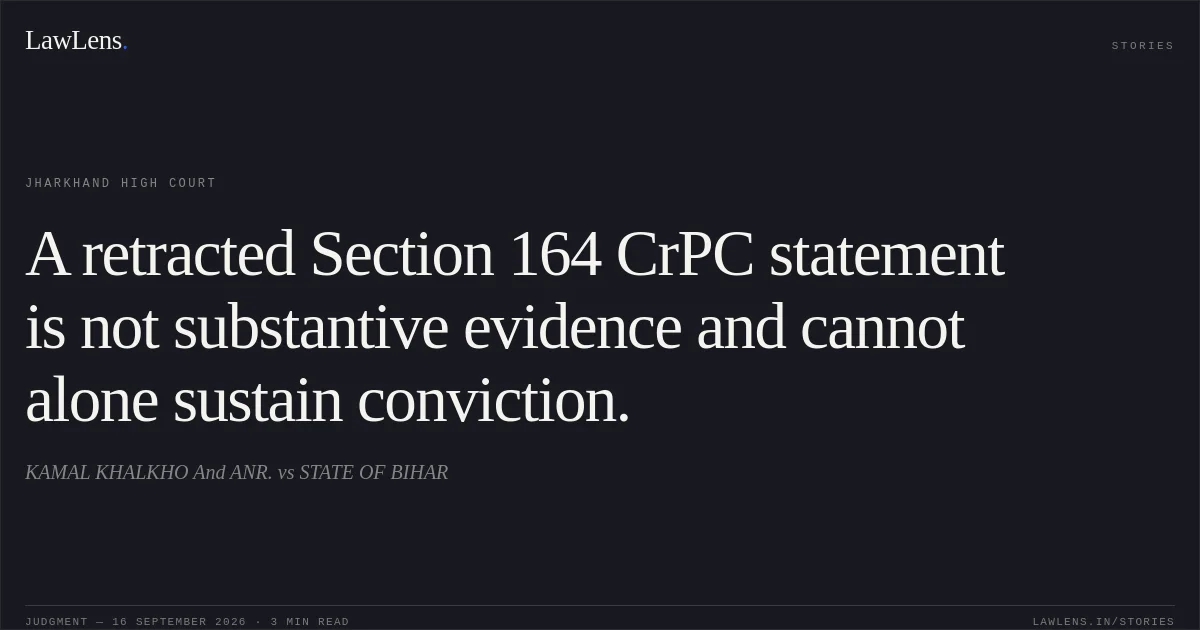
Source reference: paras. 1, 17A statement recorded under Section 164 Cr.P.C. is not substantive evidence; it may be used only to corroborate or contradict its maker under Sections 157 and 145 of the Evidence Act, and cannot, by itself, support conviction when the witness does not affirm its contents in court.
Source reference: paras. 42–58The Court relied on Ram Kishan Singh v. Harmit Kaur , AIR 1972 SC 468; Utpal Das v. State of West Bengal , (2010) 6 SCC 493; Baij Nath Sah v. State of Bihar , (2010) 6 SCC 736; and R. Shaji v. State of Kerala , (2013) 14 SCC 266.
Source reference: paras. 44–51For circumstantial evidence, every circumstance must be firmly established, consistent only with guilt, conclusive in tendency, incompatible with innocence, and form a complete chain pointing unerringly to the accused, as stated in Hanumant v. State of Madhya Pradesh , AIR 1952 SC 343; Sharad Birdhichand Sarda v. State of Maharashtra , (1984) 4 SCC 116; and Padala Veera Reddy v. State of Andhra Pradesh , 1989 Supp. (2) SCC 706.
Source reference: paras. 75–80The prosecution bears the burden of proving guilt beyond reasonable doubt, and where two views are reasonably possible, the view favourable to the accused must be adopted.
Source reference: paras. 99–103Reasoning
The Court held that P.Ws. 1 and 2 had completely retracted their alleged eyewitness accounts, denied witnessing the occurrence, and attributed their Section 164 statements to police coercion.
Source reference: paras. 60–69Their earlier statements were therefore usable only for contradiction or corroboration and could not constitute substantive evidence or independently establish the appellants’ guilt.
Source reference: paras. 42–58, 69–70Although the medical evidence proved that the death was homicidal, it did not connect either appellant with the crime.
Source reference: paras. 25, 39(i)The informant and the deceased’s mother were admittedly not eyewitnesses, and the informant’s evidence regarding the alleged Panchayat was hearsay. The alleged Panchayat was not proved through documentary or reliable oral evidence, the persons said to have attended it were largely not examined, and the Investigating Officer’s non-examination further weakened the prosecution case.
Source reference: paras. 83–96Consequently, the prosecution failed to establish any complete chain of circumstances linking the appellants to the murder, and the conviction under Sections 302/34 IPC could not be sustained.
Source reference: paras. 97, 104–106Holding
The Court answered the issues against the prosecution, holding that the hostile witnesses’ Section 164 Cr.P.C. statements were not substantive evidence and could not, without independent corroboration, form the basis of conviction.
It further held that the circumstantial evidence was incomplete and did not prove the appellants’ guilt beyond reasonable doubt.
Source reference: paras. 97, 104–106The judgment of conviction and order of sentence dated 31.08.1998 were quashed and set aside; the appellants were acquitted of the charge under Sections 302/34 IPC, and their bail bonds were discharged.
Source reference: paras. 107–110Acts & Sections Cited
11 provisions across 4 statutes referred to in this judgment. Each provision opens on LawLens.
Code of Criminal Procedure, 19735
Indian Penal Code, 18602
Bharatiya Nagarik Suraksha Sanhita, 20233
Bharatiya Sakshya Adhiniyam, 20231
Original Court PDF
KAMAL KHALKHO And ANR.vsSTATE OF BIHAR
Click to open original judgment
Original judgment, available to read, download and summarize on LawLens.in