Facts
The Seventh Industrial Tribunal, West Bengal, passed an ex parte award under Section 2A(2) of the Industrial Disputes Act, 1947, setting aside the employee’s termination, directing reinstatement with full back wages and consequential benefits, and awarding compensation and costs.
Source reference: para. 1, 13The Tribunal found the termination unlawful both for non-compliance with Section 25F and for failure to initiate disciplinary proceedings under clause 28 of the appointment letter.
Source reference: para. 14–18The employer’s application to set aside or recall the award was dismissed; the employer then challenged both the award and the dismissal order in a writ petition.
Source reference: para. 1The High Court set aside the award on its merits without deciding the validity of the order refusing recall.
Source reference: para. 23Issues
Whether the ex parte award was liable to be set aside on the merits, particularly in light of the Tribunal’s findings under Section 25F and clause 28 of the appointment letter.
Source reference: para. 21–23Whether the employer was required to comply with the remaining requirements of Section 25F, and, if so, within what time and with what interest.
Source reference: para. 24Law Applied
Section 2(oo) of the Industrial Disputes Act defines “retrenchment” to include termination for any reason, other than termination by way of disciplinary punishment, subject to the statutory exclusions.
Source reference: para. 16Section 25F prescribes conditions precedent to retrenchment; the Court treated the termination as retrenchment and observed that the termination letter showed payment of one month’s notice pay, prima facie satisfying the notice requirement.
Source reference: para. 18–20Section 2A(2) provides the basis for an individual workman’s industrial dispute concerning termination to be adjudicated.
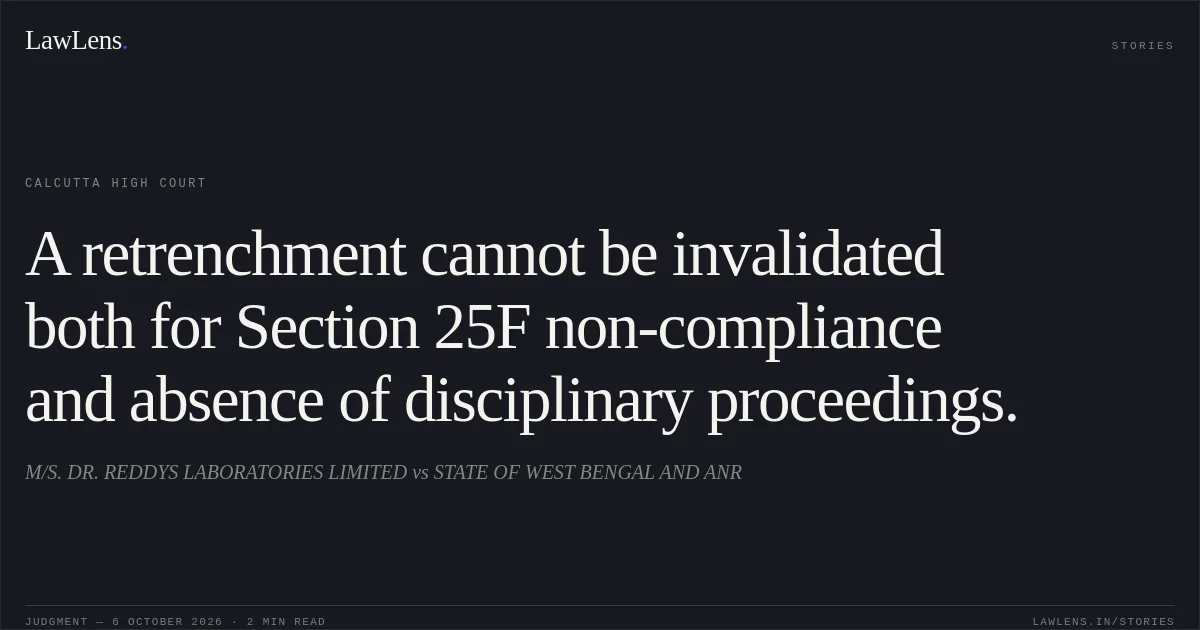
Source reference: para. 1, 20The Court held that the Tribunal could not treat the same termination as unlawful both for non-compliance with Section 25F—which concerns retrenchment other than disciplinary punishment—and for failure to initiate disciplinary proceedings, where the record showed prima facie compliance with the notice-pay requirement under Section 25F.
Source reference: para. 21–23Although the parties cited authorities on ex parte awards and review or recall, the Court did not resolve those questions or rely on those authorities in setting aside the award.
Source reference: para. 5–12, 23Reasoning
The Court found that the employer had terminated the employee otherwise than as punishment through disciplinary action, bringing the termination within the definition of retrenchment and making the Section 2A(2) proceeding maintainable.
Source reference: para. 17, 20The termination letter recorded payment of one month’s notice pay, so the Tribunal’s finding of non-compliance with Section 25F was not sustainable on that basis.
Source reference: para. 18–19The Court considered the Tribunal’s simultaneous reliance on Section 25F and the absence of disciplinary proceedings contradictory in the circumstances, and held the award perverse, erroneous, and bad in law.
Source reference: para. 21–23It did not determine whether the Tribunal had rightly refused to set aside or recall the ex parte award.
Source reference: para. 23Holding
The High Court allowed the writ petition and set aside the ex parte award dated 27 December 2024.
It directed the employer to comply with clauses (b) and (c) of Section 25F within 30 days, if not already complied with, together with statutory interest from the date of retrenchment until payment.
Source reference: para. 24The Court left the order refusing to set aside or recall the award undecided.
Source reference: para. 23Acts & Sections Cited
5 provisions across 1 statute referred to in this judgment. Linked provisions open on LawLens.
Industrial Disputes Act, 19475
Original Court PDF
M/S. DR. REDDYS LABORATORIES LIMITEDvsSTATE OF WEST BENGAL AND ANR
Click to open original judgment
Original judgment, available to read, download and summarize on LawLens.in