Facts
The appellants, original plaintiffs, instituted proceedings under Section 5 of the Mamlatdars’ Courts Act, 1906, claiming an ancestral access way along the southern side of Revenue Survey No. 265/1 to reach their agricultural land.
Source reference: p.1, para. 1The Mamlatdar rejected the claim, finding that the alleged southern way had been discontinued approximately ten years before the suit was filed.
Source reference: p.1, para. 1Before the High Court, the appellants contended that although the southern way had ceased to be used, they had subsequently used an eastern-side route, which was allegedly blocked about one month before institution of the suit. However, that fact was not pleaded in the original plaint.
Source reference: p.2, paras. 2–4In revision, the Deputy Collector directed the respondents to permit use of a different way passing along the western boundary of Survey No. 265/1.
Source reference: p.3, para. 5The Single Judge set aside that order, holding that the Deputy Collector had introduced a new access route that was not the subject matter of the original suit and had exceeded revisional jurisdiction.
Source reference: pp.3–4, paras. 5–7Issues
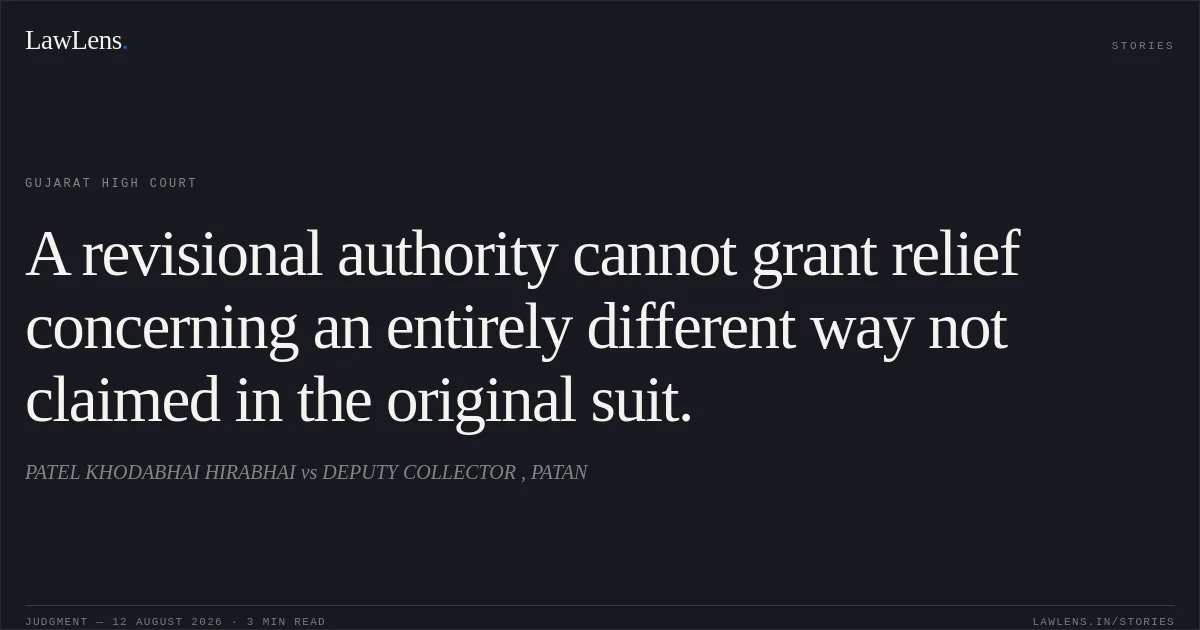
1. Whether the Deputy Collector, while exercising revisional jurisdiction under the proceedings arising from Section 5 of the Mamlatdars’ Courts Act, 1906, could direct the respondents to permit use of an altogether different way that was not claimed in the original plaint.
Source reference: pp.3–4, paras. 5–82. Whether the Single Judge erred in setting aside the Deputy Collector’s direction on the ground that the claimed southern way had been discontinued and that the Deputy Collector had introduced a new case in revision.
Source reference: p.4, paras. 6–8Law Applied
The proceedings were governed by Section 5 of the Mamlatdars’ Courts Act, 1906, under which the Mamlatdar adjudicated the appellants’ claim concerning the alleged obstruction of an access way.
Source reference: p.1, para. 1Revisional jurisdiction is confined to examining the legality and propriety of the subordinate authority’s order and does not permit the revisional authority to grant relief on an altogether new factual case or in respect of a route that was not the subject matter of the original proceedings.
Source reference: p.4, para. 7A party is also expected to disclose material facts in its original pleading; a subsequent change in the factual case cannot ordinarily support relief beyond the scope of the original claim.
Source reference: p.2, paras. 3–4Reasoning
The Court held that the original plaint asserted only that the southern side of Survey No. 265/1 constituted an ancestral way and that no other access existed, while omitting the alleged use and later obstruction of the eastern-side route.
Source reference: p.2, paras. 3–4The Mamlatdar’s finding that the southern way had been discontinued for about ten years was not challenged in the appeal.
Source reference: p.2, para. 2Despite this, the Deputy Collector directed the respondents to open a western-side route, which was an altogether different way and had not been claimed in the original suit.
Source reference: p.3, para. 5Since that direction was based on a newly introduced case and exceeded the permissible scope of revision, the Single Judge correctly quashed it.
Source reference: p.4, para. 8The appellants failed to demonstrate any infirmity in that reasoning.
Source reference: p.4, para. 8Holding
The High Court dismissed the Letters Patent Appeal as devoid of merit and affirmed the Single Judge’s decision setting aside the Deputy Collector’s direction to permit use of the western-side route.
The Court imposed no order as to costs.
Source reference: p.5, paras. 8–9The connected Civil Application for Stay was disposed of as having become infructuous.
Source reference: p.5, paras. 8–9Acts & Sections Cited
1 provisions across 1 statute referred to in this judgment. Linked provisions open on LawLens.
Mamlatdars1
Original Court PDF
PATEL KHODABHAI HIRABHAIvsDEPUTY COLLECTOR , PATAN
Click to open original judgment
Original judgment, available to read, download and summarize on LawLens.in