Facts
The petitioner, a proprietorship firm operating a Hindustan Petroleum Corporation Limited retail outlet, established its outlet on the Badora–Pichhor PMGSY-2 Road after obtaining the requisite approvals and NOCs.
Source reference: pp. 2–3Respondent No. 6 invited applications for another retail outlet at Khasra No. 281, Mauja Nohora, on the same road, allegedly in close proximity to the petitioner’s outlet.
Source reference: pp. 3–4The petitioner submitted objections, but an NOC was issued in favour of the selected applicant on 4 October 2024.
Source reference: pp. 3–4Following the petitioner’s complaint, the authorities acknowledged that the earlier NOC had been issued mistakenly, directed that its operation be stopped, and indicated that a fresh application and compliance with the applicable Government guidelines would be required.
Source reference: p. 4A subsequent NOC was issued on 17 December 2024, which the petitioner challenged under Article 226 of the Constitution on the grounds that the proposed outlet was approximately 107 metres from his outlet, contrary to the alleged 300-metre requirement; that no fresh application or licence fee had been submitted; and that the NOC had been issued without hearing him.
Source reference: pp. 3–4The petitioner had also approached the Allahabad High Court.
Source reference: pp. 4–5In Writ-C No. 23565 of 2024, he was granted liberty to submit a representation under Clause 18 of the 2023 dealership brochure, with a direction to the competent authority to consider it after notice and hearing.
Source reference: pp. 4–5Another writ petition was dismissed on the ground of multiplicity of proceedings.
Source reference: pp. 4–5The respondents contested the petition on the grounds of lack of territorial jurisdiction, availability of the Clause 18 grievance mechanism, and the inapplicability of the 300-metre guideline to the road in question.
Source reference: pp. 5–6Issues
Whether the impugned NOC dated 17 December 2024 was liable to be quashed on the ground that the proposed retail outlet violated the alleged mandatory requirement of maintaining a minimum distance of 300 metres from the petitioner’s existing outlet?
Source reference: pp. 6–7Whether the applicability of the 300-metre guideline depended upon the classification and nature of the road and the relevant dealership process?
Source reference: pp. 6–7Whether the disputed factual questions concerning distance, road classification, compliance with NOC conditions, payment of licence fee, and submission of documents could be adjudicated in a writ petition under Article 226?
Source reference: pp. 7–9Whether the petitioner, as a rival retail outlet dealer, was entitled to a prior hearing and could challenge the NOC on the ground of violation of natural justice?
Source reference: pp. 8–9Whether the petitioner was required to pursue the grievance redressal mechanism under Clause 18 of the applicable dealership brochure?
Source reference: pp. 4–5, 7–9Law Applied
The Court exercised its jurisdiction under Articles 226 and 227 of the Constitution but reiterated that disputed questions of fact and dealership-related grievances should ordinarily be examined by the competent authority or an efficacious alternative forum rather than through writ proceedings.
Source reference: pp. 7–9The Government guidelines concerning a 300-metre separation between retail outlets cannot be mechanically applied unless their applicability to the particular road, access, and dealership process is established.
Source reference: pp. 5–7In Jay Shankar Kapoor v. Bharat Petroleum Corporation Limited & Another, the Court held that such guidelines, in the circumstances of that case, applied in the context of National Highways and could not automatically be extended to a Major District Road.
Source reference: pp. 5–7Clause 18 of the 2023 dealership brochure provides a specialised grievance redressal mechanism requiring complaints to be considered by the Oil Company and decided by a speaking order.
Source reference: pp. 5, 8A rival dealer has no absolute right to veto the establishment of another retail outlet merely because it may cause adverse commercial consequences, although relevant statutory and regulatory violations may be examined by the competent authority.
Source reference: pp. 8–9Reasoning
The Court held that the petitioner had not established that the alleged 300-metre restriction constituted an enforceable statutory prohibition applicable to the road and dealership in question.
Source reference: pp. 6–7The petitioner relied on the guideline without demonstrating whether the road was one to which the guideline applied, while the respondents relied on the road’s classification and Jay Shankar Kapoor.
Source reference: pp. 6–7The alleged distance of 107 metres, the classification of the road, compliance with NOC conditions, payment of licence fee, and submission of requisite documents were factual matters requiring examination of departmental records and possible verification by the competent authority; they could not ordinarily be conclusively determined in a writ petition based on competing assertions.
Source reference: pp. 7–8The petitioner had already objected before the authorities and had been granted liberty by the Allahabad High Court to invoke the Clause 18 mechanism.
Source reference: pp. 7–9Consequently, the Court declined to adjudicate the dealership dispute under Article 226.
Source reference: pp. 7–9The earlier NOC having been stopped or withdrawn did not, by itself, invalidate the subsequent NOC dated 17 December 2024; its legality had to be assessed on the norms and material existing when it was issued.
Source reference: p. 9Further, the petitioner’s status as a rival dealer did not confer an absolute right to a hearing or a veto over a competing outlet, particularly where he had already availed opportunities to raise objections.
Source reference: pp. 8–9Holding
The Court found no sufficient ground to interfere with the NOC dated 17 December 2024 under Article 226/227, holding that the petitioner had failed to establish any statutory prohibition rendering the NOC void ab initio.
The writ petition was accordingly dismissed.
Source reference: p. 9The Court clarified that the dismissal would not prevent the petitioner from pursuing any otherwise available remedy before the competent authority or forum, including the Clause 18 grievance redressal mechanism, subject to the orders of the Allahabad High Court and issues of limitation and maintainability.
Source reference: p. 10The intervention application filed by the proposed selected dealer was rejected as unnecessary because the writ petition had already been dismissed and Bharat Petroleum Corporation Limited was already a party.
Source reference: pp. 10–11No order as to costs was made.
Source reference: p. 11Original Court PDF
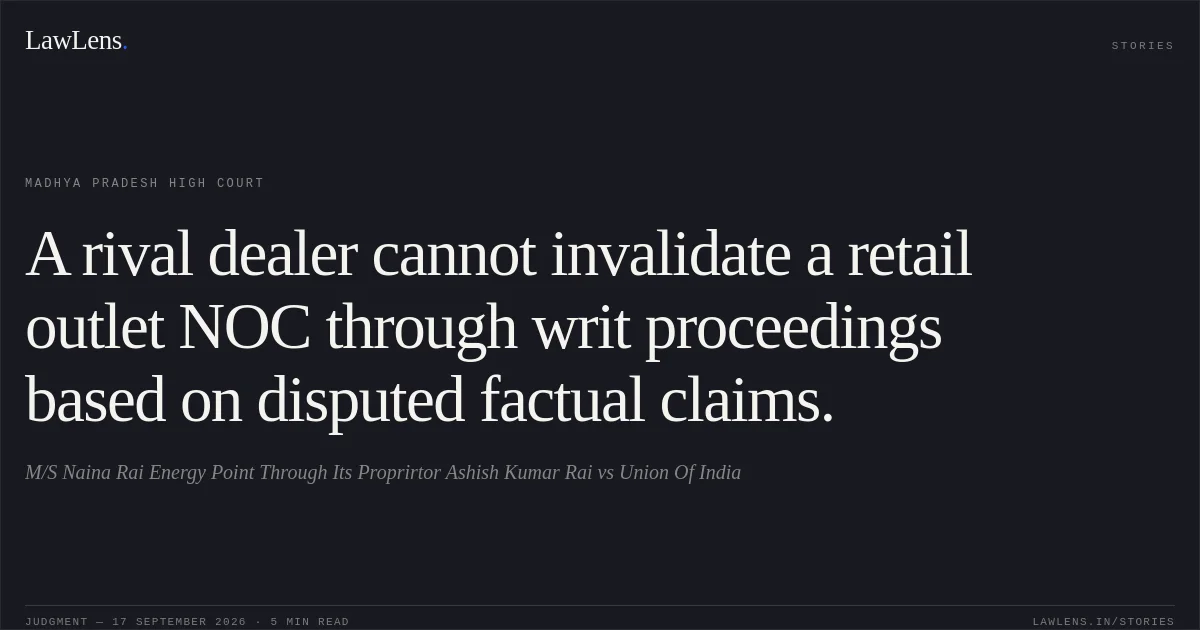
M/S Naina Rai Energy Point Through Its Proprirtor Ashish Kumar RaivsUnion Of India
Click to open original judgment
Original judgment, available to read, download and summarize on LawLens.in