01Facts
The plaintiff, Sri Uddhab Datta, instituted a suit seeking declaration of title over the suit properties—item I on the basis of a registered sale deed dated 20 February 1997 and item II on the basis of adverse possession—along with declaration that the defendants had no right or interest and a permanent injunction.
¶ 3–11The sale deed described its executant as “Puspa Bala Goswami,” whereas Defendant No. 1 was described in the plaint as “Puspa Rani Goswami”; Defendant No. 1 denied executing the sale deed and alleged that it was forged.
¶ 12–16, 33–34The Trial Court dismissed the suit, principally holding that the sale deed had not been duly proved, that no attesting witness or Registrar’s Record Keeper had been examined, and that the plaintiff had not established that Puspa Bala Goswami and Puspa Rani Goswami were the same person.
¶ 18–21The First Appellate Court reversed the decree, finding that Defendant No. 1 was also known as Puspa Bala Goswami, relying on the sale deed, her written statement, her signature on the notice in the temporary-injunction proceedings, and the evidence of the deed’s scribe.
¶ 24–27It held that the sale deed was binding on Defendant No. 1 to the extent of her share, granted the plaintiff title over half of the property, set aside the cancellation of mutation, and granted permanent injunction against Defendant No. 1.
¶ 28–31Defendant No. 1 filed the present second appeal challenging those findings.
¶ 3202Issues
i.1. Whether the executant named as “Puspa Bala Goswami” in the registered sale deed was the same person as Defendant No. 1, described as “Puspa Rani Goswami”/“Puspa Rani Baishnab,” and whether she executed the sale deed in favour of the plaintiff?
¶ 33–39ii.2. Whether the plaintiff was required to examine an attesting witness or the Record Keeper of the Registration Office to prove execution of the registered sale deed?
¶ 19, 42–43iii.3. Whether the First Appellate Court was justified in granting the plaintiff declaration of title to the extent of half of the property and permanent injunction?
¶ 28–31, 44–45iv.4. Whether the second appeal involved any substantial question of law warranting interference with the First Appellate Court’s judgment?
¶ 4603Law Applied
The Court applied the principle that a registered sale deed carries a strong presumption of validity and genuineness and cannot be lightly characterised as sham or forged; the burden lies heavily on the person challenging it to produce cogent evidence, as held in Hemalatha v. Tukaram, (2026) 5 SCC 168, and reiterated in Shri Mukund Bhavan Trust v. Shrimant Chhatrapati Udayan Raje Pratapsinh Maharaj Bhonsle, (2024) 15 SCC 675.
¶ 40–41It further applied the rule that a sale deed is not compulsorily required by law to be attested and, consequently, the proviso to Section 68 of the Indian Evidence Act, 1872—which requires an attesting witness where a document is legally required to be attested—does not mandate examination of an attesting witness for proving a sale deed, as held in R. Veronica v. Rudrayani Devaki, Civil Appeal No. 6526 of 2024, decided on 14 July 2026, following Hans Raji v. Yasodanand, (1996) 7 SCC 122, and Bayanabai Kawre v. Rajendra, (2018) 1 SCC 585.
¶ 42A co-sharer’s transfer is effective to the extent of the transferor’s share, though it cannot prejudice the rights of other co-sharers.
¶ 28Provisions in the judgment · 1
Indian Evidence Act, 1872 Section 68
04Reasoning
The Court upheld the First Appellate Court’s factual finding that Puspa Bala Goswami and Defendant No. 1 were the same person. Both the sale deed and Defendant No. 1’s written statement contained the same husband’s name, Binode Bihari Goswami; Defendant No. 1 did not specifically deny that she was also known as Puspa Bala Goswami; and she had signed the notice in the injunction proceedings using that name.
¶ 35–39The evidence of PW-4, the scribe, further corroborated the execution of the sale deed, and Defendant No. 1’s general denial did not displace the strong presumption attached to a registered instrument.
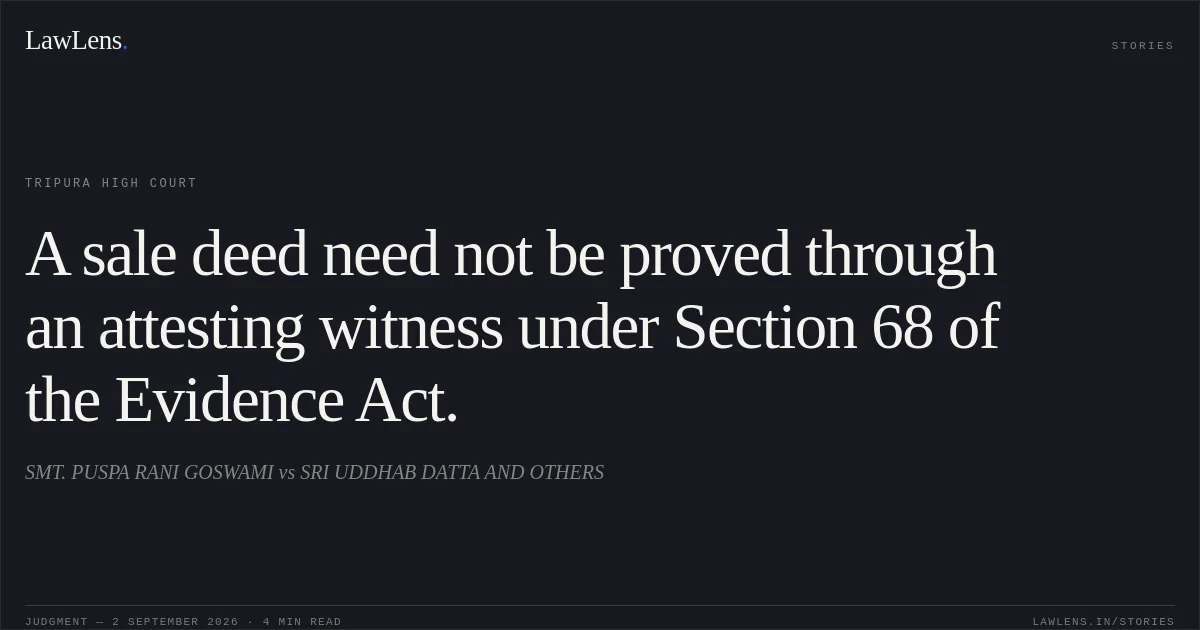
¶ 39–41The Trial Court’s insistence on examination of an attesting witness was legally erroneous because a sale deed is not a document required by law to be attested; therefore, Section 68 of the Evidence Act did not impose such a requirement.
¶ 42Since Defendants Nos. 2 to 8 claimed co-sharership but had not been effectively cross-examined by the plaintiff, the First Appellate Court appropriately restricted the declaration to half of the property—the extent attributable to Defendant No. 1’s share—and did not grant an unrestricted declaration against the other co-sharers.
¶ 28, 44The concurrent factual findings regarding the plaintiff’s possession and entitlement to injunction disclosed no error of law.
¶ 4505Holding
The High Court held that Defendant No. 1 was also known as Puspa Bala Goswami and had executed the registered sale deed dated 20 February 1997 in favour of the plaintiff.
¶ 38–43It held that no attesting witness was legally required to prove the sale deed and that the plaintiff was entitled to declaration of title to the extent of half of the property, together with permanent injunction and restoration of the mutation position as directed by the First Appellate Court.
¶ 28–31, 44–45Finding no substantial question of law, the Court dismissed the second appeal, imposed no costs, and disposed of any pending applications.
¶ 46Original Court PDF
SMT. PUSPA RANI GOSWAMIvsSRI UDDHAB DATTA AND OTHERS
Click to open original judgment
Original judgment, available to read, download and summarize on LawLens.in