Facts
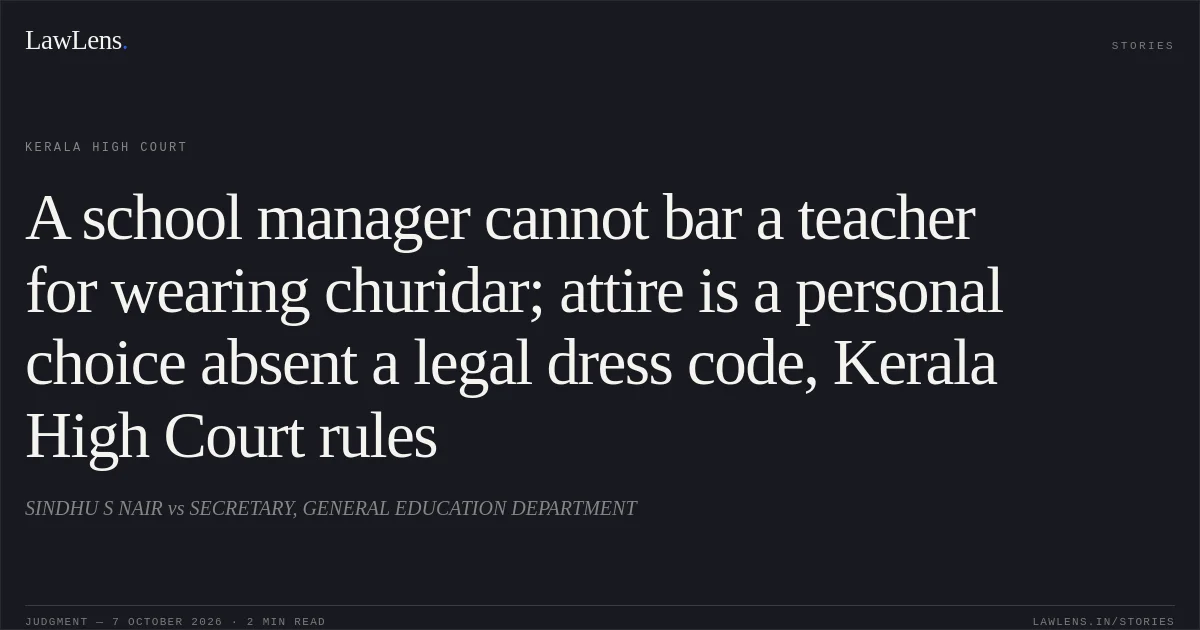
The petitioner, Headmistress of Eeswara Vilasom High School, alleged that the school Manager directed her to wear a saree rather than a churidar and caused her to be stopped at the school gate when she wore a churidar.
Source reference: pp. 3–5She relied on a Directorate of General Education circular permitting teachers to wear churidar and sought, among other reliefs, the Manager’s disqualification and police protection.
Source reference: pp. 3–5The Manager denied imposing a dress code or obstructing the petitioner. The Government Pleader stated that an educational authority’s enquiry into the incident was underway.
Source reference: pp. 8–10An interim order had directed police protection to enable the petitioner to enter the school and perform her duties.
Source reference: p. 8Issues
Whether the Manager could insist that the petitioner wear a saree, or otherwise restrict her choice to wear a churidar, in the absence of a lawful dress-code requirement.
Source reference: pp. 6–7Whether directions were warranted to protect the petitioner’s access to the school and to address the Manager’s conduct while the authorities’ enquiry remained pending.
Source reference: pp. 10–12Law Applied
The Court stated that a citizen’s attire is ordinarily a matter of personal choice and that neither society nor an individual may dictate a person’s dress without legal authority; it connected that choice with individual dignity and fundamental rights, without identifying a specific constitutional article.
Source reference: pp. 3, 7, 11The Court also relied on the Directorate’s circular dated 20 November 2015, which permitted teachers to wear churidar.
Source reference: pp. 6–7Reasoning
The circular permitted teachers to wear churidar, and the Court found no basis for the Manager to override that permission through a personal preference for sarees.
Source reference: pp. 6–7However, because the Manager disputed the allegations and an official enquiry was ongoing, the Court made no factual finding on whether the alleged obstruction occurred and declined to decide the requested disqualification relief. It left the matter to the competent authorities to act according to law after giving the parties an opportunity to be heard.
Source reference: pp. 9–11Holding
The Court declared that a citizen’s attire is a matter of personal choice and cannot be dictated by reference to social custom or acceptability where no law supports the restriction.
It directed the Station House Officer to ensure that the petitioner could enter the school and perform her duties without obstruction from the Manager or others while she remained in service.
Source reference: pp. 10–12It further left any pending enquiry concerning the Manager to the competent authorities, to proceed in accordance with law and after hearing the petitioner and the Manager.
Source reference: pp. 10–12The writ petition was disposed of with those declarations and directions; no order disqualifying the Manager was made.
Source reference: pp. 10–12Acts & Sections Cited
2 provisions across 1 statute referred to in this judgment. Each provision opens on LawLens.
Indian Penal Code, 18602
Original Court PDF
SINDHU S NAIRvsSECRETARY, GENERAL EDUCATION DEPARTMENT
Click to open original judgment
Original judgment, available to read, download and summarize on LawLens.in