Facts
On 14 June 1994, the appellant and his wife were travelling on a scooter when a Maruti van, allegedly driven rashly and negligently on the wrong side of the road while overtaking another vehicle, collided head-on with them.
Source reference: p.2The appellant sustained multiple fractures, including injuries to the clavicle, humerus, femur, pubic ramus, patella, tibia and fibula, and underwent indoor treatment for 41 days.
Source reference: p.2; p.8The appellant, employed as a seaman with Century Shipping, filed MACP No. 787 of 1994 claiming ₹24,50,000.
Source reference: p.2–3The Motor Accident Claims Tribunal held the van driver solely negligent and awarded ₹2,13,750 with interest at 9% per annum.
Source reference: p.2–3The appellant appealed, challenging the assessment of income, loss of earnings, disability-related loss, future income, and compensation for pain and suffering.
Source reference: p.3–5Issues
1. Whether the appellant’s monthly income ought to have been assessed at ₹21,000 instead of ₹2,400 on the basis of the Seaman’s Account of Wages and his oral evidence.
Source reference: p.6–72. Whether the appellant established actual loss of income for 27 months, considering his inability to perform seaman’s duties for three years and the fact that seamen work approximately nine months in a year.
Source reference: p.8–113. Whether the appellant was entitled to compensation for future loss of income or prospective earnings despite rejoining service at an increased salary.
Source reference: p.9–104. Whether the compensation for pain, shock and suffering required enhancement in view of the appellant’s multiple fractures, treatment and prolonged inability to work.
Source reference: p.10Law Applied
The Court applied the compensatory principles governing claims under the Motor Vehicles Act, 1988, including assessment of actual loss of income, medical expenses, attendant, transport and special-diet expenses, and non-pecuniary damages for pain, shock and suffering.
Source reference: no citationIn assessing income, the Court treated regular allowances and perks forming part of a seaman’s remuneration as relevant components of monthly earnings.
Source reference: p.6–7Loss of income was assessed by reference to the period during which the claimant was actually unable to work, while future or prospective loss requires proof of continuing impairment in earning capacity; such compensation was not justified where the claimant had resumed employment with an increased salary.
Source reference: p.9–10The Court also applied the principle that compensation for pain and suffering must reflect the nature and seriousness of the injuries and their consequences.
Source reference: p.10Reasoning
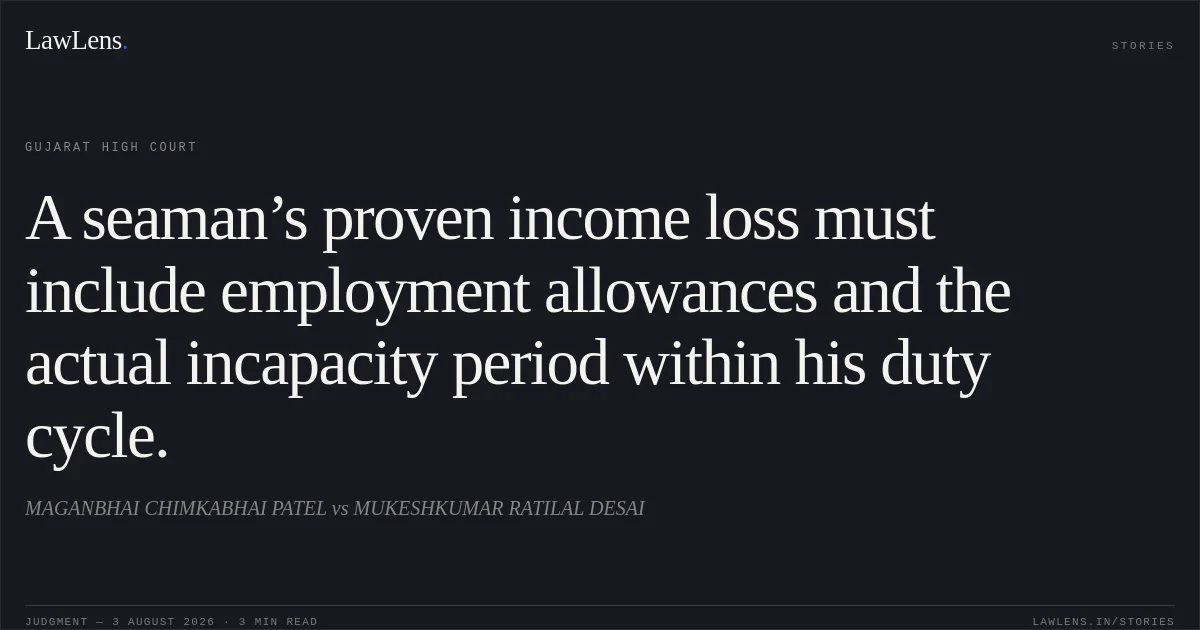
The Tribunal had relied upon the Seaman’s Account of Wages to assess income but considered only ₹2,400 per month and disregarded the allowances and perks recorded in the same document.
Source reference: p.6–7Since the document showed earnings of approximately ₹23,990 for one month and twelve days, and the appellant’s deposition stated a monthly salary of ₹21,000, the High Court accepted ₹21,000 as the appropriate monthly income.
Source reference: p.6–7The appellant’s evidence that he could not attend duty for 36 months was not effectively controverted in cross-examination.
Source reference: p.8–11Given that his seaman’s employment involved physical offshore work and approximately nine months of duty per year, the Court calculated compensable loss for 27 months, amounting to ₹5,67,000.
Source reference: p.8–11However, future loss of income was rejected because the appellant had rejoined service and his salary had increased, demonstrating no established continuing loss of earnings.
Source reference: p.9–10In light of the multiple fractures, prolonged treatment and three-year interruption of work, compensation for pain, shock and suffering was enhanced from ₹20,000 to ₹40,000.
Source reference: p.10–12Holding
The appeal was partly allowed.
The total compensation was enhanced from ₹2,13,750 to ₹6,99,950, comprising ₹5,67,000 for actual loss of income, ₹10,250 for transport, attendance and special diet, ₹40,000 for pain, shock and suffering, and ₹82,700 for medical expenses.
Source reference: p.10–12The enhanced amount of ₹4,86,200 was directed to be deposited by the Insurance Company with interest at 9% per annum from the date of the claim petition until realisation, within four weeks.
Source reference: p.10–12The Tribunal was directed to disburse the awarded amount to the claimant after due verification and deduction of court fees, if payable.
Source reference: p.10–12Original Court PDF
MAGANBHAI CHIMKABHAI PATELvsMUKESHKUMAR RATILAL DESAI
Click to open original judgment
Original judgment, available to read, download and summarize on LawLens.in

![Relief is made contingent on the Supreme Court’s eventual determination in the analogous pending case.. Ashok Tolani vs REVENUE. CAT - ['Jaipur']. LawLens](/stories/thumbnails/relief-is-made-contingent-on-the-supreme-courts-eventual-determination-in-the-analogous-pe-0a05b6600e0644cf9facfda571d15955.webp)